
Can You Overuse Red Light Therapy Mask? A Complete Guide to Safe and Effective Usage
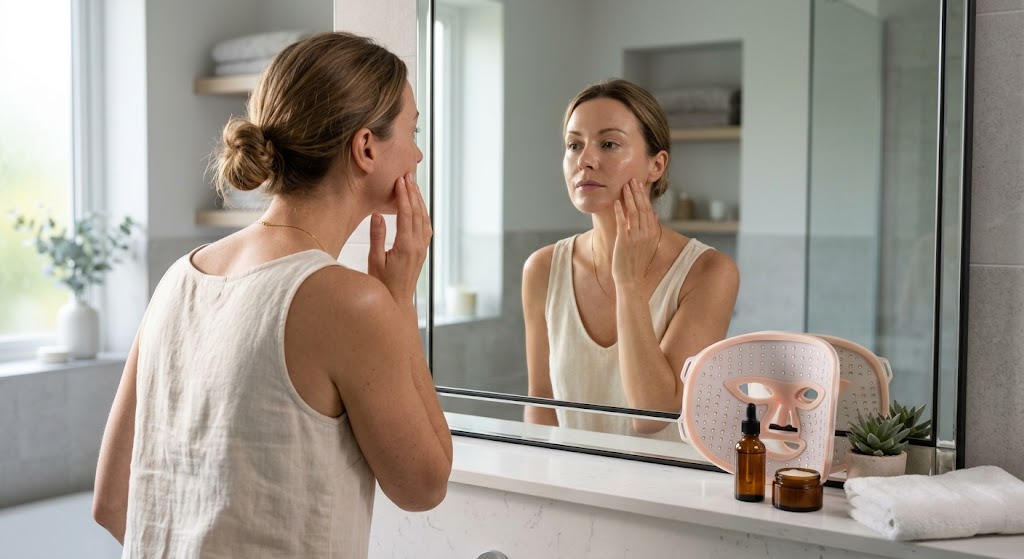
Yes — but overuse is an effectiveness problem, not a UV-style safety problem. Red and NIR light is non-ionizing; the real risk is the biphasic dose response: past the therapeutic window, extra sessions add irritation and can blunt results[1]. Stick to 3–5 sessions/week for 8–12 weeks (build), then 2–3/week (maintenance), sessions of 10–20 minutes[2][3]. Overuse signs: persistent redness, tingling, dryness, or no improvement — cut back and let skin recover.
Table of Contents
- 1. What Is Red Light Therapy and How Does a Mask Work?
- 2. Can You Overuse a Red Light Therapy Mask?
- 3. Why More Isn’t Better: The Biphasic Dose Response
- 4. How Often Should You Use Your Mask?
- 5. How to Use Your Mask Safely
- 6. Signs You May Be Overusing
- 7. How Long Until You See Results?
- 8. Who Should Consult a Doctor First
- 9. FAQ
- 10. Partner With Rainbow Technology for Custom LED Devices
- 11. References & External Links
1. What Is Red Light Therapy and How Does a Mask Work?
Red light therapy (RLT) delivers specific wavelengths — red (630–660 nm) and near-infrared (~830 nm) — into the skin, where they stimulate mitochondrial activity, collagen production, circulation, and anti-inflammatory signaling[1]. A red light therapy mask is a wearable device with LEDs that emit these wavelengths directly onto the face — a hands-free, consistent way to apply the therapy. Mechanism detail: what red light does to your skin.
2. Can You Overuse a Red Light Therapy Mask?
Yes — but the framing matters. Unlike UV, red and NIR light are non-ionizing and do not cause DNA damage at clinical doses[1]. So overuse is not a “sunburn-style” safety issue. It is an effectiveness and skin-comfort issue:
- Skin irritation — redness, swelling, or dryness from sessions stacked without rest.
- Reduced effectiveness — cells can become less responsive when overstimulated (Section 3).
- Heat discomfort — with poorly made devices or abnormally long sessions, warmth can become burning. Quality masks hold a mild, safe temperature at the recommended duration[2].
Bottom line: the danger of overuse is wasting your time and irritating your skin — not damaging your DNA.
3. Why More Isn’t Better: The Biphasic Dose Response
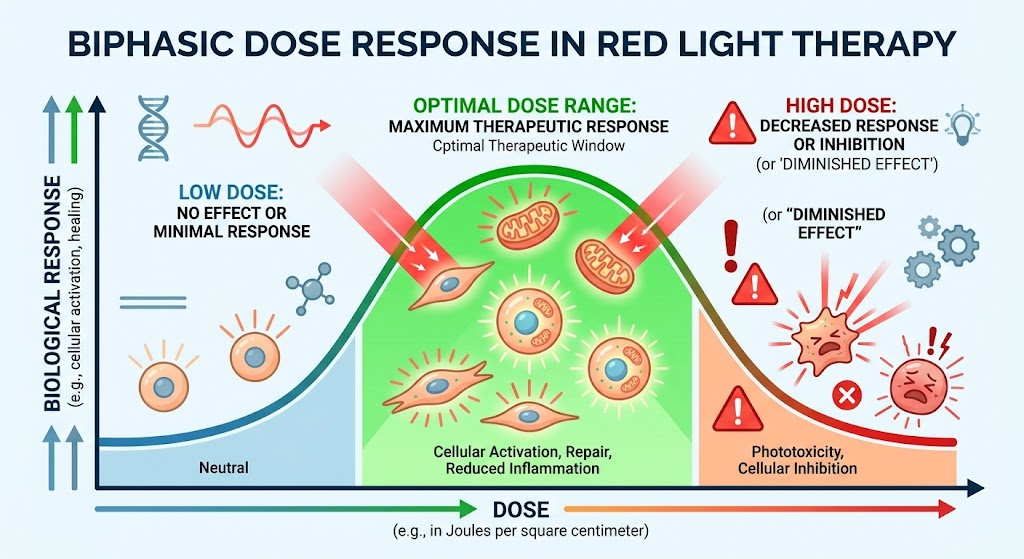
Photobiomodulation follows a biphasic dose response (historically described as the Arndt-Schulz law): biological response rises with dose up to an optimum, then falls as dose increases further[1]. Low doses stimulate the beneficial mitochondrial signaling; excessive light can shift the balance toward excess reactive oxygen species and stress signaling — the opposite of the intended effect.
What this means in practice: doubling your session time or frequency will not double your results. It can slow them. The clinical protocols that show results — 3–5 sessions weekly, 10–20 minutes — are calibrated to sit inside the effective window[2][3].
4. How Often Should You Use Your Mask?
Frequency is a function of goal, phase, and device — but the evidence-backed pattern is stable:
| Goal | Build Phase | Maintenance | Session |
|---|---|---|---|
| Anti-aging | 3–5×/week | 2–3×/week | 10–20 min |
| Acne (red + blue) | Start 3–5×/week, short sessions | 2–3×/week | 5–15 min; respect blue-mode cap[4] |
| Brightening / tone | 3–5×/week | 2–3×/week | 10–20 min |
| Sensitive skin / first-time | 2–3×/week, 3–5 min, build up | 2–3×/week | 5–10 min |
Daily use is generally unnecessary for red-only masks — the clinical literature centers on 3–5 sessions weekly[2]. Devices with automatic timers, like the RAINBOW 3D Laser Light Mask, enforce sensible session lengths so the “daily” impulse can’t push you past the window. Frequency deep-dive: how often to use a red light mask; session math: how long to wear one.
5. How to Use Your Mask Safely
- Start slow and build up. Begin with 2–3 sessions/week at 10 minutes; increase only as your skin adapts.
- Follow the manual. The manufacturer calibrated session length and frequency to the device’s irradiance — trust it over generic advice[2].
- Space sessions. 48–72 hours between sessions is a common, sensible pattern — consistent with 3–5×/week[3].
- Protect your eyes. Closed eyes + device eye protection or goggles — especially in blue modes[5].
- Track your routine. A simple session log prevents accidental stacking and shows you when results actually appear.
- Post-care. Clean skin before, hydrating serum after. Full routine: the 7-step mask routine.
6. Signs You May Be Overusing
Your skin gives clear signals. Watch for:
- Persistent redness or swelling after sessions
- Tingling, burning, or itching during or after use
- Increased sensitivity or dryness
- No visible improvement despite frequent use
- Eye strain or headaches (when eye protection is skipped)[5]
If any appear: reduce frequency or duration, and let your skin recover for a few days before resuming. Eye-related questions: are LED masks safe for eyes?.
7. How Long Until You See Results?
| Timeline | What Changes |
|---|---|
| ~4 weeks | Initial texture, tone, and hydration changes[3] |
| 8–12 weeks | Collagen production and wrinkle reduction — where clinical endpoints are measured[2][6] |
Cramming sessions will not compress this timeline — collagen remodeling is a biological process with its own clock. Consistency is the only accelerator that works[6].
8. Who Should Consult a Doctor First
- Anyone on photosensitizing medications — including isotretinoin and some antibiotics.
- Recent cosmetic surgery or skin procedures (within ~2 months).
- Weakened immune systems or active skin infections.
- Suspicious or changing skin lesions — get them evaluated regardless.
- Pregnancy or children — no established safety data; professional guidance required.
A note on thyroid claims: some articles warn against masks for thyroid conditions. The evidence for clinically relevant effects from a low-dose consumer face mask on the thyroid is thin — the sensible rule is to avoid aiming intense light at the neck/thyroid area and to consult your clinician if you have a thyroid condition. More on who should be careful: eye-safety and precautions.
9. FAQ
Can red light therapy be combined with other skincare treatments?
Yes — but avoid retinoids or photosensitizing agents immediately before sessions to prevent irritation. Post-session serums are ideal[1].
Is there a best time of day?
No strict rule — many prefer evening sessions to align with overnight skin repair.
How close should the mask be?
Face masks sit directly on the skin by design. For panels, follow the manual — typically 6–12 inches. Distance cuts irradiance fast (inverse square), so fit matters[1].
Does red light therapy make skin sensitive to sunlight?
No — it does not increase photosensitivity. Daily SPF is still recommended for overall skin health.
10. Partner With Rainbow Technology for Custom LED Devices
The auto-timer that keeps users inside the therapeutic window — and the documentation that tells them why — is an engineering decision made before the product ships. That is the daily work of Rainbow Technology’s Shenzhen R&D and production teams. As an ISO 13485, CE, and FDA-compliant LED device manufacturer, we support:
- Custom mask, panel, and multi-wavelength device design with verified optical specifications.
- ODM/OEM production — including private label — from prototyping to mass production.
- Full regulatory documentation (ISO 13485, CE, FDA 510(k) support) for your market entry.
Building a light therapy brand? Visit our OEM/ODM Manufacturing Page or request your custom quote today.
