
Red Light Therapy Pads: A Revolutionary Way to Boost Your Pet’s Health at Home
Red light therapy for pets is not a fad — it’s backed by randomized veterinary trials. The strongest evidence is for joint pain and osteoarthritis: in a double-blind sham-controlled trial, 9 of 11 dogs receiving photobiomodulation reduced their NSAID (painkiller) dose, versus 0 of 9 in the sham group[1]. A 2022 trial found photobiomodulation matched or beat the NSAID meloxicam for hip arthritis in dogs[2]. Wound healing also has good support. Coat shine and stress reduction are emerging claims — we say so honestly. The golden rules: consult your veterinarian first, use a device with verified 660 nm / 850 nm wavelengths, and be consistent.
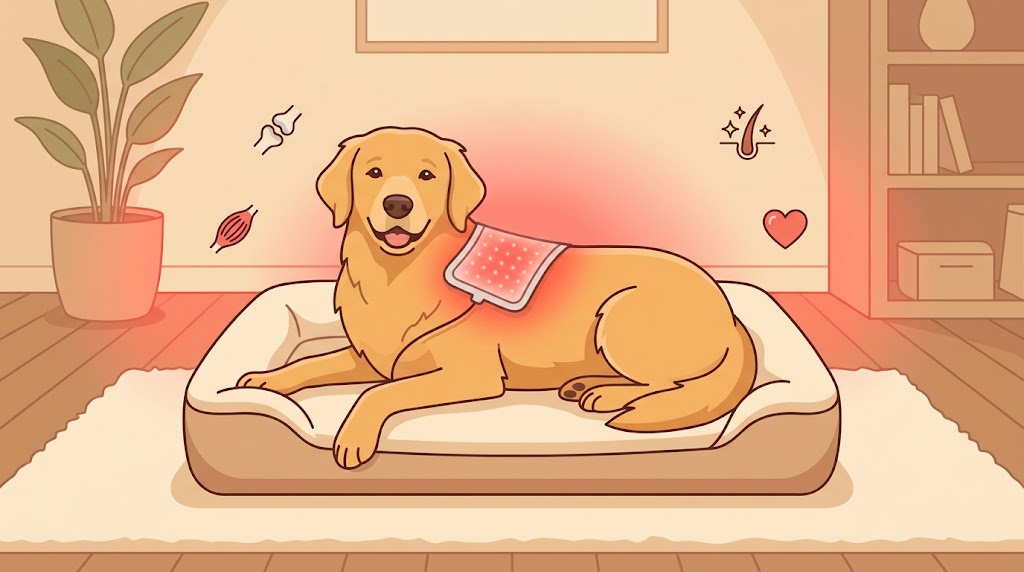
Table of Contents
- 1. What Is Red Light Therapy for Pets?
- 2. Benefits: What the Evidence Really Shows
- 3. How to Use a Pet Pad Safely at Home
- 4. What to Check Before You Buy
- 5. Partner With Rainbow Technology
- 6. References
1. What Is Red Light Therapy for Pets?
Red light therapy for pets works exactly as it does in humans: LED light in specific wavelengths — red around 660 nm and near-infrared around 850 nm — penetrates skin to be absorbed by mitochondrial cytochrome c oxidase. This boosts ATP production, the energy currency cells need for repair and regeneration, which in turn supports blood flow, reduces inflammation, and accelerates healing in muscles, joints, and skin[4]. The same physics applies to canine and feline tissue — which is why devices developed for human wellness translate directly to veterinary use.
2. Benefits: What the Evidence Really Shows
| Claim | Evidence Level | What We Know |
|---|---|---|
| Joint pain & osteoarthritis | ✅ Strong | Double-blind sham RCT (20 dogs, elbow OA): 9/11 dogs reduced NSAID dose vs 0/9 sham (P=0.0003); lameness and pain improved[1]. 2022 RCT: PBMT matched/surpassed meloxicam for hip OA, with faster return to normal gait[2]. |
| Wound healing & post-surgical | ✅ Good | Collagen synthesis and tissue-repair mechanisms are well documented; veterinary reviews rank wound healing among the best-supported applications[3][5]. |
| Healthier skin & coat | ⚠️ Emerging | Improved microcirculation supports skin health, but direct veterinary studies on coat shine and dermatitis are limited. Treat as a bonus, not the headline. |
| Stress & anxiety reduction | ⚠️ Mechanism only | A calm, warm session may soothe anxious pets, but stress reduction is not an established, study-backed effect. We don’t overclaim it. |
The takeaway: for aging pets with arthritis, stiffness, or recovery needs, red light therapy has genuine, published support. For coat cosmetics or anxiety, keep expectations realistic — the primary value is tissue repair and pain management.
3. How to Use a Pet Pad Safely at Home
- Consult your veterinarian first. Especially important if your pet has underlying conditions, takes medication, or has a history of cancer — light therapy should be an adjunct, not a replacement for prescribed care.
- Follow manufacturer instructions. A reasonable starting protocol: 10–20 minutes per area, once or twice daily in the initial phase, adjusted by your vet’s guidance. The 15–30 minute figure in some guides is on the high side for home LED pads — check your device’s irradiance spec.
- Target specific areas. Focus on joints, muscles, or skin areas showing soreness or inflammation — elbows, hips, knees, and the lower back for arthritic pets.
- Be consistent. Regular treatments yield cumulative results, much like routine exercise or medication. Most trials run 4–6 weeks[1][2].
- Never shine light into eyes. Pets can’t tell you when it’s uncomfortable — position the pad away from the head. See our safety primer for the human-side equivalent.
Many pet pads are portable, rechargeable, and easy to clean — designed so you can pamper your pet on a bed, in a crate, or anywhere at home.
4. What to Check Before You Buy
- Verified wavelengths — 660 nm red and 850 nm NIR. These are the clinically studied peaks. A pad that won’t publish its exact wavelength and irradiance (mW/cm²) is a red flag.
- Same build standard as human devices. There’s no separate “pet physics” — a good pet pad is a human-grade device in an animal-friendly format (flexible, cleanable, chew-resistant cabling).
- Compliance documentation. Look for ISO 13485, CE, and FDA registration — the same standards we hold on the human side. See our buyer’s checklist for the detailed version.
5. Partner With Rainbow Technology
Red light therapy pads represent a safe, non-invasive way to support your pet’s health at home — and they’re also one of the fastest-growing categories for private-label brands. Rainbow Technology builds pet pads to the same clinical standards as our human devices:
- Flexible, chew-resistant pet pad formats with 660 nm red + 850 nm NIR arrays, verified by spectrometer batch testing.
- Full ISO 13485, CE, and FDA registration compliance documentation.
- OEM/ODM from concept to certification — low MOQs for brand launches. Consult our engineering team.
- Reference designs on our product lineup page.
Contact our team to discuss your pet wellness line.
6. References
[1] Looney AL, Huntingford JL, Blaeser LL, Mann S.
A randomized blind placebo-controlled trial investigating the effects of photobiomodulation therapy (PBMT) on canine elbow osteoarthritis. The Canadian Veterinary Journal. 2018;59(9):959-966.
[2] Alves JC, Santos A, Jorge P, Carreira LM.
A randomized double-blinded controlled trial on the effects of photobiomodulation therapy in dogs with osteoarthritis. American Journal of Veterinary Research. 2022;83(8).
[3] Pryor B, Millis DL.
Therapeutic laser in veterinary medicine. Veterinary Clinics of North America: Small Animal Practice. 2019;49(1):xi-xii. (Review of evidence base)
[4] Hamblin MR.
Mechanisms and applications of the anti-inflammatory effects of photobiomodulation. AIMS Biophysics. 2017;4(3):337-361.
[5] Wunsch A, Matuschka K.
A controlled trial to determine the efficacy of red and near-infrared light treatment… Photomedicine and Laser Surgery. 2014;32(2):93-100.
