
Decoding Irradiance (mW/cm²): A B2B Procurement Guide for Red Light Therapy Devices
What Is Irradiance (mW/cm²) and Why Does It Matter for B2B Sourcing?
30-Second Summary:
Irradiance, measured in milliwatts per square centimeter ($mW/cm^2$), defines the exact power density of light energy delivered to targeted tissue. For B2B procurement managers and brand founders sourcing red light therapy caps, masks, or panels, understanding irradiance is vital for preventing under-dosing or thermal overexposure, verifying supplier technical claims, and ensuring strict compliance with international manufacturing standards like ISO13485.
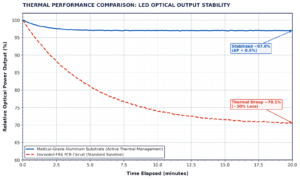
Table of Contents
- 1. Defining Irradiance: The Core Physics of Power Density
- 2. Why Irradiance Directs B2B Sourcing Decisions
- 3. Spotting Inflated Claims: Testing Distance & Spectroradiometry
- 4. Partner With Rainbow Technology for Verified Optical Specs
- 5. Medical Disclaimer
- 6. References & External Links
1. Defining Irradiance: The Core Physics of Power Density
In photobiomodulation engineering, irradiance represents the intensity of light energy that lands on a specific surface area, quantified as milliwatts per square centimeter ($mW/cm^2$). It dictates how rapidly photon energy is absorbed by target cells (such as cytochrome c oxidase in mitochondria).
Total delivered energy—known as fluence or energy density ($J/cm^2$)—is calculated by multiplying irradiance by treatment time:
Dose ($J/cm^2$) = Irradiance ($mW/cm^2$) × Time (seconds) ÷ 1,000
| Application Target | Ideal Irradiance Range | Recommended Session Duration | Clinical Objective |
|---|---|---|---|
| Facial Skincare & Anti-Aging Masks | 20 to 50 $mW/cm^2$ | 10–15 minutes | Superficial dermal collagen synthesis without thermal stress. |
| Hair Follicle Stimulation Caps | 30 to 70 $mW/cm^2$ | 15–20 minutes | Direct scalp penetration for micro-circulation and cellular activation. |
| Deep Muscle & Joint Panels | 75 to 150 $mW/cm^2$ | 10–20 minutes | Subcutaneous tissue penetration for recovery and pain mitigation. |
2. Why Irradiance Directs B2B Sourcing Decisions
For brand founders and procurement directors, evaluating a manufacturing partner’s optical specifications is non-negotiable. Sub-par consumer gadgets often feature low-cost LEDs with inadequate power output (<15 $mW/cm^2$), resulting in zero biological response and high product return rates from end-consumers.
Conversely, unverified high irradiance without proper thermal management can cause localized overheating, risking skin discomfort and regulatory non-compliance. Sourcing from an OEM/ODM partner that guarantees stable, certified irradiance safeguards your brand reputation and ensures repeatable therapeutic outcomes.
3. Spotting Inflated Claims: Testing Distance & Spectroradiometry
A common pitfall in global B2B procurement is encountering suppliers who advertise inflated irradiance numbers without disclosing testing parameters. Light intensity drops sharply over distance according to the inverse-square law.
Ethical manufacturers utilize calibrated spectroradiometers to measure optical output at standardized operational distances (e.g., 0cm for skin-contact devices like silicone masks and hair growth caps, or 15cm–30cm for commercial panels). Always request independent lab reports rather than taking manufacturer spec sheets at face value.
4. Partner With Rainbow Technology for Verified Optical Specs
At Shenzhen Rainbow Technology, we eliminate uncertainty through rigorous engineering and transparent manufacturing standards. Operating under strict ISO13485 quality management systems, our red light therapy caps, hair growth helmets, and facial masks undergo 100% batch testing for wavelength precision and irradiance stability.
- Customizable optical power densities tailored to your target market’s regulatory requirements.
- Advanced thermal management to prevent optical power decay during standard 20-minute sessions.
- Comprehensive documentation support including 510(k) pathways, CE, and RoHS declarations.
Ready to elevate your product catalog with medical-grade photonic devices?
Contact our R&D engineering team today to request sample units and technical datasheets.
5. Medical Disclaimer
6. References & External Links
[1] National Center for Biotechnology Information.
Biphasic Dose Response and Power Density Thresholds in Photobiomodulation (2014).
[2] International Organization for Standardization.
ISO 13485:2016 Medical Devices — Quality Management Systems for Regulatory Requirements (2016).
[3] PubMed Health & Clinical Optics.
Measurement Standardizations of Irradiance and Fluence in Therapeutic Light Devices (2010).
