
Red Light Therapy and Retinol: The Ultimate Duo for Radiant, Youthful Skin
Yes — red light therapy and retinol can be used together, and the pairing is genuinely complementary. Retinol drives surface cell turnover and collagen gene expression[1]; red light therapy powers the mitochondria in the cells that build collagen and calms inflammation[3][5]. The one rule that matters: always do red light therapy on clean, bare skin, then apply retinol after — never the reverse, because products sitting on the skin physically block the light. Start slow (retinol 2–3×/week, RLT 3–5×/week), moisturize, and never skip SPF 30+ during the day.
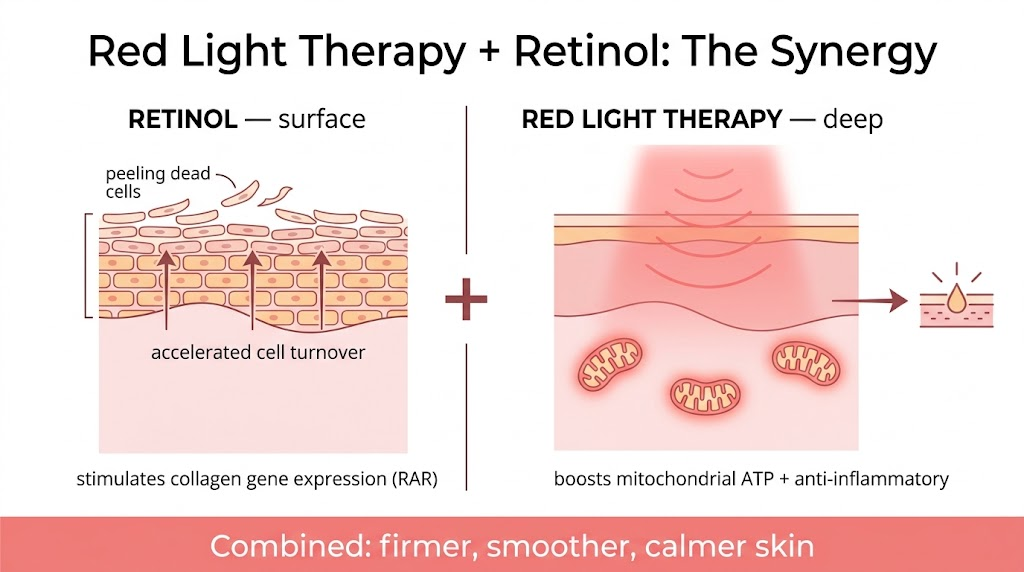
Table of Contents
- 1. How Red Light Therapy and Retinol Work Together
- 2. Benefits of Combining Them
- 3. What the Evidence Actually Says
- 4. How to Use Them Safely: Sequencing & Dosing
- 5. Who Should Skip This Combination
- 6. Partner With Rainbow Technology for Custom LED Devices
- 7. References & External Links
1. How Red Light Therapy and Retinol Work Together
The pairing works because the two treatments operate at different layers of the skin, through different mechanisms — which is exactly why they don’t compete, they stack.
- Retinol (vitamin A derivative) — the surface architect.
Retinol converts to retinoic acid in the skin, binds retinoic acid receptors (RAR), and changes gene expression: it accelerates keratinocyte turnover (shedding dead cells), normalizes keratinization, and stimulates dermal fibroblasts to produce new collagen[1]. A landmark randomized, double-blind, vehicle-controlled trial of 0.4% retinol lotion (24 weeks, elderly skin) showed significantly increased glycosaminoglycan expression and procollagen I — the building block of new collagen — versus placebo[2]. - Red light therapy (photobiomodulation) — the deep-energy engine.
Red and near-infrared photons are absorbed by cytochrome c oxidase in mitochondria, boosting ATP production, supporting fibroblast activity and collagen synthesis, and reducing inflammation[3][5]. A controlled trial of red + NIR treatment showed increased intradermal collagen density and reduced fine lines and roughness[4].
Together, they create a dynamic duo: retinol refines the surface; red light therapy reinforces the structure underneath and calms the irritation retinol can trigger.
2. Benefits of Combining Them
| Benefit | How It Happens |
|---|---|
| Enhanced collagen production | Retinol stimulates collagen gene expression in fibroblasts[1][2]; red light energizes the same cells to build it[4]. Two directions, one outcome: firmer skin, fewer wrinkles. |
| Improved texture and tone | Retinol speeds cell renewal (smoother, more even surface); red light supports healing and reduces roughness[4]. |
| Reduced retinol irritation | PBM’s anti-inflammatory signaling[5] can help calm the redness, dryness, and peeling retinol can cause — mechanistically supported, though direct combo RCTs are still limited. |
| Acne & hyperpigmentation control | Retinol unclogs pores and fades dark spots; red light calms the inflammatory component of acne[5]. |
3. What the Evidence Actually Says
The honest position: both treatments have strong individual evidence; the combination is supported by mechanism and emerging data, but direct large-scale combination RCTs are still scarce. Here’s the graded picture:
| Claim | Evidence Level | What We Know |
|---|---|---|
| Retinol improves photoaged skin (collagen, fine lines, texture) | Strong — RCT + systematic review | 0.4% retinol RCT showed ↑ procollagen I, ↑ GAGs, ↓ fine wrinkling[2]; comprehensive reviews confirm mechanism[1] |
| Red/NIR light increases collagen density and reduces wrinkles | Good — controlled trial | Red + NIR treatment ↑ intradermal collagen density, ↓ fine lines & roughness[4] |
| Red light reduces inflammation | Good — mechanism + clinical | PBM’s anti-inflammatory signaling is well documented[5] |
| Combining retinol + RLT gives greater results than either alone | Emerging — limited direct RCTs | Mechanistically complementary; early pilot data suggest benefit, but large-scale combination RCTs are needed[3][5] |
4. How to Use Them Safely: Sequencing & Dosing
The single most important rule — and the one most articles get right: never apply retinol (or any product) before a red light session. Creams, serums, and oils physically block or reflect light, wasting the session. Always run red light on clean, bare skin.
| Approach | Routine | Best For |
|---|---|---|
| Same evening, RLT first | Cleanse → red light (bare skin) → wait 10–15 min → retinol → moisturizer | Most users, most nights |
| Time-of-day split | Morning: red light + SPF; Evening: retinol | Maximum separation; busy schedules |
| Alternating nights | RLT on Mon/Wed/Fri; retinol on Tue/Thu/Sat | Sensitive skin, retinol beginners |
- Start slow. Begin with retinol 2–3 times per week and red light 3–5 times per week, adjusting based on your skin’s response. Introduce one treatment at a time (2–4 weeks apart) so you can tell which one your skin is reacting to.
- Wait 10–15 minutes after red light before applying retinol. This lets the skin cool and return to baseline — especially relevant if your device runs warm[3].
- Hydrate and protect. Follow with a moisturizer rich in hyaluronic acid or ceramides, and apply broad-spectrum SPF 30+ every morning. Retinol increases UV sensitivity — but note this is UV-specific; red/NIR light contains no UV, so the photosensitivity concern does not apply to the red light session itself[3].
- Listen to your skin. If you experience redness, dryness, or peeling, reduce frequency or alternate nights. If irritation persists, pause the retinol, not the red light — PBM’s anti-inflammatory effect may actually help you through the retinization phase[5].
For more on session timing and frequency, see our optimal session duration guide and LED mask frequency guide. And before layering anything, read our safety primer and pre-session skin prep guide.
5. Who Should Skip This Combination
- Compromised skin barrier: If your skin is actively peeling, stinging, or shows signs of barrier damage, pause both actives and rebuild the barrier first.
- Retinol beginners: Don’t stack both from day one. Give retinol 2–4 weeks alone to establish tolerance, then add red light.
- Pregnancy & breastfeeding: Retinol is not recommended during pregnancy (teratogenic risk at high doses) — consult your OB-GYN. Red light therapy alone has a different safety profile; see our pregnancy safety guide.
- Photosensitizing medications: If you take photosensitizing drugs, check with your doctor before combining either treatment.
6. Partner With Rainbow Technology for Custom LED Devices
Building an anti-aging LED mask brand or skincare-tech lineup? Your customers are asking exactly the questions this guide answers — wavelength (630–670nm), session timing, and safety certification. That’s what Rainbow Technology engineers into every unit from our Shenzhen facility:
- Full ISO 13485, CE, and FDA registration compliance documentation for your market entry.
- Verified wavelength and irradiance curves per device — so your “10-minute session” claims are backed by lab-measured output, not marketing numbers.
- Flexible sample testing & small-batch production (500–1,000 units) for new brand launches.
- Custom face-mask ergonomics (soft silicone, eye-safe designs) optimized for nightly skincare routines.
Explore our manufacturing-grade product lineup for reference architectures, or contact our R&D engineering team to discuss your project.
7. References & External Links
[1] Mukherjee S, Date A, Patravale V, Korting HC, Roeder A, Weindl G.
Retinoids in the treatment of skin aging: an overview of clinical efficacy and safety. Clinical Interventions in Aging. 2006;1(4):327-348.
[2] Kafi R, Kwak HS, Schumacher WE, et al.
Improvement of naturally aged skin with vitamin A (retinol). Archives of Dermatology. 2007;143(5):606-612.
[3] Avci P, Gupta A, Sadasivam M, Vecchio D, Pam Z, Pam N, Hamblin MR.
Low-level laser (light) therapy (LLLT) in skin: stimulating, healing, restoring. Seminars in Cutaneous Medicine and Surgery. 2013;32(1):41-52.
[4] Wunsch A, Matuschka K.
A controlled trial to determine the efficacy of red and near-infrared light treatment in patient satisfaction, reduction of fine lines, wrinkles, skin roughness, and intradermal collagen density increase. Photomedicine and Laser Surgery. 2014;32(2):93-100.
[5] Hamblin MR.
Mechanisms and applications of the anti-inflammatory effects of photobiomodulation. AIMS Biophysics. 2017;4(3):337-361.

