
Are Red Light Therapy Masks Safe for Eyes? A Comprehensive Safety Guide
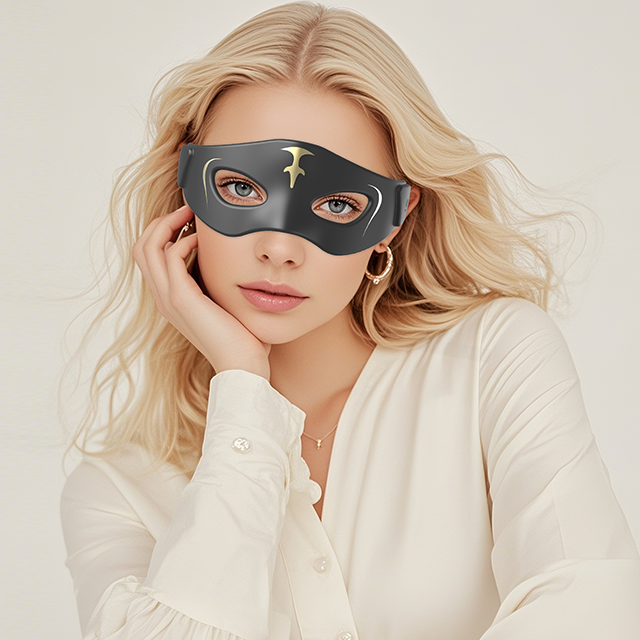
Yes, red light therapy masks are safe for eyes when used as directed. Red (630–660 nm) and NIR (~830 nm) are non-ionizing — unlike UV, they lack the energy to damage DNA or the retina at clinical doses[1][2]. Best practices: keep eyes closed during sessions, use masks with built-in eye protection or wear goggles, remove contact lenses, and skip treatment if you are on photosensitizing medications. Blue-light modes deserve extra caution. People with retinal disease, recent eye surgery, or light-triggered migraines should consult a doctor first[3].
Table of Contents
- 1. What Is Red Light Therapy?
- 2. Can Red Light Therapy Masks Damage Eyes?
- 3. Eyes Open or Closed During Treatment?
- 4. Do You Need Eye Protection?
- 5. Possible Side Effects
- 6. Who Should Consult a Doctor First
- 7. Emerging Eye-Health Research (Clinical Only)
- 8. Safe-Use Checklist
- 9. Partner With Rainbow Technology for Custom LED Devices
- 10. References & External Links
1. What Is Red Light Therapy?
Red light therapy (RLT) delivers red (630–660 nm) and near-infrared (~830 nm) light to the skin, where it stimulates mitochondrial activity, collagen production, and anti-inflammatory signaling[1]. The key safety distinction: these are non-ionizing wavelengths. Unlike UV, they do not carry enough photon energy to break DNA bonds — the mechanism behind sun-related eye and skin damage. Mechanism detail: what red light does to your skin.
2. Can Red Light Therapy Masks Damage Eyes?
The honest, evidence-based answer has four parts:
2.1 Red and NIR light are not retina-damaging at clinical doses
Retinal damage requires either ionizing radiation or sufficient thermal/optical energy to denature tissue. At the irradiance levels used in FDA-cleared masks (typically 20–60 mW/cm²), red and NIR light lack the energy for either mechanism. Reviews of photobiomodulation consistently describe ocular exposure at therapeutic doses as safe, with no evidence of long-term retinal harm in standard use[1][2].
2.2 Brightness discomfort is real, even if harm is not
Staring at a bright LED array for 10–20 minutes can cause temporary glare, dryness, eye strain, or mild headache — especially at close range. This is a comfort issue, not tissue damage, but it is the main reason eye protection is recommended[2].
2.3 Photosensitivity changes the calculus
Certain medications (some antibiotics, acne treatments, beta-blockers, St. John’s wort) and conditions (light-triggered migraines, lupus photosensitivity) increase sensitivity to light. If this applies to you, the safe answer is: consult a professional before starting — and use full eye protection if cleared to proceed.
2.4 The NIR and cataract question — stated precisely
The claim that near-infrared causes cataracts deserves precision. Cataract risk in the literature is associated with high-intensity thermal exposure — industrial infrared heating sources and chronic high-heat environments — not with the low-irradiance NIR in consumer LED devices[4]. A mask emitting ~830 nm at tens of mW/cm² is orders of magnitude below that thermal threshold. The distinction matters: NIR phototherapy vs. FIR heat therapy.
3. Eyes Open or Closed During Treatment?
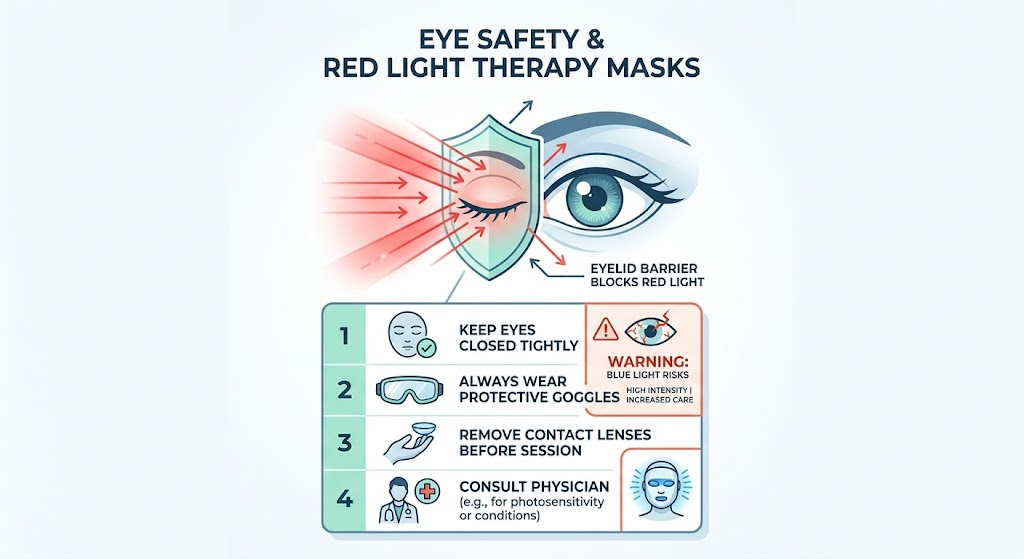
Keep them closed. Eyelids provide a natural, physical barrier that blocks most visible light while transmitting only a small fraction of the already-low optical power[1]. Closed eyes eliminate glare and strain entirely. If your device’s design keeps LEDs away from the eye area (cutout designs), closed eyes are still the simplest habit to keep. If you prefer eyes open — not recommended — never look directly at the LEDs and wear protective goggles.
Extra note for blue modes: 415 nm blue light sits at higher photon energy than red. Blue-light acne modes warrant the most careful eye habits — closed eyes or goggles, always[5].
4. Do You Need Eye Protection?
Depends on the device — and the user:
| Scenario | Recommendation |
|---|---|
| Mask with built-in eye cutouts/diffusers | Closed eyes are usually sufficient; goggles optional |
| Mask with LEDs close to eyes, no shielding | Wear the included goggles/eye shields every session |
| Sensitive eyes, contact lens wearer | Goggles + remove contacts before the session |
| Blue-light mode | Goggles strongly recommended[5] |
When in doubt, goggles cost nothing and remove all doubt. What to check when buying: eye-safety features in the buying guide.
5. Possible Side Effects
Side effects are rare and typically mild. The ones reported:
- Dry or irritated eyes — usually from prolonged exposure without protection; blink-friendly habits and goggles prevent it.
- Brightness discomfort / eye strain — temporary; resolves after the session.
- Photosensitivity reactions — relevant only if you are on photosensitizing medication or have a light-sensitive condition.
Rule: stop if it hurts. Any persistent discomfort deserves an eye-care professional, not a second session.
6. Who Should Consult a Doctor First
| Condition / Situation | Why |
|---|---|
| Retinal or macular disease (macular degeneration, diabetic retinopathy) | Damaged retinas may respond differently to light; professional guidance required[3] |
| Recent eye surgery or trauma | Healing tissues need a clinician’s timeline, not a guess |
| Light-triggered migraines or epilepsy | Flicker and brightness can trigger episodes |
| Photosensitizing medications | Some antibiotics, acne drugs, and beta-blockers raise light sensitivity |
| Pregnancy or children’s use | No established safety data; consult a healthcare provider |
7. Emerging Eye-Health Research (Clinical Only)
There is genuine early research on light for eye conditions — but it is clinical, device-specific, and not a reason to point a face mask at your eyes:
- Dry eye disease: some clinical protocols report reduced inflammation and improved tear-film stability with targeted red/NIR exposure.
- Age-related visual decline: specific red wavelengths have shown promise in improving color contrast sensitivity in older adults in early trials[3].
- Ocular inflammation: preclinical work suggests PBM may modulate retinal inflammation — far from clinical application.
Do not attempt these with an at-home face mask. Eye-directed light therapy uses tightly controlled doses, specific wavelengths, and medical supervision. Your mask is a skincare device; keep it on your skin.
8. Safe-Use Checklist
- Choose an FDA-cleared/registered, CE-marked device from a manufacturer with documented quality systems (ISO 13485)[6].
- Use built-in eye protection or wear goggles every session — especially with blue modes.
- Keep eyes closed during treatment.
- Remove contact lenses before sessions.
- Respect session length (10–20 minutes) and frequency (3–5×/week)[2].
- Start with shorter sessions to gauge tolerance.
- Check your medications for photosensitivity before starting.
- Stop if discomfort persists and consult an eye-care professional.
Full daily routine: the 7-step red light mask routine.
9. Partner With Rainbow Technology for Custom LED Devices
Eye safety is engineered, not assumed: LED spacing relative to the orbital area, diffuser design, intensity limits, and safety documentation are manufacturing decisions. That is the daily work of Rainbow Technology’s Shenzhen R&D and production teams. As an ISO 13485, CE, and FDA-compliant LED device manufacturer, we support:
- Custom mask, panel, and multi-wavelength device design with verified optical specifications.
- ODM/OEM production — including private label — from prototyping to mass production.
- Full regulatory documentation (ISO 13485, CE, FDA 510(k) support) for your market entry.
Building a light therapy brand? Visit our OEM/ODM Manufacturing Page or request your custom quote today.

