
Benefits of Red Light Therapy for Acne: A Natural Solution for Clearer Skin
Red light therapy is a genuinely promising, non-invasive option for acne — but the evidence is strongest for blue + red light used together, not red light alone. In randomized trials, combined blue-red light cut inflammatory lesions by up to 76–77%[1][2], while red light alone shows mixed results in meta-analyses[4]. It’s generally very well tolerated, works best as part of a consistent routine (3–5×/week, 4–6 weeks to see change), and is not a replacement for prescription acne treatment in moderate-to-severe cases — see a dermatologist first.
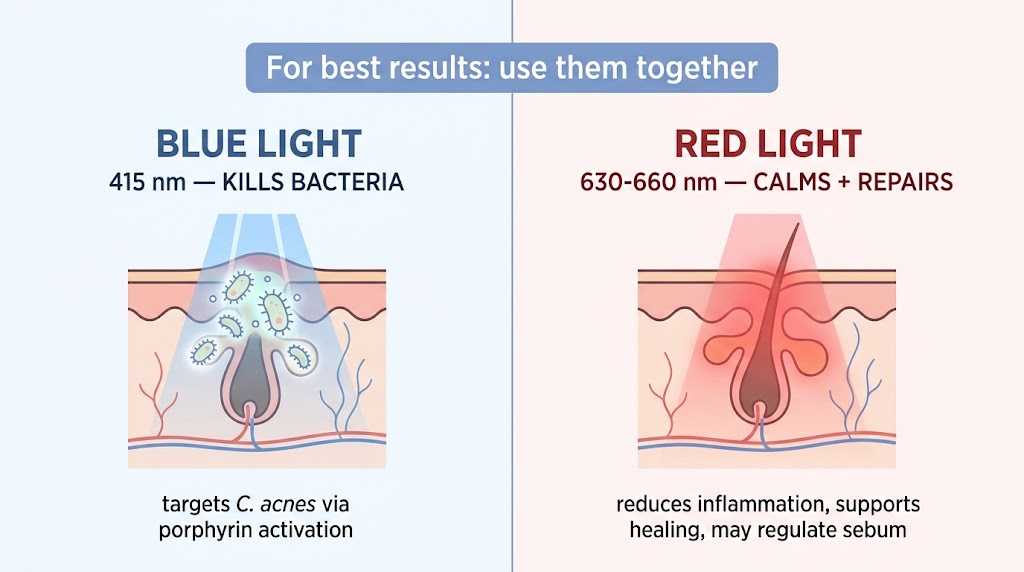
Table of Contents
- 1. What Is Red Light Therapy for Acne?
- 2. The Evidence, Graded Honestly
- 3. Benefits and What the Research Supports
- 4. How to Use LED Light Therapy at Home
- 5. Important Caveats
- 6. Partner With Rainbow Technology for Custom LED Devices
- 7. References
1. What Is Red Light Therapy for Acne?
Red light therapy (RLT), also called photobiomodulation, exposes the skin to low-level red light — typically 630–660 nm — that penetrates into the dermis, energizes mitochondria, and shifts cellular behavior: less inflammation, more repair, and support for collagen-producing fibroblasts[3][6].
The key distinction: blue light (around 415 nm) kills acne-causing bacteria (C. acnes) by activating their porphyrins; red light doesn’t kill bacteria — it calms the inflammation and supports healing that the bacteria and the immune response trigger[1]. That’s why the most successful clinical protocols pair both wavelengths.
2. The Evidence, Graded Honestly
If you read one thing, read this table. A lot of acne marketing overstates what light therapy can do. Here’s the graded reality:
| Claim | Evidence Level | What We Know |
|---|---|---|
| Blue + red light combination reduces inflammatory acne lesions | Best — randomized trials | Papageorgiou 2000: 76% inflammatory lesion reduction, outperforming benzoyl peroxide (58%)[1]. Kwon 2013 double-blind: −77% inflammatory, −54% non-inflammatory[2] |
| Red light therapy alone reduces inflammation & speeds healing | Mixed — positive small RCTs; meta-analysis inconclusive | Split-face RCT showed significant improvement with red light alone (15 min ×2/day)[3], but a 13-RCT meta-analysis found no statistically significant superiority over conventional treatments[4] |
| Red light regulates sebum (oil) production | Emerging — histology in one combination-device RCT | Kwon 2013 showed reduced sebum output and smaller sebaceous glands — but in a blue-red combination device, not red alone[2] |
| Red light fades acne scars | Limited — indirect evidence | Collagen support is well documented for aging skin[6], but direct acne-scar trials are scarce. Treat this as plausible, not proven |
| Light therapy for acne is safe and well tolerated | Good — multiple trials | Mild, transient redness reported in some studies; no serious adverse events in the included trials[5] |
3. Benefits and What the Research Supports
- Reduces inflammation. Red light lowers inflammatory signaling — calming the redness and swelling of active breakouts[6]. This is red light’s best-supported role in acne.
- Promotes faster healing. By energizing skin cell mitochondria, RLT supports tissue repair, helping blemishes settle more quickly[3].
- Supports sebum balance (with blue light). Combination blue-red treatment showed reduced sebum output and smaller sebaceous glands in a double-blind RCT[2].
- May help with post-acne marks over time. Increased collagen support can improve texture — evidence is indirect, so keep expectations realistic[6].
- Safe, non-invasive, no downtime. No needles, no harsh chemicals — generally well tolerated across skin types, with mild transient redness as the most commonly reported effect[5].
4. How to Use LED Light Therapy at Home
- Choose the right device. For acne, look for devices with red light (630–660 nm) and ideally blue light (415 nm) — the combination has the strongest evidence[1][2]. Verify the device’s wavelength and irradiance specs are published, and check for FDA registration / CE / ISO 13485 compliance documentation.
- Be consistent. 3–5 sessions per week, 3–20 minutes per session depending on device output. Consistency matters more than session length.
- Cleanse first. Light can’t work through makeup, sunscreen, or heavy products — wash and dry your skin before each session. See our pre-session prep guide.
- Moisturize after. Follow with a gentle, non-comedogenic moisturizer.
- Give it time. Visible improvements typically appear within 4–6 weeks of consistent use. For session timing details, see our duration guide and frequency guide.
5. Important Caveats
- See a dermatologist for moderate-to-severe acne. Light therapy is a helpful adjunct — not a replacement for prescription treatment. Never stop prescribed medication to start light therapy without medical advice.
- Red light alone is not a miracle cure. The evidence is mixed; the strongest results come from blue-red combination protocols[4].
- Check for photosensitizing medications. If you take photosensitizing drugs or have a known light sensitivity, consult your doctor before starting. See our safety primer.
- Don’t expect overnight results. Acne responds to cumulative, consistent exposure — 4–6 weeks minimum before judging whether it works for you.
6. Partner With Rainbow Technology for Custom LED Devices
Building an LED acne device brand? The science above has one practical lesson: wavelength matters, and the blue-red combination carries the strongest evidence. That’s exactly what Rainbow Technology engineers into every unit from our Shenzhen facility — verified dual-wavelength output, published irradiance curves, and full compliance documentation:
- Custom red (630–660 nm) + blue (415 nm) LED arrays engineered for acne protocols.
- Full ISO 13485, CE, and FDA registration compliance documentation for your market entry.
- Verified wavelength and irradiance curves per device — lab-measured, not marketing numbers.
- Flexible sample testing & small-batch production (500–1,000 units) for new brand launches.
Explore our manufacturing-grade product lineup for reference architectures, or contact our R&D engineering team to discuss your project.
7. References
[1] Papageorgiou P, Katsambas A, Chu A.
Phototherapy with blue (415 nm) and red (660 nm) light in the treatment of acne vulgaris. British Journal of Dermatology. 2000;142(5):973-978.
[2] Kwon HH, Lee JB, Yoon JY, et al.
The clinical and histological effect of home-use, combination blue-red LED phototherapy for mild-to-moderate acne vulgaris in Korean patients: a double-blind, randomized controlled trial. British Journal of Dermatology. 2013;168(5):1088-1094.
[3] Na JI, Kim SY, Kim WS, et al.
Red light phototherapy alone is effective for acne vulgaris: randomized, single-blinded clinical trial. Dermatologic Surgery. 2007;33(10):1228-1233.
[4] Wu Y, et al.
Application of red light therapy for moderate-to-severe acne vulgaris: A systematic review and meta-analysis. Journal of Cosmetic Dermatology. 2021;20(11):3471-3477.
[5] Barbaric J, Abbott R, Posadzki P, et al.
Light therapies for acne. Cochrane Database of Systematic Reviews. 2016;(9):CD007917.
[6] Hamblin MR.
Mechanisms and applications of the anti-inflammatory effects of photobiomodulation. AIMS Biophysics. 2017;4(3):337-361.

