
Red Light and Retinol: The Ultimate Duo for Radiant, Youthful Skin
Yes — red light therapy and retinol can be used together, and they complement each other beautifully. Retinol works on the skin’s surface (faster cell turnover, smoother texture)[1], while red light therapy works deeper (cellular energy, collagen, anti-inflammation)[3]. The golden rule: red light first on clean, bare skin — then retinol after. Start slow, moisturize, and never skip SPF. Full routine below.
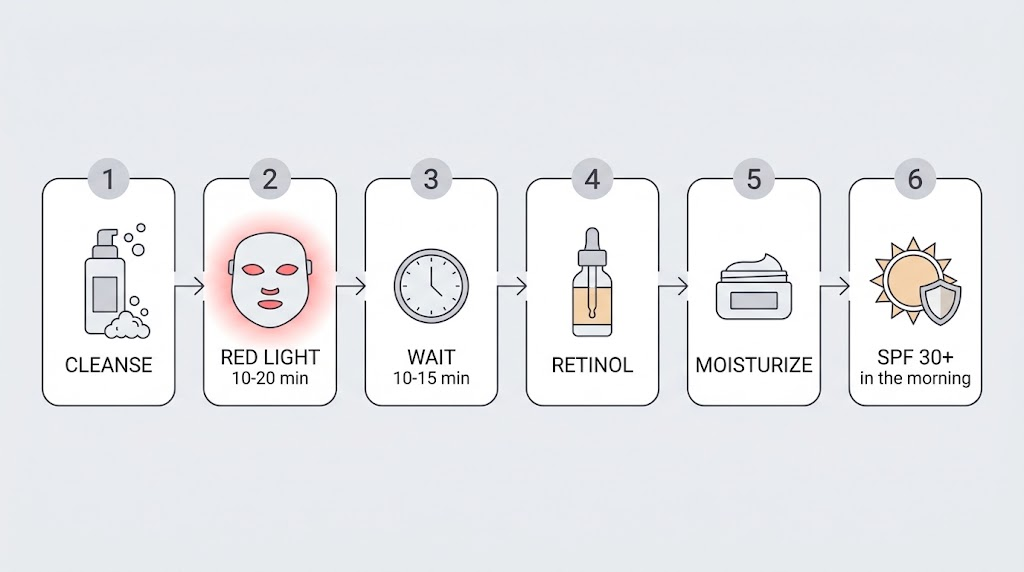
Table of Contents
- 1. The Short Answer
- 2. How They Complement Each Other
- 3. The 6-Step Safe Routine
- 4. 3 Ways to Pair Them (Choose Yours)
- 5. Common Mistakes to Avoid
- 6. Partner With Rainbow Technology for Custom LED Devices
- 7. References
1. The Short Answer
Yes, you can use red light therapy and retinol together — and with the right sequencing, they’re one of the most effective anti-aging combinations available. The two treatments work through different mechanisms at different skin depths, so they don’t compete — they stack. The only non-negotiable rule is order: red light on clean, bare skin first, retinol afterward.
Want the deeper science? Our sister guide Red Light Therapy and Retinol: The Complete Guide covers the evidence in detail. This article is the practical, beginner-friendly version.
2. How They Complement Each Other
- Red light therapy (deep): Red and near-infrared light penetrate into the skin, energizing mitochondria to boost ATP, stimulate collagen production, reduce inflammation, and accelerate healing[3][4].
- Retinol (surface): A vitamin A derivative that accelerates cell turnover, sheds dead skin cells, improves texture and pigmentation, and reduces fine lines[1][2].
Combined, they target multiple layers: retinol refines the surface while red light drives deeper cellular repair — firmer, smoother, more radiant skin from both directions.
3. The 6-Step Safe Routine
- Cleanse first. Start with a clean face to ensure maximum light absorption. No serums, creams, or oils — they physically block the light.
- Apply red light therapy. Use your device for 10–20 minutes on bare skin. See our session duration guide for dosing details.
- Wait 10–15 minutes. Let your skin calm down and return to baseline before applying retinol.
- Apply retinol. Incorporate it into your nighttime routine after red light — never before.
- Moisturize. Follow with a hydrating moisturizer containing hyaluronic acid or ceramides to prevent dryness.
- Use sunscreen daily. Retinol increases sun sensitivity, so broad-spectrum SPF 30+ every morning is essential. (Note: this is UV-specific — red/NIR light contains no UV, so the photosensitivity concern doesn’t apply to the light session itself[3].)
4. 3 Ways to Pair Them (Choose Yours)
| Approach | Schedule | Best For |
|---|---|---|
| Same evening | Cleanse → red light → wait 10–15 min → retinol → moisturizer | Most users (the 6-step routine above) |
| Morning / evening split | Morning: red light + SPF; Evening: retinol | Maximum separation; busy schedules |
| Alternate nights | RLT Mon/Wed/Fri; retinol Tue/Thu/Sat | Sensitive skin, retinol beginners |
5. Common Mistakes to Avoid
- Applying retinol before red light therapy. This blocks light penetration and wastes the session — always red light first on bare skin[3].
- Starting both at full intensity. Begin with retinol 2–3×/week and red light 3–5×/week, then adjust. Introduce one at a time so you know which product your skin is reacting to.
- Skipping moisturizer. Retinol can dry the skin — hydration is not optional.
- Skipping SPF. Retinol’s UV sensitivity means daily SPF 30+ is non-negotiable.
- Ignoring skin signals. If irritation occurs, reduce frequency or alternate nights. If it persists, pause retinol (not red light — its anti-inflammatory effect can actually help you through the adjustment phase[5]).
- Using low-quality devices. Verify wavelength (630–670nm), irradiance, and certification — see our safety primer and pre-session prep guide.
6. Partner With Rainbow Technology for Custom LED Devices
Building an LED mask brand that fits seamlessly into skincare routines like this one? Consumers expect verified wavelengths, consistent irradiance, and safety certification — which is what Rainbow Technology engineers into every unit from our Shenzhen facility. We offer end-to-end ODM/OEM manufacturing for skincare-tech brands:
- Full ISO 13485, CE, and FDA registration compliance documentation for your market entry.
- Verified wavelength and irradiance curves per device — lab-measured, not marketing numbers.
- Flexible sample testing & small-batch production (500–1,000 units) for new brand launches.
- Custom face-mask ergonomics (soft silicone, eye-safe designs) for nightly skincare routines.
Explore our manufacturing-grade product lineup for reference architectures, or contact our R&D engineering team to discuss your project.
7. References
[1] Mukherjee S, Date A, Patravale V, Korting HC, Roeder A, Weindl G.
Retinoids in the treatment of skin aging: an overview of clinical efficacy and safety. Clinical Interventions in Aging. 2006;1(4):327-348.
[2] Kafi R, Kwak HS, Schumacher WE, et al.
Improvement of naturally aged skin with vitamin A (retinol). Archives of Dermatology. 2007;143(5):606-612.
[3] Avci P, Gupta A, Sadasivam M, et al.
Low-level laser (light) therapy (LLLT) in skin: stimulating, healing, restoring. Seminars in Cutaneous Medicine and Surgery. 2013;32(1):41-52.
[4] Wunsch A, Matuschka K.
A controlled trial to determine the efficacy of red and near-infrared light treatment in patient satisfaction, reduction of fine lines, wrinkles, skin roughness, and intradermal collagen density increase. Photomedicine and Laser Surgery. 2014;32(2):93-100.
[5] Hamblin MR.
Mechanisms and applications of the anti-inflammatory effects of photobiomodulation. AIMS Biophysics. 2017;4(3):337-361.

