
Do At-Home Red Light Therapy Devices Work? A Complete 2025 Expert Guide
Yes — at-home red light therapy devices work, but only when three things are engineered correctly: wavelength, delivered dose, and your consistency. The evidence that supports clinical LED therapy (collagen, inflammation, recovery) transfers to home devices when the device actually delivers a therapeutic dose at your skin. That means verified 630–660 nm red / 810–850 nm NIR output, irradiance matched to the device type (contact masks need far less than distance panels — see the table), and a routine you can sustain for 8–12 weeks. Cheap gadgets with unverified wavelengths fail not because the science is weak, but because the dose never arrives. This guide shows you how to tell the difference.
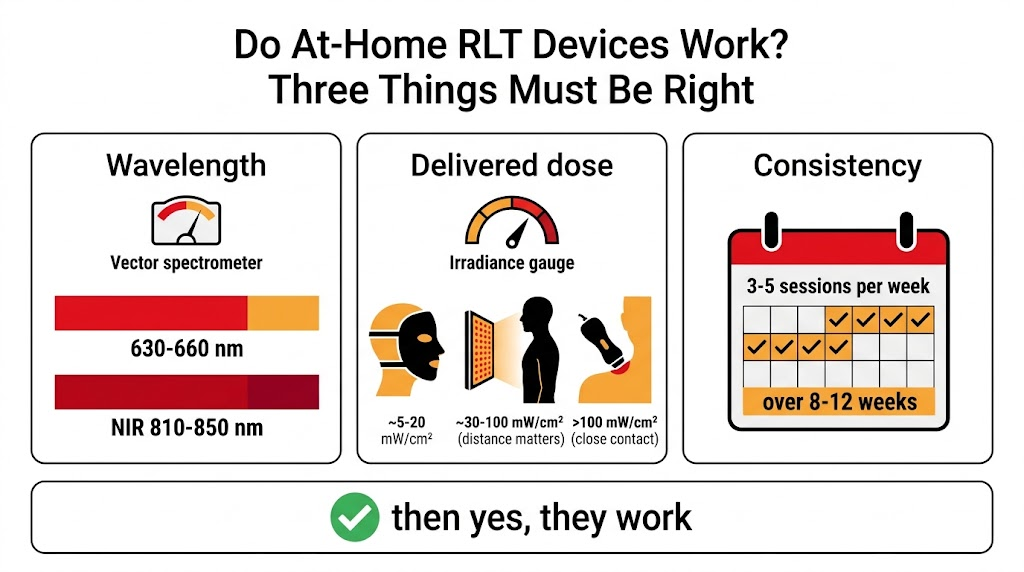
Table of Contents
- 1. Understanding At-Home Red Light Therapy
- 2. What RLT Is and How It Works
- 3. Do At-Home Devices Deliver Real Results?
- 4. Benefits of At-Home RLT, Graded by Evidence
- 5. How to Choose the Right Device
- 6. How to Use Your Device Effectively
- 7. Common Myths and Safety Tips
- 8. Conclusion
- 9. Partner With Rainbow Technology
- 10. References
1. Understanding At-Home Red Light Therapy
In recent years, red light therapy (RLT) has surged in popularity as a non-invasive, natural treatment for skin rejuvenation, anti-aging, pain relief, and muscle recovery. But with a flood of at-home red light devices — masks, panels, handhelds — many consumers wonder: “Do at-home red light therapy devices actually work?”
This guide explores the science, effectiveness, and safety of home devices, and gives you a practical framework for telling a real therapeutic tool from an expensive light show — before you invest.
2. What Is Red Light Therapy and How It Works
Red light therapy involves exposing the skin and tissues to specific wavelengths of red light (630–660 nm) and near-infrared light (810–850 nm). These penetrate cells and are absorbed by mitochondria — the powerhouses of your cells — boosting ATP (cellular energy) production through a process called photobiomodulation[1]. The commonly cited 660 nm and 850 nm values sit inside these clinically studied bands.
| Light Type | Penetration & Benefits |
|---|---|
| Red light (630–660 nm) | Absorbed by the skin’s surface; promotes collagen production, skin healing, and anti-aging effects[2] |
| Near-infrared (810–850 nm) | Penetrates deeper into muscles and joints; supports pain relief, inflammation reduction, and recovery[4] |
This dual-action explains why dermatologists, physical therapists, and athletes use RLT for both skin and wellness benefits.
3. Do At-Home Red Light Therapy Devices Deliver Real Results?
Short answer: yes — but only if you choose a device that actually delivers a therapeutic dose and follow a consistent routine. The clinical evidence behind LED therapy comes from devices with defined wavelengths, irradiance, and exposure times; the same biology works at home when those parameters are reproduced[3].
Key Factor 1: Wavelength Accuracy
Only devices with verified 630–660 nm red and 810–850 nm near-infrared output can claim the corresponding clinical evidence. Cheap or unverified gadgets often emit wavelengths that drift outside the therapeutic window — and many brands never publish a spectrometer report.
Key Factor 2: Power Output & Delivered Dose — By Device Type
This is where most buyer guides go wrong. There is no single “correct” irradiance: the right number depends on how far the light travels. A distance panel needs high irradiance because light spreads over 6–12 inches; a contact mask needs far less because the LEDs sit 0–2 cm from your skin.
| Device Type | Typical Irradiance at Skin | Typical Session |
|---|---|---|
| Contact mask / wrap (0–2 cm) | 20–60 mW/cm² | 10–20 min |
| Distance panel (6–12 in) | 50–200+ mW/cm² | 5–15 min |
| Handheld wand / spot device | Varies with distance (closer = higher) | 1–10 min per spot |
What matters is delivered dose (irradiance × time) at your actual treatment distance — a spec sheet number measured at the LED surface tells you little. For the full dose math, see Is 10 Minutes of Red Light Therapy Enough?
Key Factor 3: Consistency & Duration
Red light therapy is cumulative: typically 10–20 minutes per area, 3–5 sessions per week. In controlled trials, measurable collagen changes appear over roughly 10–12 weeks of consistent use[2] — the device that gathers dust is the device that “doesn’t work.”
Key Factor 4: Safety & Certifications
Look for devices with verifiable safety documentation — FDA registration / 510(k) documentation, ETL/UL, CE, RoHS, and IEC 62471 photobiological safety. Documentation you can check is a better signal than any marketing badge.
4. Benefits of At-Home Red Light Therapy, Graded by Evidence
| Claimed Benefit | Evidence Grade | Reality Check |
|---|---|---|
| Skin rejuvenation & anti-aging | ✅ Good | Collagen density and fine-line improvements in controlled trials[2]; pigmentation claims remain emerging |
| Pain relief & inflammation | ✅ Good | Meta-analytic evidence for conditions like knee osteoarthritis at defined doses[4] |
| Muscle recovery & performance | ✅ Good | Recovery support documented in sports contexts; NIR reaches muscle tissue |
| Mental wellness & sleep | ⚠️ Not established | Red/NIR is narrow-band light — not bright-light therapy used in circadian research. Any mood benefit would be indirect (e.g., less pain) |
| Convenience & cost-effectiveness | ✅ Practical | Home use avoids clinic visits; cost per session drops steeply over the device’s life |
5. How to Choose the Right At-Home Red Light Therapy Device
First decide your form factor by goal: face-focused daily use suits a mask; whole-body recovery suits a panel; targeted spots suit a handheld. Our Mask vs. Panel comparison walks through that decision. Then evaluate any device — brand aside — on these criteria:
| Criteria | What to Look For | Why It Matters |
|---|---|---|
| Wavelengths | 630–660 nm red + 810–850 nm NIR, stated and verifiable | Off-wavelength output = no therapeutic claim applies |
| Irradiance | Stated at working distance, matched to device type (see table in Section 3) | Surface-rated power misleads; delivered dose is what counts |
| Certifications | FDA registration / 510(k) documentation, ETL/UL, CE, RoHS, IEC 62471 | Verifiable compliance, not marketing badges |
| Treatment area & design | Full-face or full-body coverage with uniform LED spacing | Hotspots and gaps mean uneven dose delivery |
| Realistic review patterns | Reviews that mention weeks of consistent use and honest limits | Instant-magic testimonials contradict how the biology works |
| Warranty & support | Minimum 1-year warranty; responsive manufacturer | LEDs and drivers are the parts most likely to need support |
For the deeper question of whether masks specifically deliver results — including how to read the clinical landscape — see Do Red Light Therapy Masks Really Work?
6. How to Use Your At-Home Device Effectively
- Clean skin: Remove makeup, sunscreen, or oils before treatment (skincare products block light)
- Position device: Follow your device’s working distance — masks sit on the face; panels typically sit 6–18 inches away; closer is not automatically better — check the manual’s dose table
- Session duration: 10–20 minutes per area for most home devices
- Frequency: 3–5 sessions per week; more is not better — red light has a biphasic dose response[5]
- Post-treatment care: Apply hydrating or antioxidant-rich serums to clean skin after the session
- Relax and repeat: Consistency over 8–12 weeks is the variable that predicts results
Note: most users report visible changes in skin glow, reduced redness, or comfort within 4–8 weeks of consistent use — with structural changes (collagen, deeper recovery) building over roughly 10–12 weeks[2].
7. Common Myths About At-Home RLT Devices
| Myth | Fact |
|---|---|
| All red light devices are the same | Only devices with verified wavelengths and delivered dose are effective — the rest are lamps |
| Results are immediate | Benefits accumulate over weeks of consistent use — that’s how the biology works |
| Red light therapy is unsafe | Non-UV and non-thermal when used properly; certified devices with eye shielding are safe for home use |
| More power / more minutes = faster results | False — the dose-response curve is biphasic; beyond the effective window, extra exposure adds nothing[5] |
Safety Tips
- Use devices with verifiable safety documentation and certifications
- Wear protective eyewear if sensitive to bright light — Do You Need Goggles?
- Avoid overuse; follow the manufacturer’s session instructions
- Consult a dermatologist or healthcare provider if you have photosensitive conditions, take photosensitizing medication, or have underlying health concerns — Who Cannot Use Red Light Therapy?
8. Conclusion: Do At-Home Red Light Therapy Devices Actually Work?
Yes — with three conditions. The device must deliver verified therapeutic wavelengths, at a dose matched to its form factor, and you must use it consistently over weeks. When those three are in place, at-home RLT brings clinical-grade biology into your daily routine at a fraction of the clinic cost.
When they’re not — when the wavelength drifts, the irradiance is theater, or the device sits in a drawer — it “doesn’t work.” The technology was never the variable. The engineering was.
9. Partner With Rainbow Technology
Every “effectiveness factor” in this article — wavelength, delivered dose, certifications, form factor — is decided at the factory, years before a device reaches a consumer’s hands. That’s what we do:
- Verified wavelengths: 630–660 nm red / 810–850 nm NIR — spectrometer-verified per batch, irradiance stated at actual working distance.
- All form factors: Masks, panels, handhelds, wraps — the device type that fits your market’s goal.
- Documentation you can show buyers: FDA registration & 510(k) documentation, CE, RoHS, FCC, KC, IEC 62471, ISO 13485 + MDSAP QMS.
- OEM/ODM: Custom wavelengths, molds, private labeling, firmware — from concept to certified product. Consult our engineering team; see designs on our product lineup.
Request your custom quote today.
10. References
[1] Hamblin MR.
Mechanisms and applications of the anti-inflammatory effects of photobiomodulation. AIMS Biophysics. 2017;4(3):337-361.
[2] Wunsch A, Matuschka K.
A controlled trial to determine the efficacy of red and near-infrared light treatment in patient satisfaction, reduction of fine lines, wrinkles, skin roughness, and intradermal collagen density increase. Photomedicine and Laser Surgery. 2014;32(2):93-100.
[3] Jagdeo J, Austin E, Mamalis A, et al.
Light-emitting diodes in dermatology: a systematic review of randomized controlled trials. Lasers in Surgery and Medicine. 2018;50(6):613-628.
[4] Stausholm MB, Naterstad IF, Joensen J, et al.
Efficacy of low-level laser therapy on pain and disability in knee osteoarthritis: systematic review and meta-analysis of randomized placebo-controlled trials. BMJ Open. 2019;9(10):e031142.
[5] Huang YY, Sharma SK, Carroll J, Hamblin MR.
Biphasic dose response in low level light therapy — an update. Dose-Response. 2011;9(4):602-618.

