
What Is the Best FDA-Cleared Red Light Therapy Mask? A 2025 Expert Guide
There is no single “best” FDA-cleared mask — there are five device archetypes, and the best one is the type that matches your goal, plus a clearance you can actually verify. FDA clearance means a device met safety standards for a defined intended use — it is not FDA “approval” in the pharmaceutical sense, and it is not proof of clinical superiority. This guide compares five archetypes (multi-wavelength, red+blue+NIR, red+NIR single-protocol, app-controlled, and simple dual-wavelength) against five evidence-based criteria — and then shows you exactly how to verify a manufacturer’s FDA 510(k) claim yourself, because a spec sheet you can check beats a brand name every time.
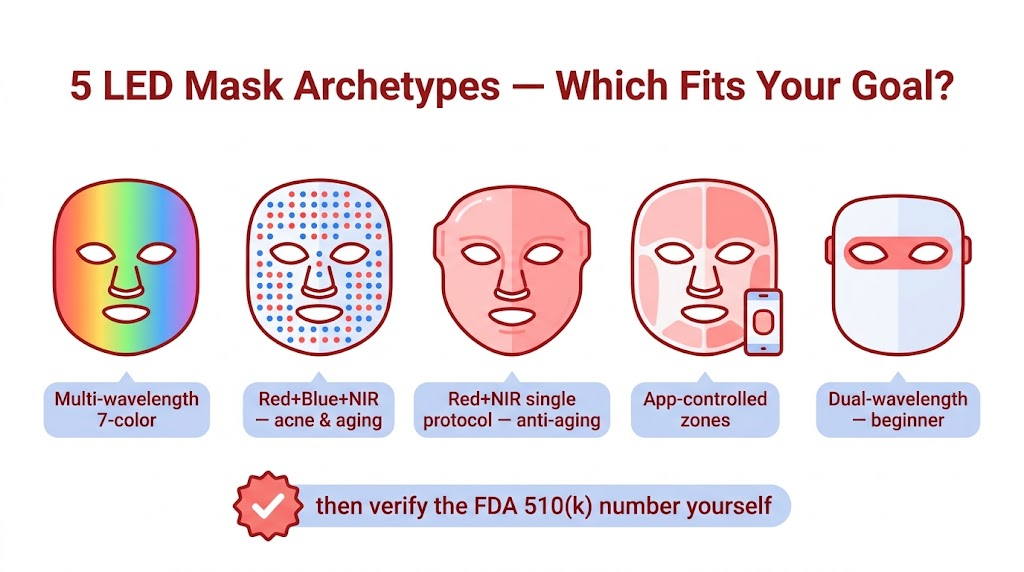
Table of Contents
- 1. Introduction: What Is the Best FDA-Cleared Mask?
- 2. Why FDA Clearance Matters — and What It Doesn’t Mean
- 3. Five Device Archetypes to Compare
- 4. How Experts Evaluate the “Best” Mask
- 5. How to Verify FDA Clearance Yourself
- 6. FAQs
- 7. Final Thoughts
- 8. Partner With Rainbow Technology
- 9. References
1. Introduction: How to Choose the Best FDA-Cleared Red Light Therapy Mask
Red light therapy masks have become one of the most searched skincare technologies in recent years. From reducing visible signs of aging to helping manage breakouts, LED face masks are now widely used both in dermatology clinics and at home. But with dozens of devices claiming clinical results, many consumers ask: What is the best FDA-approved or FDA-cleared red light therapy mask?
The answer depends on several factors — wavelengths, device engineering, treatment goals, and safety certifications. In this expert guide, we compare the main device types on the market and explain how to evaluate them based on dermatology-informed criteria rather than marketing claims.
2. Why FDA Clearance Matters for LED Face Masks — and What It Doesn’t Mean
When a red light therapy mask is FDA cleared, it means the manufacturer has demonstrated that the device meets safety standards and performs similarly to legally marketed devices. An important clarification for users:
- Most LED skincare devices are FDA cleared via the 510(k) pathway — not “FDA approved” in the pharmaceutical sense
- Clearance focuses on safety and intended use rather than guaranteed clinical outcomes
- A clearance number is verifiable — which is exactly why you should check it (Section 5)
Choosing a properly cleared device may offer:
- Verified safety parameters
- Defined wavelength ranges
- Built-in protective features
- More transparent technical specifications
Dermatologists often recommend prioritizing safety certifications over aesthetic design alone. For a deeper look at how clinical evidence maps to LED devices, see our companion guides: Do Red Light Therapy Masks Really Work? and the LED Mask Buyer’s Guide.
3. Five Device Archetypes to Compare
Instead of ranking brand names, we describe the five device types that dominate the market. This is not a medical endorsement — it’s an educational framework based on public reviews, dermatologist commentary, and market visibility. Most masks on the market fit one of these archetypes.
| Archetype | Typical Design | Best For | Watch Out For |
|---|---|---|---|
| Multi-wavelength 7-color | Red, NIR plus amber, yellow, green, cyan, etc. | Users who want one device for multiple concerns | Extra colors ≠ extra evidence — red/NIR remain the most clinically studied ranges |
| Red + blue + NIR cordless | Red, ~415 nm blue, and NIR; lightweight cordless body | Acne-prone skin plus anti-aging in one routine | Check the blue peak — acne evidence targets ~415 nm, not 450 nm consumer blue |
| Red + NIR flexible silicone, single protocol | Flexible silicone, fixed red+NIR program | Anti-aging focus with maximum simplicity | No blue mode — not a one-device acne solution |
| App-controlled zone mask | App customization, zone-specific programs | Tech-comfortable users who like personalization | Complexity can reduce long-term consistency — the variable that matters most |
| Simple dual-wavelength portable | Red + NIR, minimal modes, portable structure | Beginners wanting straightforward anti-aging support | Fewer modes is fine — verify the wavelengths and irradiance are actually stated |
Why the Archetype View Matters for Buyers
The multi-wavelength spectrum may support different skin concerns, but dermatologists often emphasize that red and near-infrared remain the most clinically studied ranges[1]. Devices focusing on fewer clinically relevant wavelengths may deliver more consistent energy distribution, and some dermatology professionals prefer simplified treatment modes for better compliance — because consistency over weeks matters more than feature lists.
4. How Experts Evaluate the “Best” Red Light Therapy Mask
Instead of focusing only on brand names, dermatology-aligned selection criteria include:
1. Wavelength Accuracy
Research most commonly supports 630–660 nm red light and 810–850 nm near-infrared light[2]. Blue light (~415 nm) may help target acne-related bacteria[3]. Transparent wavelength disclosure is a strong trust signal for both users and search engines.
2. LED Distribution and Coverage
Higher LED counts don’t always mean better performance — but even light distribution across the face can improve consistency. Look for full-face coverage, uniform spacing, and consistent diode quality.
3. Comfort and Ergonomic Design
Consistent use matters more than short-term intensity. Key design factors include flexible or lightweight materials, adjustable straps, and balanced weight distribution.
4. Safety Features
From an E-E-A-T perspective, safety signals strongly influence credibility: eye protection or shielding (see Do You Need Goggles?), auto shut-off timers, clearly defined session durations, and transparent certification claims. Avoid devices that lack technical specifications or make exaggerated medical promises.
5. Ease of Use and Realistic Treatment Time
Most dermatology guidelines suggest 10–15 minute sessions, 3–5 treatments per week, sustained over several weeks[4]. Short sessions can improve compliance, which often matters more than peak power output. For the dose science behind session length, see How Long Should Red Light Therapy Sessions Be?
5. How to Verify FDA Clearance Yourself
“FDA-cleared” is a verifiable claim — and the verification is public. Here is the five-minute checklist:
| Step | What to Do | What It Tells You |
|---|---|---|
| 1. Ask for the number | Request the 510(k) number (K-prefix) from the brand or spec sheet | A real clearance has a real, public number |
| 2. Search the FDA database | Search the FDA 510(k) database by number or company name | Confirms the device exists and who owns the clearance |
| 3. Read the intended use | Check the clearance’s stated intended use and indications | Reveals what the claim actually covers — and doesn’t |
| 4. Request test reports | Ask for wavelength and irradiance measurement reports | Confirms output matches the marketing claims |
| 5. Check establishment registration | Confirm the manufacturer is a registered establishment | Distinguishes branded resellers from actual manufacturers |
Clearance is about safety and intended use — it is not a guarantee of clinical outcomes. That distinction is exactly why the five evaluation criteria above still matter after clearance is confirmed.
6. FAQs About FDA-Cleared Red Light Therapy Masks
How long before results appear?
Some users report improvements within 4–6 weeks, but outcomes vary depending on skin condition, device design, and usage consistency. Clinical collagen studies show measurable changes over roughly 10–12 weeks of consistent sessions[2].
Can LED masks be used daily?
Many cleared devices allow frequent use when following manufacturer instructions. But overuse does not necessarily improve results and may increase irritation risk — red light follows a biphasic dose response, where more exposure beyond the effective window doesn’t add benefit[4].
Are red light therapy masks safe for all skin tones?
Current research suggests red and near-infrared light are generally safe across diverse skin tones because they rely less on pigment absorption than lasers or IPL. The honest caveat: large per-skin-type trials are still limited, so follow manufacturer guidance and patch-test conservatively if you have concerns.
Should I combine skincare with LED therapy?
Most experts recommend clean skin before treatment, active serums or moisturizers afterward, and avoiding strong photosensitizing ingredients immediately before sessions. For the full pre-treatment protocol, see Should You Apply Skincare Before a Red Light Therapy Mask?
7. Final Thoughts: What Is the “Best” FDA-Cleared Red Light Therapy Mask?
There is no single universal best device — only the one that best matches your skin goals, comfort preferences, and safety expectations. Dermatology professionals often suggest focusing on verified wavelengths, transparent technical specifications, FDA clearance and safety features, and consistent long-term use.
A well-designed LED mask should support your skincare routine rather than replace professional medical care. And when a brand says “FDA-cleared,” the best response is not blind trust — it’s the five-minute verification in Section 5.
8. Partner With Rainbow Technology
Every archetype in this article — multi-wavelength, red+blue+NIR, red+NIR silicone, app-controlled, and portable dual-wavelength — is a product category we engineer and manufacture. The “best mask” isn’t a mystery brand; it’s a spec sheet you can verify:
- Verified wavelengths: 630–660 nm red / 810–850 nm NIR / ~415 nm blue — spectrometer-verified per batch, irradiance stated at working distance.
- Documentation you can check: FDA registration & 510(k) documentation available for partner review; CE, RoHS, FCC, KC; IEC 62471; ISO 13485 + MDSAP QMS.
- Full-form freedom: Silicone masks, rigid masks, cordless designs, app-controlled firmware — your archetype, your spec.
- OEM/ODM: Custom wavelengths, molds, private labeling, firmware — from concept to certified product. Consult our engineering team; see designs on our product lineup.
Request your custom quote today.
9. References
[1] Jagdeo J, Austin E, Mamalis A, et al.
Light-emitting diodes in dermatology: a systematic review of randomized controlled trials. Lasers in Surgery and Medicine. 2018;50(6):613-628.
[2] Wunsch A, Matuschka K.
A controlled trial to determine the efficacy of red and near-infrared light treatment in patient satisfaction, reduction of fine lines, wrinkles, skin roughness, and intradermal collagen density increase. Photomedicine and Laser Surgery. 2014;32(2):93-100.
[3] Kwon HH, Lee SK, Lee J, et al.
Combined 420-nm and 660-nm LED phototherapy for acne vulgaris: a double-blind, randomized, sham-controlled trial. British Journal of Dermatology. 2013;168(6):1288-1294.
[4] Huang YY, Sharma SK, Carroll J, Hamblin MR.
Biphasic dose response in low level light therapy — an update. Dose-Response. 2011;9(4):602-618.
[5] Hamblin MR.
Mechanisms and applications of the anti-inflammatory effects of photobiomodulation. AIMS Biophysics. 2017;4(3):337-361.

