
Do LED Red Light Therapy Masks Really Work?
Yes — LED red light masks work, when engineered correctly, used at proper frequency, and supported by clear post-treatment guidance. This consolidated buyer reference answers the three questions that matter for product success: (1) the clinical case for effectiveness, (2) the industry-standard usage framework (3–5 sessions/week, short controlled sessions), and (3) post-treatment do’s and don’ts that directly affect user satisfaction and reviews. The commercial insight: moderate, repeatable use outperforms extreme claims — and clear aftercare education is a brand asset, not an afterthought.
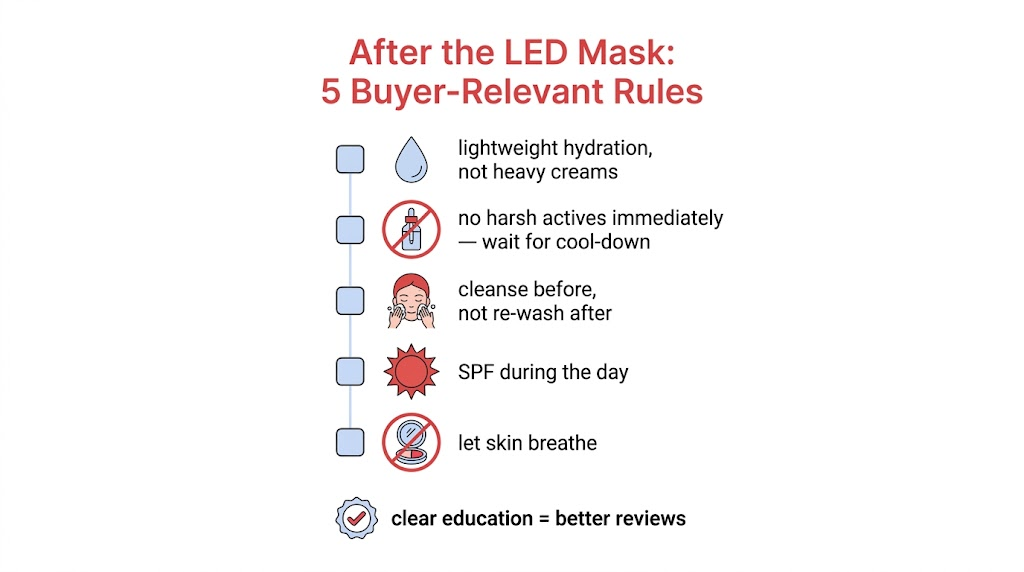
Table of Contents
- 1. What Is RLT and Why It Matters to Buyers
- 2. Do LED Red Light Masks Really Work?
- 3. How Often Should a Mask Be Used?
- 4. Why Overuse Is a Product Risk
- 5. What NOT to Do After Using an LED Mask
- 6. Product Design Factors to Evaluate
- 7. Commercial Value of LED Masks
- 8. Final Buyer Verdict
- 9. Buyer Checklist
- 10. Partner With Rainbow Technology
- 11. References
1. What Is Red Light Therapy and Why It Matters to Buyers
Red light therapy (RLT), also known as photobiomodulation, uses low-level red and near-infrared light to stimulate cellular activity in the skin[1]. Commercially viable LED masks typically operate within:
- Red light: ~630–660 nm (collagen stimulation, wrinkle reduction)
- Near-infrared light: ~810–850 nm (cellular repair, firmness support)
From a buyer perspective, this technology offers three strategic advantages:
- Non-invasive and home-use friendly
- Lower regulatory burden compared to medical aesthetics
- Strong alignment with long-term skincare routines
These factors explain why LED masks are considered a sustainable category, not a short-lived trend.
2. Do LED Red Light Therapy Masks Really Work?
Clinical research and real-world usage data support the effectiveness of red light therapy when used consistently and within safe parameters. Documented benefits include:
- Increased collagen and elastin activity[3]
- Improved skin tone and texture[3]
- Reduced redness and inflammation[1]
- Gradual improvement in firmness and radiance
In a controlled trial of 136 participants, red and near-infrared treatment significantly increased intradermal collagen density and reduced fine lines and wrinkles over 12 weeks[3]. A dermatology-led systematic review of 31 LED RCTs supports clinical use for several indications[4].
Buyer insight: LED masks are maintenance and preventative devices, not instant-result treatments. This positioning actually improves market stability by setting realistic expectations and reducing refund disputes. For the full supplier-evaluation perspective, see our B2B supplier guide.
3. How Often Should a Red Light LED Mask Be Used?
Usage frequency directly impacts safety, certification, and consumer compliance. Industry-standard guidelines:
| Skin Objective | Frequency | Session Duration |
|---|---|---|
| Anti-aging & firmness | 3–5 times/week | 8–10 minutes |
| Acne & oil control | Daily (short-term), then 3–5× | 5–10 minutes |
| Skin glow & maintenance | 4–6 times/week | 5–10 minutes |
| Sensitive skin | 2–4 times/week | 5–8 minutes |
* Short-term daily cycles for acne follow published at-home protocols (e.g., brief daily sessions over 4–8 weeks)[5]; always defer to the specific device manual. See the full frequency framework in our usage frequency buyer guide.
From a procurement standpoint, moderate repeat usage performs best commercially: easier compliance with safety standards, higher user retention, and lower misuse-related complaints.
4. Why Overuse Is a Product Risk, Not a Selling Point
Red light therapy works through controlled cellular stimulation, and it follows a biphasic dose response — beyond the effective window, more exposure doesn’t add benefit and can blunt it[2]. Excessive exposure does not improve results and may cause:
- Temporary redness
- Dryness or discomfort
- Reduced user confidence in the product
Well-engineered LED masks therefore include:
- Preset treatment durations
- Automatic shut-off functions
- Balanced irradiance output
These features protect both the end user and the brand reputation.
5. What NOT to Do After Using an LED Mask (Buyer-Relevant Guidance)
Post-treatment behavior significantly affects user experience and reviews. Buyers should ensure products clearly communicate the following precautions.
1. Don’t Layer Heavy or Occlusive Products Immediately
Thick creams or oils applied right away may reduce comfort after treatment. Best practice: recommend lightweight, water-based hydration — see our post-therapy moisturizing guide.
2. Don’t Apply Harsh Actives Immediately — Respect the Cool-Down
Retinoids, AHAs, and BHAs can increase sensitivity if applied immediately after a session. This doesn’t mean they’re off-limits: with a short cool-down (2–5 minutes) and gradual introduction, actives like retinol can be used after LED therapy — see our retinol timing guide.
3. Don’t Skip Pre-Treatment Cleansing
Residue on skin can affect light penetration, perceived effectiveness, and comfort. Cleanse before the session; after phototherapy, re-washing isn’t required — see our wash-after guide and pre-treatment prep.
4. Don’t Skip Sun Protection During the Day
Skin may be temporarily more sensitive after LED therapy; daily SPF remains a non-negotiable skincare baseline.
5. Don’t Apply Heavy Makeup Immediately
Allowing skin to breathe post-treatment improves comfort and compliance. Comfort-focused design supports this behavior naturally.
6. Product Design Factors Buyers Should Evaluate
Optical Stability
Consistent wavelength and irradiance output across long-term use.
Multi-Mode Functionality
Red and near-infrared combinations allow broader positioning and SKU expansion.
Ergonomic Comfort
Soft silicone materials and balanced weight improve repeat usage.
Certification Readiness
UKCA / CE / FDA / RoHS documentation directly impacts market access[4].
7. Commercial Value of LED Red Light Masks
| Attribute | Buyer Advantage |
|---|---|
| Non-invasive | Low regulatory risk |
| Routine-based | Strong customer retention |
| Gradual results | Fewer unrealistic claims |
| Science-backed | Long product lifecycle[3] |
For brands building durable beauty device portfolios, LED masks offer stable demand with scalable positioning.
8. Final Buyer Verdict
Do LED red light therapy masks really work?
Yes — when engineered correctly, used at proper frequency, and supported by clear post-treatment guidance. For buyers and brand owners, success depends less on extreme claims and more on verified wavelengths, safe usage standards, clear education, and reliable manufacturing partners. These factors determine whether an LED mask becomes a long-term bestseller or a short-term experiment.
9. Buyer Checklist Before Sourcing
- Wavelength & irradiance test reports
- Usage cycle recommendations
- Certification scope by market
- Post-treatment education materials (manuals, packaging, app content)
- OEM / ODM customization options
10. Partner With Rainbow Technology
Effectiveness, safe usage standards, and aftercare education aren’t three separate purchases — they’re one engineering decision. At Rainbow, we deliver all three:
- Verified effectiveness: 630–660 nm red / 810–850 nm NIR / ~415 nm blue — spectrometer-verified per batch; irradiance stated at working distance.
- Safe usage by design: Preset modes, automatic shut-off, balanced output inside the effective dose window[2].
- Education-ready: Manual language, packaging guidance, and app content support for post-treatment best practices.
- Compliance: CE, RoHS, FCC, KC; IEC 62471; ISO 13485 + MDSAP QMS; FDA registration & 510(k) documentation.
- Start sourcing: Consult our engineering team; reference designs on our product lineup page.
Request your custom quote today.
11. References
[1] Hamblin MR.
Mechanisms and applications of the anti-inflammatory effects of photobiomodulation. AIMS Biophysics. 2017;4(3):337-361.
[2] Huang YY, Sharma SK, Carroll J, Hamblin MR.
Biphasic dose response in low level light therapy — an update. Dose-Response. 2011;9(4):602-618.
[3] Wunsch A, Matuschka K.
A controlled trial to determine the efficacy of red and near-infrared light treatment in patient satisfaction, reduction of fine lines, wrinkles, skin roughness, and intradermal collagen density increase. Photomedicine and Laser Surgery. 2014;32(2):93-100.
[4] Jagdeo J, Austin E, Mamalis A, et al.
Light-emitting diodes in dermatology: a systematic review of randomized controlled trials. Lasers in Surgery and Medicine. 2018;50(6):613-628.
[5] Kwon HH, Lee SK, Lee J, et al.
Combined 420-nm and 660-nm LED phototherapy for acne vulgaris: a double-blind, randomized, sham-controlled trial. British Journal of Dermatology. 2013;168(6):1288-1294.

