
Do Red Light Therapy Masks Really Work? A Science-Backed Guide for Buyers and Brands
30-Second Summary:
Yes — red light therapy masks work, and they’re a strategic category for brands — when sourced from a technically reliable manufacturer. The science is backed by controlled trials on collagen and skin texture. But for buyers, “does it work” is really two questions: does the technology work, and does the supplier deliver it? This guide covers both — the engineering factors that separate real devices from marketing (wavelength accuracy, delivered irradiance, LED coverage), the certifications that unlock markets, and a supplier evaluation checklist for RFQ discussions.
Table of Contents
- 1. What Is Red Light Therapy?
- 2. How RLT Masks Work — Engineering Perspective
- 3. Scientific and Market Evidence
- 4. What End Users Actually Expect
- 5. How to Evaluate a Supplier
- 6. RLT Masks vs Other Anti-Aging Categories
- 7. Common Buyer Misconceptions
- 8. Final Verdict
- 9. Procurement Tips
- 10. Partner With Rainbow Technology
- 11. References
1. What Is Red Light Therapy?
Red light therapy (RLT), also known as photobiomodulation, uses specific wavelengths of red and near-infrared light to stimulate biological activity in skin cells. Most clinically referenced devices operate within:
- 630–660 nm (Red Light): Supports collagen stimulation and skin renewal
- 810–850 nm (Near-Infrared): Enhances cellular energy and elasticity
Instead of invasive treatments, these wavelengths promote ATP production in mitochondria — helping skin repair itself naturally over time[1].
For brands and distributors, this scientific foundation is the reason LED masks have gained long-term market viability rather than being a short-term trend.
2. How Red Light Therapy Masks Work — From a Product Engineering Perspective
A red light therapy mask typically integrates:
- High-density LED arrays
- Controlled wavelength output
- Stable irradiance levels
- Flexible or silicone ergonomic design
When evaluating suppliers, buyers should understand that performance is determined by engineering quality, not just marketing claims. Key technical factors include:
- Wavelength Accuracy: Common center points within the 630–660 nm red and 810–850 nm NIR bands — e.g., ~633 nm and ~830 nm — remain industry benchmarks.
- Power Density: Approximately 20–40 mW/cm² is a typical effective range for home-use contact masks; the delivered dose depends on the device’s actual irradiance at working distance.
- LED Coverage: Full-face uniformity ensures consistent treatment results.
Reliable manufacturers often provide spectral testing reports and optical validation data — something serious buyers should request during RFQ discussions.
3. Do Red Light Therapy Masks Really Work? Scientific and Market Evidence
Independent studies have shown that consistent red light therapy can support:
- Increased collagen and elastin activity[2]
- Improved skin tone and texture[4]
- Reduced redness and inflammation[1]
- Enhanced skin firmness over time[2]
In a controlled trial of 136 participants, red and near-infrared treatment significantly increased intradermal collagen density and reduced fine lines and wrinkles over 12 weeks[2]. A dermatology-led systematic review of 31 LED RCTs supports clinical use for several indications while noting common field limitations[3].
However, experienced buyers understand that LED masks are maintenance and preventative tools, not instant clinical replacements. From a commercial perspective, this positioning is actually beneficial:
- Encourages repeat usage
- Supports long product lifecycle
- Builds strong brand loyalty through gradual results
4. Real Market Feedback: What End Users Actually Expect
Across skincare communities and aesthetic retailers, feedback trends are consistent:
- ✔ Visible improvements appear after several weeks of consistent use
- ✔ Comfort and design influence customer retention
- ✔ Battery life and portability affect product reviews
For distributors and private-label brands, this means product success depends not only on light output but also on wearability, safety perception, and brand positioning.
5. How Buyers Should Evaluate a Red Light Therapy Mask Supplier
1. Certifications and Compliance
Look for:
- UKCA / CE compliance
- FDA registration or clearance documentation
- RoHS testing
- Photobiological safety reports (IEC 62471)
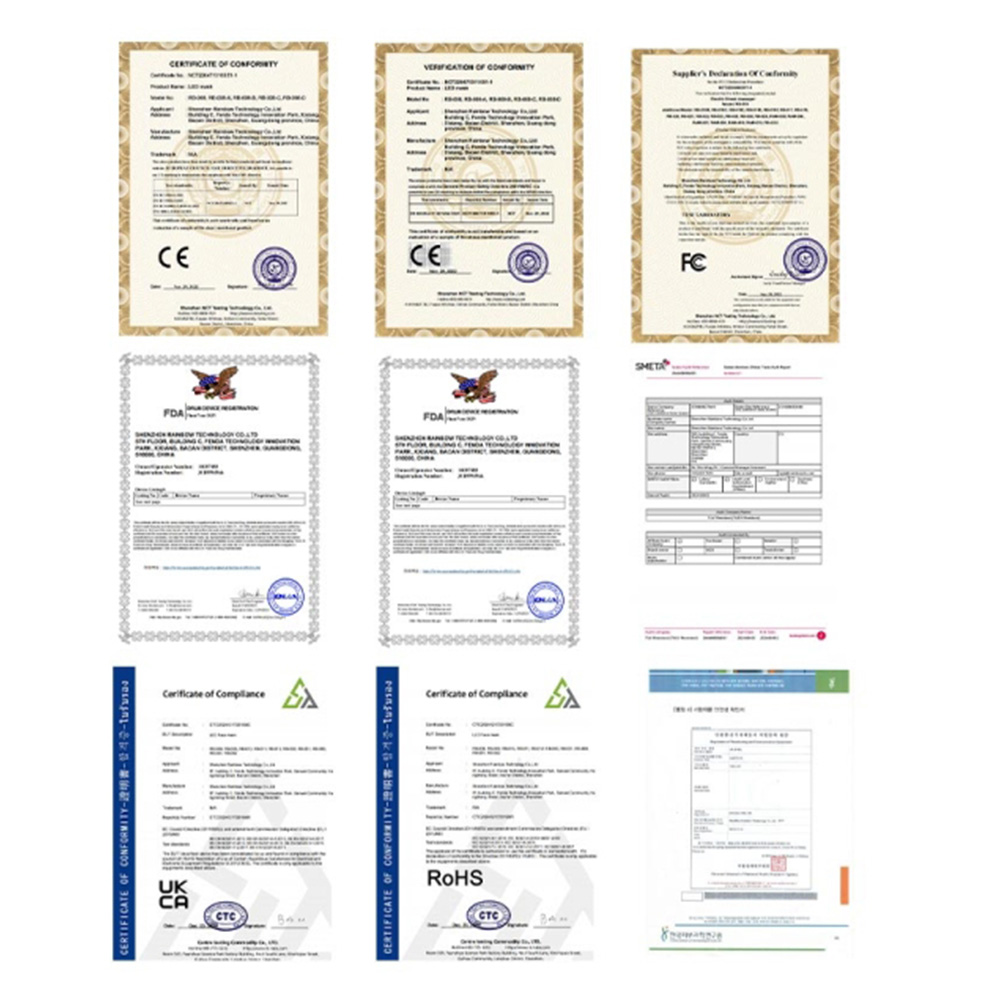
These certifications directly impact your ability to sell in international markets. For the full picture of our quality system, see our MDSAP & ISO 13485 certification overview.
2. Manufacturing Capability
Reliable OEM/ODM partners typically offer:
- Custom wavelength combinations
- Mold development
- Private labeling
- Firmware and controller customization
3. Stability and Consistency
Ask suppliers for:
- LED lifespan testing
- Irradiance stability data
- Batch quality control processes
Consistent output matters more than peak power numbers — the dose-response relationship favors moderate, well-delivered doses[5].
6. Red Light Therapy Masks vs. Other Anti-Aging Categories (Buyer Perspective)
| Category | Market Position | Repeat Purchase Potential | Risk Level |
|---|---|---|---|
| Red Light Masks | Preventative skincare device | High | Low |
| Botox / Injectables | Clinical treatment | Low | High |
| Fillers | Medical procedure | Low | Medium |
For brands building long-term device portfolios, LED masks offer scalable positioning without the regulatory burden of medical procedures. For the mask vs panel decision specifically, see our mask vs panel comparison.
7. Common Buyer Misconceptions
Myth: Higher power always means better results.
Reality: Excessive irradiance can reduce comfort and increase compliance risk — the dose-response curve favors moderation[5].
Myth: All LED masks use the same technology.
Reality: Optical design, LED binning, and driver stability vary significantly between manufacturers.
Myth: Faster results guarantee stronger sales.
Reality: Sustainable skincare devices often rely on long-term customer education.
8. Final Verdict: Are Red Light Therapy Masks Worth Adding to Your Product Line?
Yes — when sourced from a technically reliable manufacturer and positioned correctly, red light therapy masks represent a stable and scalable category within beauty technology.
For buyers, the key is not simply choosing a popular product but selecting a partner capable of delivering accurate wavelengths, verified safety standards, consistent production quality, and customization for brand differentiation. As consumer demand for non-invasive skincare continues to grow, red light therapy masks remain one of the most strategic additions to a modern beauty device portfolio.
9. Procurement Tips Before Placing an Order
- Request spectral testing and irradiance reports
- Confirm certification scope for your target market
- Evaluate design comfort and wearability
- Discuss OEM/ODM customization early in development — see our mask manufacturer guide for a full sourcing checklist
A well-engineered product combined with strong brand positioning can significantly improve conversion rates in both B2B and DTC channels.
10. Partner With Rainbow Technology
“Does it work?” is answered by the science. “Does your product line work?” is answered by the supplier. At Rainbow, we deliver both sides:
- Verified engineering: 630–660 nm red / 810–850 nm NIR / ~415 nm blue — spectrometer-verified per batch; irradiance stated at working distance.
- Certifications that open markets: CE, RoHS, FCC, KC; IEC 62471; UKCA pathway; ISO 13485 + MDSAP QMS; FDA 510(k) & registration documentation.
- Full OEM/ODM: Custom wavelengths, molds, private labeling, firmware and controller customization.
- Consistency: LED lifespan testing, irradiance stability data, batch QC — ask us for the reports.
- Start the conversation: Consult our engineering team; see reference designs on our product lineup page.
Request your custom quote today.
11. References
[1] Hamblin MR.
Mechanisms and applications of the anti-inflammatory effects of photobiomodulation. AIMS Biophysics. 2017;4(3):337-361.
[2] Wunsch A, Matuschka K.
A controlled trial to determine the efficacy of red and near-infrared light treatment in patient satisfaction, reduction of fine lines, wrinkles, skin roughness, and intradermal collagen density increase. Photomedicine and Laser Surgery. 2014;32(2):93-100.
[3] Jagdeo J, Austin E, Mamalis A, et al.
Light-emitting diodes in dermatology: a systematic review of randomized controlled trials. Lasers in Surgery and Medicine. 2018;50(6):613-628.
[4] Couturaud V, et al.
A randomized controlled study evaluating the effects of 630 nm light-emitting diode therapy on periorbital wrinkles. Skin Research and Technology. 2023;29(8):e13342.
[5] Huang YY, Sharma SK, Carroll J, Hamblin MR.
Biphasic dose response in low level light therapy — an update. Dose-Response. 2011;9(4):602-618.

