
Do LED Masks Work for Wrinkles? A Science-Backed Guide by Shenzhen Rainbow Technology Co., Ltd.
Yes — LED masks work for fine lines and skin texture, when used consistently and with realistic expectations. Controlled trials show measurable improvements in collagen density and wrinkle depth over 8–12 weeks. But “work” has honest limits: surface wrinkles respond well; deep, structural wrinkles are not a home-LED target. The wavelength table matters more than the price tag — this guide covers the mechanism, the actual evidence, and the routine that makes the science show up on your face.
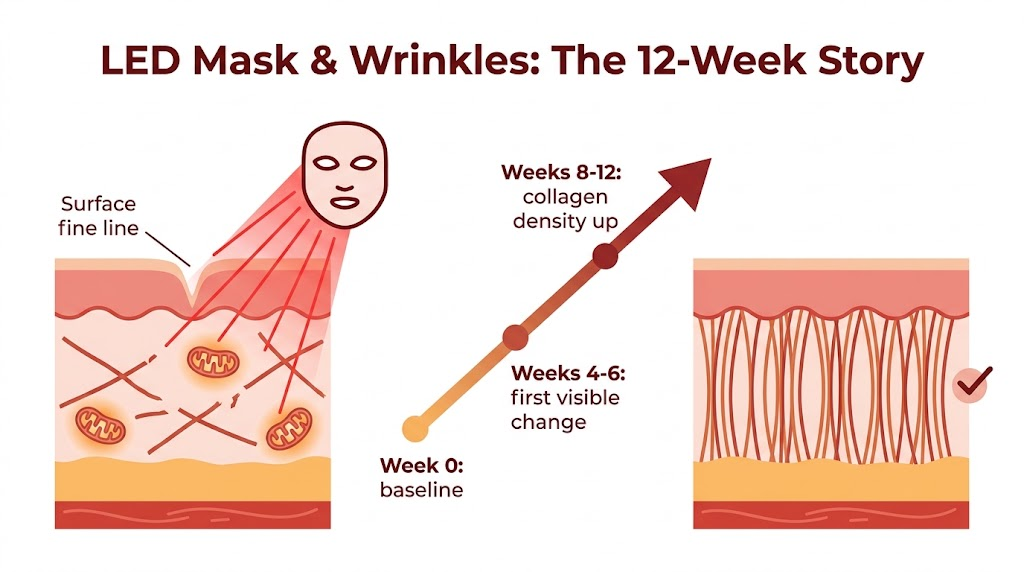
Table of Contents
- 1. What Are LED Masks?
- 2. How Do LED Masks Work for Wrinkles?
- 3. Scientific Evidence
- 4. Who Can Benefit
- 5. How to Use for Wrinkle Reduction
- 6. Benefits Beyond Wrinkles
- 7. Safety Tips and Best Practices
- 8. Why Choose Rainbow Technology
- 9. FAQ
- 10. Partner With Rainbow Technology
- 11. References
1. What Are LED Masks?
LED (Light Emitting Diode) masks are wearable skincare devices that emit specific wavelengths of light to penetrate the skin at varying depths. Unlike chemical or invasive treatments, LED masks stimulate the skin’s natural repair processes without downtime or pain[1].
Common LED Wavelengths and Benefits:
| Light Type | Wavelength | Primary Benefit |
|---|---|---|
| Red Light | 630–660 nm | Stimulates collagen & elastin for skin firmness |
| Near-Infrared | 810–850 nm | Improves circulation & deep tissue repair |
| Blue Light | ~415 nm | Targets acne-causing bacteria |
| Yellow/Green | 570–590 nm / 520–560 nm | Traditional positioning: redness & pigmentation — clinical evidence limited |
A note on wavelengths: 415 nm blue is the C. acnes absorption peak for acne use; 450–470 nm “standard blue” looks similar but has a far weaker acne effect. And true near-infrared sits at 810–850 nm — some cheap devices claim “940 nm NIR,” which is outside the well-studied treatment window. The wavelength table is where mask quality separates from marketing.
2. How Do LED Masks Work for Wrinkles?
Wrinkles and fine lines are primarily caused by collagen breakdown, decreased elasticity, and oxidative stress. LED masks target these factors through:
- Stimulating collagen production: Red and near-infrared light activate fibroblasts in the dermis, boosting collagen and elastin synthesis. This plumps the skin and smooths wrinkles[2].
- Enhancing cellular energy: LED therapy increases mitochondrial activity, producing ATP (cellular energy) that powers repair and regeneration[1].
- Reducing inflammation: Light therapy calms the skin, reducing redness and irritation that can make wrinkles more noticeable[1].
- Improving circulation: Near-infrared light improves blood flow, delivering nutrients and oxygen crucial for healthy, youthful skin.
What the data shows: In a controlled trial of 136 participants, red and near-infrared treatment significantly increased intradermal collagen density and reduced fine lines and wrinkles over 12 weeks[2]. A separate 2023 randomized trial reported crows-feet depth reduced by 38.3% and dermal density increased by 47.7% after three months of 630 nm sessions[3].
3. Scientific Evidence Supporting LED Masks
- Wunsch 2014 (controlled trial, n=136): Significant increase in intradermal collagen density and reduction of fine lines, wrinkles, and roughness after 30 sessions over ~15 weeks, maintained at 12-week follow-up[2].
- Couturaud 2023 (randomized trial): 630 ± 10 nm sessions twice weekly for 3 months: crows-feet depth −38.3%, dermal density +47.7%[3].
- Jagdeo 2018 (systematic review): Dermatology-led review of 31 RCTs on LED therapy, recommending clinical use for several indications while noting the field’s common limitations (small samples, parameter variability)[4].
- Regulatory status: Some LED devices hold FDA clearance for cosmetic or specific indications; home devices vary — check individual product claims and compliance documentation rather than generic “FDA-approved” labels.
The consistent thread across the literature: results are gradual and dose-dependent — which is why device quality (wavelength, irradiance, consistency) and adherence matter more than session length alone[6].
4. Who Can Benefit from LED Masks?
LED masks are suitable for a wide range of users, including:
- Adults aged 30+ with early signs of aging (fine lines, crow’s feet, nasolabial folds)
- Individuals with dry or mature skin seeking improved elasticity
- Those preferring non-invasive alternatives to cosmetic injections or surgery
- Users aiming to complement anti-aging serums and creams (applied after, not before, sessions)
- People with sensitive skin who need gentle yet effective treatment
5. How to Use LED Masks for Wrinkle Reduction
- Cleanse first: Remove makeup, oils, and dirt for maximum light penetration — clean bare skin, no products during the session[5]. Full details in our pre-treatment prep guide.
- Wear the mask properly: Ensure full facial coverage and comfort.
- Set correct wavelengths: Use red or red + near-infrared light modes for wrinkle goals.
- Treatment duration: 10–20 minutes per session, 3–5 times per week — moderation beats intensity (biphasic dose response)[6].
- Consistency matters: Visible improvements typically appear after 4–6 weeks, with optimal results around 8–12 weeks — see our results timeline guide.
- Post-treatment care: Apply hydrating serums and moisturizer after the session, and use sunscreen during the day to protect rejuvenated skin — see our post-therapy moisturizing guide.
6. Benefits Beyond Wrinkle Reduction
- Improved skin tone and texture: Support even pigmentation and boost radiance
- Acne management: Blue light targets bacteria to reduce breakouts — see our acne evidence review
- Reduced redness & inflammation: Anti-inflammatory effects calm irritation[1]
- Non-invasive and painless: No downtime with proper use
- Convenient home use: Professional-grade sessions without clinic visits
7. Safety Tips and Best Practices
- Start with shorter sessions and lower intensity if you have sensitive skin.
- Avoid using retinol or chemical exfoliants immediately before treatment — see our retinol timing guide.
- Monitor your skin for signs of irritation; adjust frequency if needed.
- Always follow manufacturer instructions and use devices with recognized safety compliance (CE, RoHS, FCC, KC; IEC 62471 photobiological safety).
8. Why Choose Rainbow Technology LED Masks?
Shenzhen Rainbow Technology Co., Ltd. is recognized for:
- Wavelength engineering: LEDs engineered to match the parameters published research used — not marketing claims
- Multi-wavelength technology: Red, blue, and NIR channels for tailored treatments
- Ergonomic designs: Comfort during extended wear, even light distribution
- Safety certifications: CE, RoHS, FCC, KC; IEC 62471 photobiological safety; ISO 13485 + MDSAP QMS; FDA registration compliance documentation
- Comprehensive support: Customer support and warranty for peace of mind
9. FAQ
Q1: Can LED masks improve deep wrinkles?
A: LED therapy works best on fine lines and surface wrinkles. Deep, structural wrinkles are not a realistic home-LED target — they may require professional procedures. See our tightening vs lifting explainer.
Q2: Can I use LED masks daily?
A: Many devices are safe for daily use, but most guidelines recommend starting with 3–5 sessions per week to let skin adjust — the dose-response curve favors moderation[6].
Q3: Are LED masks safe for sensitive skin?
A: Yes, but begin with lower intensity and shorter sessions to monitor skin response.
Q4: Can I use skincare products with the mask?
A: Keep the session product-free (clean bare skin), then apply gentle serums and moisturizer afterward. Avoid strong retinoids or acids immediately before treatment[5].
10. Partner With Rainbow Technology
The science of LED masks is settled — the device is what varies. At Rainbow, we build masks whose wavelengths and output match what the research actually used:
- Verified wavelengths: 630–660 nm red, ~415 nm blue, 810–850 nm NIR — checked by spectrometer per batch.
- Delivered-dose honesty: Irradiance specified at actual working distance.
- Compliance: CE, RoHS, FCC, KC; IEC 62471; ISO 13485 + MDSAP QMS; FDA registration compliance documentation.
- OEM/ODM for global brands: Consult our engineering team; reference designs on our product lineup page.
Request your custom quote today.
11. References
[1] Hamblin MR.
Mechanisms and applications of the anti-inflammatory effects of photobiomodulation. AIMS Biophysics. 2017;4(3):337-361.
[2] Wunsch A, Matuschka K.
A controlled trial to determine the efficacy of red and near-infrared light treatment in patient satisfaction, reduction of fine lines, wrinkles, skin roughness, and intradermal collagen density increase. Photomedicine and Laser Surgery. 2014;32(2):93-100.
[3] Couturaud V, et al.
A randomized controlled study evaluating the effects of 630 nm light-emitting diode therapy on periorbital wrinkles. Skin Research and Technology. 2023;29(8):e13342.
[4] Jagdeo J, Austin E, Mamalis A, et al.
Light-emitting diodes in dermatology: a systematic review of randomized controlled trials. Lasers in Surgery and Medicine. 2018;50(6):613-628.
[5] Papageorgiou P, Katsambas A, Chu A.
Phototherapy with blue (415 nm) and red (660 nm) light in the treatment of acne vulgaris. British Journal of Dermatology. 2000;142(5):973-978.
[6] Huang YY, Sharma SK, Carroll J, Hamblin MR.
Biphasic dose response in low level light therapy — an update. Dose-Response. 2011;9(4):602-618.

