
Is 10 Minutes of Red Light Therapy Enough? A Practical Guide to Session Timing
Yes — for many routines, 10 minutes is enough. What actually matters isn’t the clock, it’s the dose (irradiance × time). At typical contact-mask outputs (20–60 mW/cm²), 10 minutes delivers roughly 12–36 J/cm² — plenty at the higher end, marginal at the lower. Higher-output devices need less time; low-output ones need more. This guide breaks down the 5 factors, gives you the dose math, and explains why consistency beats duration every time.
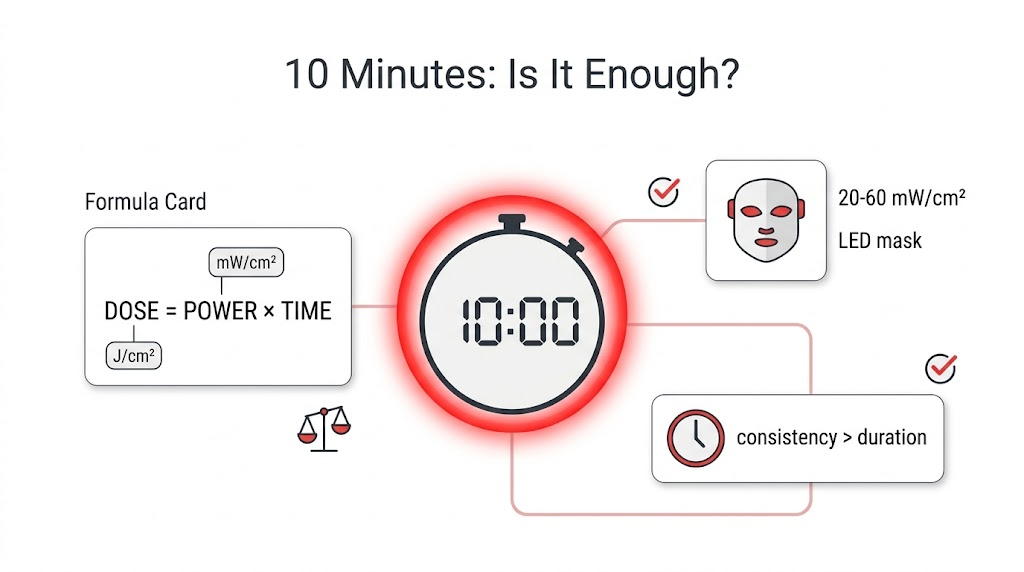
Table of Contents
- 1. What Is Red Light Therapy?
- 2. Is 10 Minutes Enough?
- 3. Why Short Sessions Can Be Effective
- 4. The 5 Factors That Affect Session Duration
- 5. The Dose Math: 10 Minutes × Your Device
- 6. Benefits of Consistent 10-Minute Sessions
- 7. Tips to Maximize Short Sessions
- 8. Choosing a Reliable Device
- 9. FAQ About Session Length
- 10. Partner With Rainbow Technology
- 11. References
1. What Is Red Light Therapy?
Red light therapy (RLT), sometimes called photobiomodulation, uses visible red and near-infrared wavelengths — typically red 630–660 nm and near-infrared 810–850 nm — to interact with skin and tissue.
Unlike UV light, these wavelengths are non-ionizing and don’t rely on heat or damage. Instead, they support cellular energy processes linked to skin renewal and recovery[2]. Many people incorporate red light therapy into routines focused on:
- Supporting skin appearance
- Promoting relaxation
- Helping with post-workout recovery
- Maintaining overall wellness habits
2. Is 10 Minutes of Red Light Therapy Enough?
In many cases, yes — 10 minutes can be sufficient. Shorter sessions are often recommended for beginners and for regular maintenance routines. The key factor isn’t just duration but consistent use over time.
Cells respond to light exposure within minutes — the biological signal cascade starts quickly[2] — which means longer sessions don’t always translate into better results. For the full timing logic, including the biphasic dose curve, see our comprehensive session duration guide.
3. Why Short Sessions Can Be Effective
1. Consistency Matters More Than Length
Regular sessions — even brief ones — are often easier to maintain. Many users find that 10-minute treatments fit naturally into daily routines.
2. Balanced Exposure
Red light therapy follows a biphasic dose response: moderate exposure provides better outcomes than excessive use, which can blunt the benefit[1]. In other words — more isn’t automatically better.
3. Device Strength Influences Timing
Higher-output devices may require shorter sessions, while lower-intensity wearable masks may recommend slightly longer exposure times. That’s why the answer to “is 10 minutes enough” is always device-dependent.
4. The 5 Factors That Affect Session Duration
| Factor | How It Influences Session Time |
|---|---|
| Treatment Goal | Skin routines often use shorter sessions than body treatments |
| Device Irradiance | Higher power may reduce required exposure time |
| Wavelength Range | Near-infrared light penetrates deeper into tissue |
| Distance From Device | Closer positioning increases intensity — see our distance guide |
| Personal Sensitivity | Beginners may prefer shorter sessions first |
Because of these variables, following device guidelines is always recommended.
5. The Dose Math: 10 Minutes × Your Device
“Enough” is a physics question. The dose your tissue receives is:
Worked example for a 10-minute session (600 seconds) with typical contact-mask outputs:
| Device Type | Typical Irradiance | Dose in 10 Minutes | Verdict for 10 Min |
|---|---|---|---|
| Low-output contact mask | ~20 mW/cm² | ~12 J/cm² | Marginal — consider 15–20 min |
| Mid-output contact mask | ~40 mW/cm² | ~24 J/cm² | Likely sufficient |
| Higher-output panel (at distance) | 50–120 mW/cm² | 30–72 J/cm² | Sufficient — often 5–10 min is enough |
The catch: these numbers only hold if the device actually delivers the claimed irradiance at the distance you use it. Cheap devices overstate output on paper — which is exactly why device choice matters more than session length.
6. Benefits of Consistent 10-Minute Sessions
When used regularly, short sessions may help support:
- A more balanced-looking complexion
- Relaxation and stress reduction
- Post-exercise recovery routines
- A simple, sustainable wellness habit
Many users report gradual changes over several weeks rather than immediate dramatic results[3]. For what to expect week by week, see our results timeline guide.
7. Tips to Make the Most of a 10-Minute Routine
- Start with clean, product-free skin when using facial devices — see our pre-treatment prep guide.
- Position yourself at the recommended distance from the light source.
- Keep sessions consistent — often several times per week.
- Avoid extending sessions unnecessarily — the biphasic curve says moderation wins[1].
- Follow manufacturer instructions for timing and safety.
Creating a calm environment during treatment can also make sessions feel more enjoyable and easier to maintain long term.
8. Choosing a Reliable Red Light Therapy Device
The quality of your device can influence how effective shorter sessions feel. When comparing devices, consider:
- Stable wavelength output — verified by spectrometer per batch
- Comfortable ergonomic design
- Adjustable timers or intensity settings
- Even light distribution across the treatment area
- Irradiance stated at working distance, not just chip rating
Selecting a well-designed device helps ensure a more predictable routine.
9. FAQ About Session Length
Q: Can I do more than one session per day?
A: Many guidelines suggest starting with once-daily or several weekly sessions to avoid overuse. The dose-response curve favors moderation[1].
Q: How soon will results appear?
A: Changes are typically gradual, with many users noticing improvements after several weeks of consistent use[3].
Q: Are longer sessions better?
A: Not necessarily. More time under the light doesn’t always mean stronger results — especially if device power is already sufficient. Beyond the effective dose window, benefit can plateau or decline[1].
10. Partner With Rainbow Technology
“Is 10 minutes enough?” is really a question about delivered dose — and that’s decided at the factory. At Rainbow, we build devices whose output matches the spec sheet:
- Wavelength precision: Verified 630–660 nm red and 810–850 nm NIR channels, checked by spectrometer per batch.
- Irradiance honesty: Output specified at actual working distance — not just LED chip rating.
- Built-in timing: Adjustable timers so sessions stay inside the effective dose window.
- Compliance: CE, RoHS, FCC, KC; IEC 62471 photobiological safety; ISO 13485 + MDSAP QMS; FDA registration compliance documentation.
- OEM/ODM for global brands: Consult our engineering team; reference designs on our product lineup page.
Request your custom quote today.
11. References
[1] Huang YY, Sharma SK, Carroll J, Hamblin MR.
Biphasic dose response in low level light therapy — an update. Dose-Response. 2011;9(4):602-618.
[2] Hamblin MR.
Mechanisms and applications of the anti-inflammatory effects of photobiomodulation. AIMS Biophysics. 2017;4(3):337-361.
[3] Wunsch A, Matuschka K.
A controlled trial to determine the efficacy of red and near-infrared light treatment in patient satisfaction, reduction of fine lines, wrinkles, skin roughness, and intradermal collagen density increase. Photomedicine and Laser Surgery. 2014;32(2):93-100.

