
LED Mask vs Panel: Which Red Light Therapy Device is Right for You?
30-Second Summary:
“Which is better, an LED mask or a panel?” is the wrong question. The right question is “which area do you want to treat, and does the device meet clinical specs?” Masks win for face-focused, portable, multitasking sessions; panels win for full-body coverage, joints, muscles, and higher irradiance at a distance. Both can deliver effective doses — and both can fail to, if the LEDs, wavelength verification, and irradiance are cheap. This guide compares five dimensions without the marketing bias, so you can pick the form factor that fits your goals.
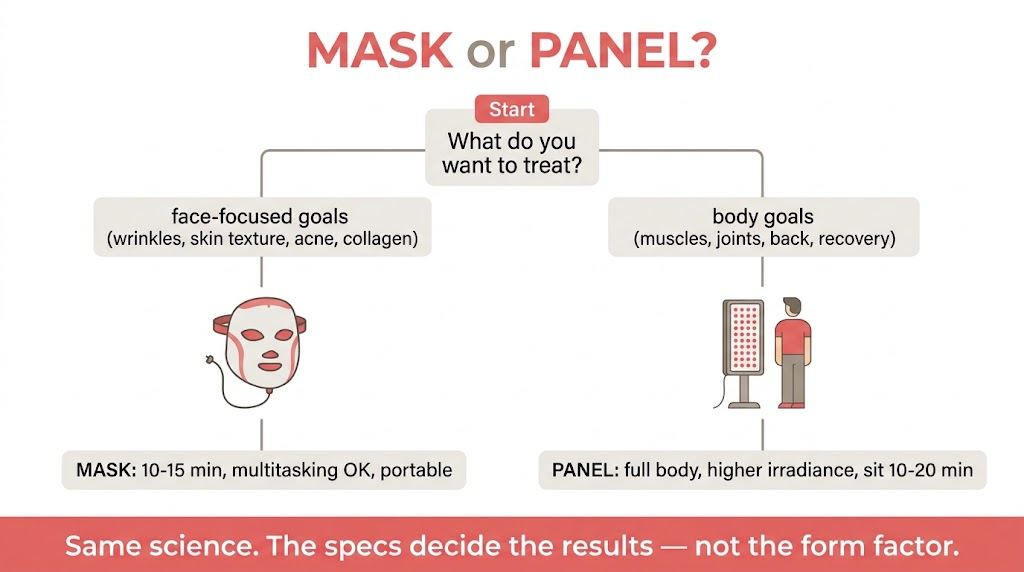
Table of Contents
- 1. Treatment Versatility
- 2. Wavelengths & Treatment Modes
- 3. Comfort & Fit
- 4. Power & Dosage: The Real Difference
- 5. Ease of Use & Lifestyle Fit
- 6. The Honest Verdict
- 7. Partner With Rainbow Technology
- 8. References
1. Treatment Versatility
- LED masks: Designed for facial use, masks fit close to the skin and contour to facial curves. They focus energy on the face — but a rigid mask is limited to the face, excluding neck and chest unless the design specifically extends there.
- LED panels: Freestanding panels cover a larger area and can treat the back, shoulders, joints, and full body by positioning. Some flexible panel designs can also drape around the face, neck, and chest.
If your goals are head-to-toe — pain relief, muscle recovery, hair growth — a panel (or flexible panel) is the practical choice. If your goals are facial, a mask is more efficient. See our mask vs panel buying guide for the full side-by-side.
2. Wavelengths & Treatment Modes
- LED masks: Entry-level masks may offer only red (630–660 nm) or red + blue. Higher-end masks — including medical-grade silicone designs — offer multiple wavelengths (red, blue, NIR 810–850 nm) with selectable modes[4].
- LED panels: Panels commonly deliver red + NIR (and sometimes blue), giving a broader therapeutic range for skin, muscle, and joint applications. NIR is the workhorse for deep tissue[3].
The pattern “masks = fewer wavelengths” is a price-tier pattern, not a physics law. Verify the actual wavelength list and irradiance of the specific model — see our NIR wavelength guide for how to compare.
3. Comfort & Fit
- LED masks: Fit varies a lot by design. A rigid plastic mask can feel heavy and press on the face; a medical-grade silicone mask is lightweight, flexible, and sits closer to the skin. Eye and mouth cutouts can reduce coverage on those areas — a trade-off for usability.
- LED panels: No contact, no pressure, better airflow. You sit or stand at a set distance; light distribution is even across the treated area.
“Comfort” is a design quality, not a category trait. A well-made mask is more comfortable than a cheap panel — and vice versa.
4. Power & Dosage: The Real Difference
This is where the honest engineering matters. The two form factors are designed for different working distances:
| Working Distance | Irradiance Needed | Typical Session | |
|---|---|---|---|
| LED mask | 0–2 cm (skin contact) | Lower — light doesn’t travel far, so less power density is needed to reach the therapeutic window (≈3–15 J/cm² at tissue) | 10–15 min |
| LED panel | 10–60 cm (distance) | Higher — irradiance falls with the square of distance, so panels need higher raw output to deliver the same dose | 10–20 min at correct distance |
The claim that “masks have subpar power” confuses raw output with delivered dose. A close-contact mask at 20–40 mW/cm² can deliver the same dose as a panel at 100+ mW/cm² from 30 cm away — if both are engineered honestly. Subpar results come from cheap LEDs, unverified wavelengths, and exaggerated spec sheets — not from the form factor. Always ask for irradiance measured at the actual working distance[1].
What the clinical literature actually shows: home-use LED devices with proper parameters produce measurable results — collagen density and wrinkle improvement with red light[2], acne improvement with blue + red masks[4], and muscle recovery benefits with NIR at 830 nm[3]. The dose-response is real[5] — which is why specs beat form factor.
5. Ease of Use & Lifestyle Fit
- LED masks: Hands-free on the face — great for multitasking (watching TV, reading, working) and travel. Easy 10–15 minute sessions.
- LED panels: Hands-free in a different way — you position yourself before the panel and sit or stand for the session. Better for routines you can schedule, like morning or evening “light baths.”
6. The Honest Verdict
Choosing between an LED mask and a panel depends on your goals and lifestyle:
- Choose a mask for targeted facial treatments — wrinkles, skin texture, acne, collagen — with convenience and portability. High-end silicone masks match clinical parameters for facial photobiomodulation[2][4].
- Choose a panel for full-body therapy — muscles, joints, back, recovery, and hair — where NIR depth penetration and larger coverage matter[3].
- Many users end up with both — a mask for daily facial care and a panel for weekly full-body recovery. That’s a legitimate setup, not overkill.
Whichever you choose, the non-negotiables are the same: verified wavelengths, honest irradiance specs, certifications, and a manufacturer with documented QC[1]. Our buyer’s checklist walks through each spec.
7. Partner With Rainbow Technology
Ready to elevate your skincare and wellness lineup? Here’s the advantage of sourcing from a factory that makes both form factors:
- Masks and panels from one supplier — launch one product line now, add the other later without requalifying a factory.
- Verified 630–660 nm red, 415 nm blue, 810–850 nm NIR channels; irradiance measured at the actual working distance, checked by spectrometer per batch.
- Full CE, RoHS, FCC, KC certificates, ISO 13485 + MDSAP certified QMS, and FDA registration compliance documentation.
- OEM/ODM from concept to certification. Consult our engineering team; reference designs on our product lineup page.
Request your custom quote today.
8. References
[1] Jagdeo J, Austin E, Mamalis A, et al.
Light-emitting diodes in dermatology: a systematic review of randomized controlled trials. Lasers in Surgery and Medicine. 2018;50(6):613-628.
[2] Wunsch A, Matuschka K.
A controlled trial to determine the efficacy of red and near-infrared light treatment in patient satisfaction, reduction of fine lines, wrinkles, skin roughness, and intradermal collagen density increase. Photomedicine and Laser Surgery. 2014;32(2):93-100.
[3] Leal Junior EC, Lopes-Martins RA, Baroni BM, et al.
Effect of 830 nm low-level laser therapy applied before high-intensity exercises on skeletal muscle recovery in athletes. Lasers in Medical Science. 2009;24(6):857-863.
[4] Kwon HH, Lee SK, Choi YS, et al.
Combined 420-nm blue and 660-nm red light-emitting diode phototherapy shows significant improvement in acne vulgaris: a randomized, double-blind, sham-controlled trial. British Journal of Dermatology. 2013;168(6):1288-1294.
[5] Hamblin MR.
Mechanisms and applications of the anti-inflammatory effects of photobiomodulation. AIMS Biophysics. 2017;4(3):337-361.

