Red Light Mask or Panel: Which One Is Right for You?
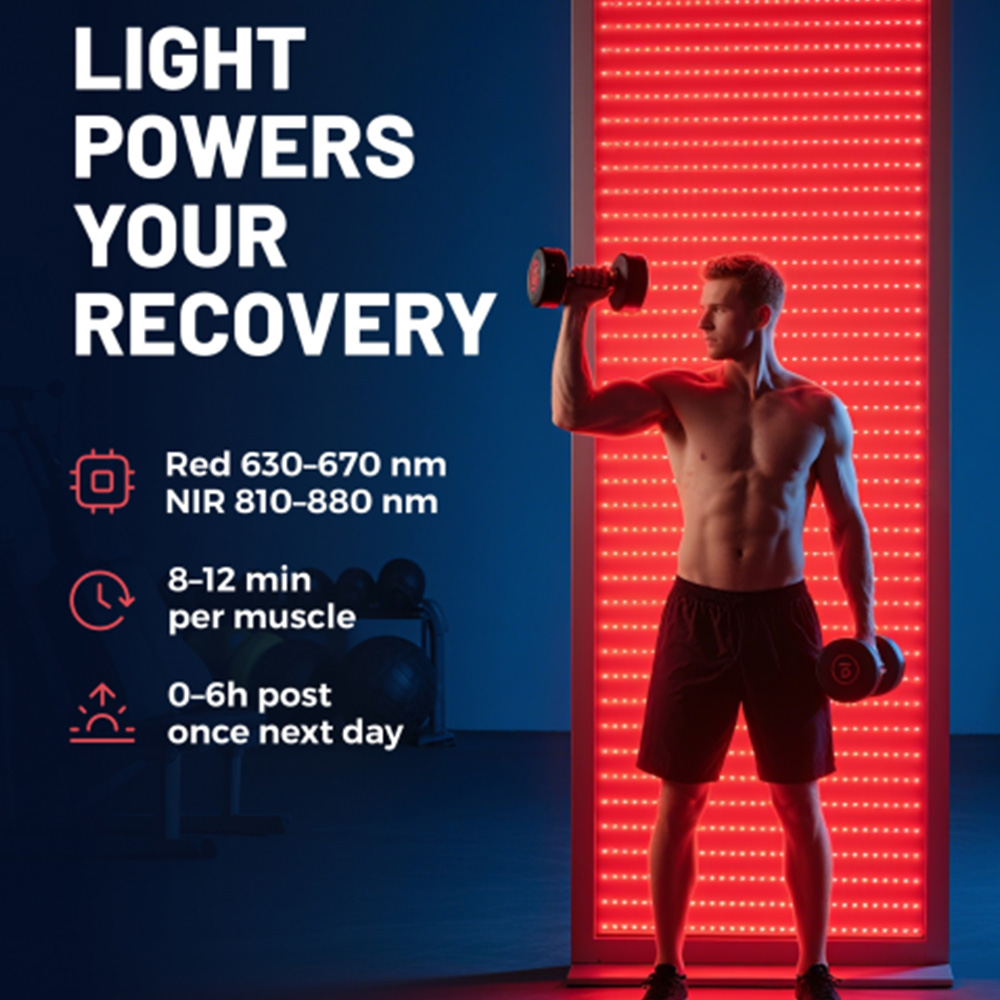
A red light mask is the right choice if your goal is facial skin — wrinkles, texture, and everyday convenience (you can wear it while reading). A red light panel is the right choice if you want whole-body coverage, deeper tissue penetration, and faster sessions — it delivers higher irradiance over larger areas, which matters for muscles, joints, and recovery[3]. Many people start with a mask and add a panel later. The deciding factors are coverage, irradiance, and lifestyle — not which one is “better.”
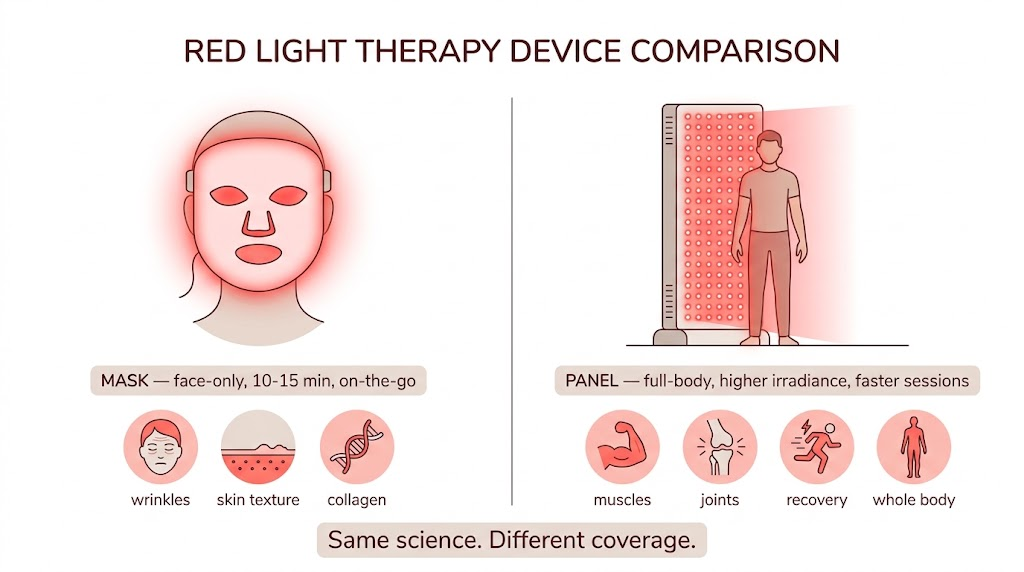
Table of Contents
- 1. What Is a Red Light Mask?
- 2. What Is a Red Light Panel?
- 3. Mask vs Panel: Side-by-Side
- 4. Which Should You Choose?
- 5. Can You Use Both?
- 6. What to Check Before You Buy
- 7. Partner With Rainbow Technology
- 8. References
1. What Is a Red Light Mask?
A red light mask is a wearable device shaped to fit the face, lined with LED chips that emit clinically studied wavelengths — typically red light (around 633–660 nm), sometimes paired with near-infrared (830 nm) and blue light (415 nm for acne). The light stimulates collagen-producing fibroblasts and reduces inflammation in the skin, supporting anti-aging outcomes documented in randomized trials[1][2]. A well-designed mask delivers full-face coverage with uniform light distribution, making it ideal for daily 10–15 minute anti-aging sessions.
Benefits of Red Light Masks:
- Targeted facial treatment for wrinkles, redness, and uneven texture
- Portable and easy to use anywhere — including while reading or traveling
- User-friendly with adjustable straps and built-in timers
- Regulatory compliance documentation (FDA registration / CE / ISO 13485) available from reputable manufacturers
2. What Is a Red Light Panel?
Red light panels are larger, freestanding devices designed to cover broad areas — arms, chest, back, legs. They emit higher irradiance than most masks, which means a therapeutic dose arrives faster and penetrates deeper into muscles, joints, and connective tissue. Near-infrared (NIR, around 830 nm) penetrates deepest — which is why panel protocols for muscle recovery and joint comfort typically use red + NIR together[3][4].
Advantages of Red Light Panels:
- Faster treatment times with larger coverage
- Deeper tissue penetration for recovery and muscle comfort support
- Suitable for full-body skin tone and texture improvement
- Durable, clinical-grade construction with published irradiance curves from reputable manufacturers
3. Mask vs Panel: Side-by-Side
| Factor | Red Light Mask | Red Light Panel |
|---|---|---|
| Coverage | Face only | Whole body (you stand/sit in front) |
| Irradiance | Lower (designed for facial dose over 10–15 min) | Higher (therapeutic dose in 5–10 min) |
| Penetration | Skin-level (epidermis/dermis) | Deeper with NIR — muscles, joints, connective tissue[3] |
| Best for | Wrinkles, skin texture, anti-aging routines[2] | Recovery, full-body skin health, joint/muscle comfort[4] |
| Usability | Hands-free, wearable, portable | Stationary; you position yourself in front |
| Typical session | 10–15 minutes, daily | 5–10 minutes per body area, 3–5×/week |
| Price range (typical retail) | $150–$600 | $300–$2,000+ |
4. Which Should You Choose?
Choose a red light mask if: your primary goal is facial skin care — wrinkles, texture, redness — with minimal setup and consistent daily use. Masks provide uniform light distribution and integrate easily into a skincare routine. See our guide to what makes a good red light mask.
Choose a red light panel if: you want efficient full-body treatment, faster sessions, and deeper therapeutic effects for muscles and joints. Panels excel at delivering high irradiance over larger areas[3][4].
Undecided? Start with the one that matches your #1 goal. If that’s facial anti-aging, a mask is the lower-cost, lower-commitment entry point. If you also train, have body aches, or want whole-body skin benefits, a panel covers more ground per session.
5. Can You Use Both?
Yes — and many users do. A common setup is a panel for full-body sessions (3–5×/week) plus a mask for daily facial convenience, especially on days when a full-body session isn’t practical. There’s no known downside to combining formats, provided each device is used within its intended dose window. For session timing guidance, see our duration guide.
6. What to Check Before You Buy
- Clinically supported wavelengths. Red 630–660 nm for skin; NIR 810–850 nm for deeper tissue. Verify the published wavelength spec — cheap devices often drift or omit it.
- Uniform LED spacing and irradiance. A face mask with uneven chip density creates hot and cold spots. Panels should publish irradiance (mW/cm²) at a stated distance.
- Compliance documentation. Look for FDA registration, CE marking, and ISO 13485 manufacturing certification — not just marketing claims.
- Safety basics. Review our safety primer and pre-session prep guide before starting.
7. Partner With Rainbow Technology
Whether you’re launching a mask, a panel, or both, the engineering decisions above — wavelength accuracy, uniform irradiance, compliance — are exactly what Rainbow Technology builds into every unit at our Shenzhen facility. We manufacture both formats, so you can scale one product line or two:
- Custom facial masks and full-body panels — red (633/660 nm), NIR (830 nm), and blue (415 nm) configurations.
- Lab-verified wavelength and irradiance curves per device — measured, not estimated.
- Full ISO 13485, CE, and FDA registration compliance documentation for your target markets.
- Sample testing and small-batch production (500–1,000 units) for new brand launches.
Explore our product lineup for reference architectures, or contact our R&D engineering team to spec your project.
8. References
[1] Jagdeo J, Austin E, Mamalis A, et al.
Light-emitting diodes in dermatology: a systematic review of randomized controlled trials. Lasers in Surgery and Medicine. 2018;50(6):613-628.
[2] Wunsch A, Matuschka K.
A controlled trial to determine the efficacy of red and near-infrared light treatment in patient satisfaction, reduction of fine lines, wrinkles, skin roughness, and intradermal collagen density increase. Photomedicine and Laser Surgery. 2014;32(2):93-100.
[3] Leal Junior ECP, Lopes-Martins RAB, Baroni BM, et al.
Effect of 830 nm low-level laser therapy applied before high-intensity exercises on skeletal muscle recovery in athletes. Lasers in Medical Science. 2009;24(6):857-863.
[4] Ferraresi C, Huang YY, Hamblin MR.
Photobiomodulation in human muscle tissue: an advantage in sports performance? Journal of Biophotonics. 2016;9(11-12):1273-1299.

