
Do You Have to Wear Goggles for Red Light Therapy?
30-Second Summary:
Red light alone (630–660 nm) is generally safe for the eyes without goggles. LED sources are non-coherent and carry a far lower retinal hazard than lasers under the ICNIRP 2013 exposure limits[1]. Near-infrared (NIR, 810–850 nm) reaches deeper and, when you’re close to a bright panel or inside its beam window, protective goggles are the safer choice. If you keep a distance of about 2 feet (60 cm) or more with eyes closed, exposure typically falls well below the limits. When in doubt — or if you have eye conditions or take photosensitizing medication — wear the goggles your device ships with and consult your doctor.
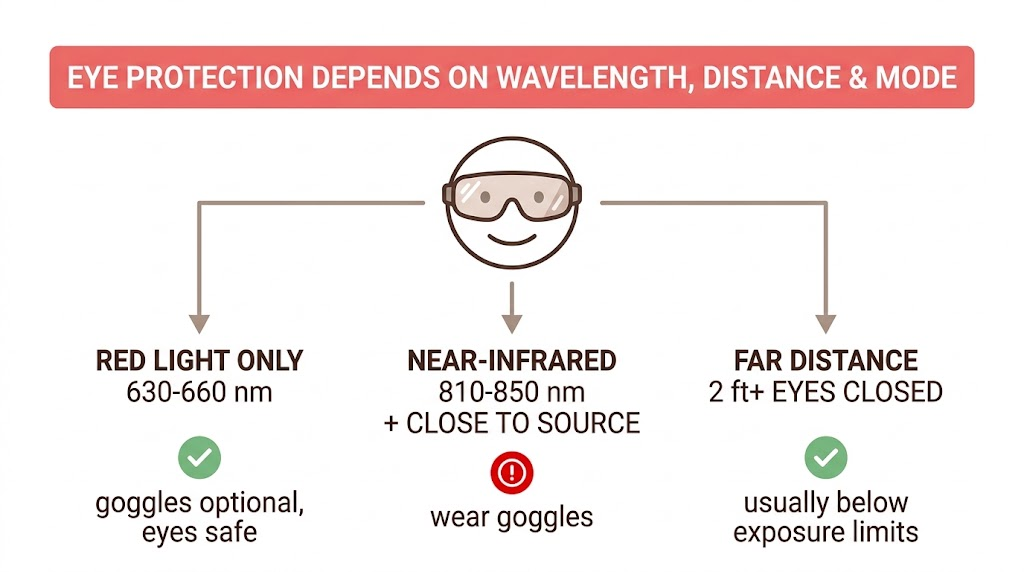
Table of Contents
- 1. Why Eye Protection Comes Up
- 2. When Goggles Are Optional
- 3. When Goggles Are Recommended
- 4. Best Practices for Eye Safety
- 5. The Safety Standard Behind This
- 6. Partner With Rainbow Technology
- 7. References
1. Why Eye Protection Comes Up
Red and near-infrared (NIR) light are non-ionizing and non-UV — unlike tanning beds or welding arcs, they don’t carry the DNA-damaging risk of ultraviolet radiation. But any bright optical source can stress the eyes if you stare into the beam at close range for a long time. The responsible question isn’t “is it UV?” but “do I exceed the applicable eye-exposure limits for this wavelength and distance?” That’s exactly what international guidelines are built to answer[1].
2. When Goggles Are Optional
- Red light only (around 660 nm). Red LEDs are non-UV and non-coherent; under the ICNIRP 2013 limits, standard consumer red-light devices operate well below the retinal exposure thresholds, so eyewear is generally not required[1].
- At a safe distance. Keeping roughly two feet (about 60 cm) or more from the device, with eyes closed or looking away, drops the dose at the eye far below the limits — this is the practical rule most whole-body panel users follow.
- Indirect viewing. Simply not staring into the emitter and letting your eyelids do the filtering is sufficient for low-irradiance sessions.
3. When Goggles Are Recommended
- NIR modes (810–850 nm). Near-infrared penetrates deeper than red and is invisible — so your eyes get no “too bright” warning. When you’re within the device’s beam window (directly in front of the emitter at the recommended distance), protective goggles are the conservative, recommended choice.
- High-intensity or close-up use. The closer you are and the higher the irradiance, the more goggles matter. If a session keeps your eyes inside the bright beam, wear them.
- Eye conditions or photosensitizing medication. If you have a retinal condition, light sensitivity, or take photosensitizing drugs, wear goggles and check with your healthcare provider first.
4. Best Practices for Eye Safety
- Wear protective goggles whenever using NIR, especially close to the source or inside the beam window.
- Never stare directly into the emitter — look away or close your eyes.
- Keep a safe distance (about 18–24 inches / 45–60 cm or more) if you prefer going without goggles.
- Consult a provider if you have eye conditions, light sensitivity, or take photosensitizing medication.
- Use compliance-grade devices and goggles specified to the relevant eye-safety limits (ICNIRP / IEC), with FDA registration, CE, and ISO 13485 documentation.
5. The Safety Standard Behind This
The ICNIRP 2013 guidelines on limits of exposure to incoherent visible and infrared radiation are the international reference for LED eye safety[1]. Two points matter for consumers:
- LEDs are incoherent, not lasers. Because their radiance (brightness) is far lower than a laser’s, standard LEDs are not expected to create a retinal thermal hazard at normal use distances[1].
- The blue-light retinal limit doesn’t apply to red/NIR. The photochemical retinal hazard function peaks in the blue (around 440 nm) and falls off sharply by 550 nm — red and NIR carry little of that risk.
Bottom line: most red-light-only, distance-respecting use is safe without goggles; NIR close-up is where protection earns its place. For the broader picture, see our red light therapy safety primer.
6. Partner With Rainbow Technology
Eye safety isn’t an afterthought in our engineering — it’s a spec. Rainbow Technology designs every consumer and clinical LED device to sit within the applicable ICNIRP / IEC eye-exposure limits, and we supply properly rated protective eyewear with NIR-capable units:
- Emitters specified and measured against ICNIRP / IEC eye-safety limits at the intended use distance.
- Protective goggles rated for the device’s red + NIR wavelengths, supplied where the mode warrants it.
- Full ISO 13485, CE, and FDA registration compliance documentation for your target markets.
- Sample testing and small-batch production (500–1,000 units) for new brand launches.
Explore our product lineup, or contact our R&D engineering team to discuss eye-safety specifications for your project.
7. References
[1] International Commission on Non-Ionizing Radiation Protection (ICNIRP).
Guidelines on limits of exposure to incoherent visible and infrared radiation. Health Physics. 2013;105(1):74-96.

