
What Are the Disadvantages of a LED Mask? (And How to Choose Quality for Your Business)
The disadvantages of an LED mask are not in the technology — they’re in how cheap devices are built. The five that matter for B2B buyers: ① eye-safety shortcuts, ② wavelength drift, ③ hotspots and uneven irradiance, ④ poor durability, ⑤ missing contraindication guidance. Each one is a reputation and liability risk when you stock or recommend devices. The fix is a spec-based sourcing checklist — not a bigger marketing budget. This guide turns each disadvantage into a procurement requirement.
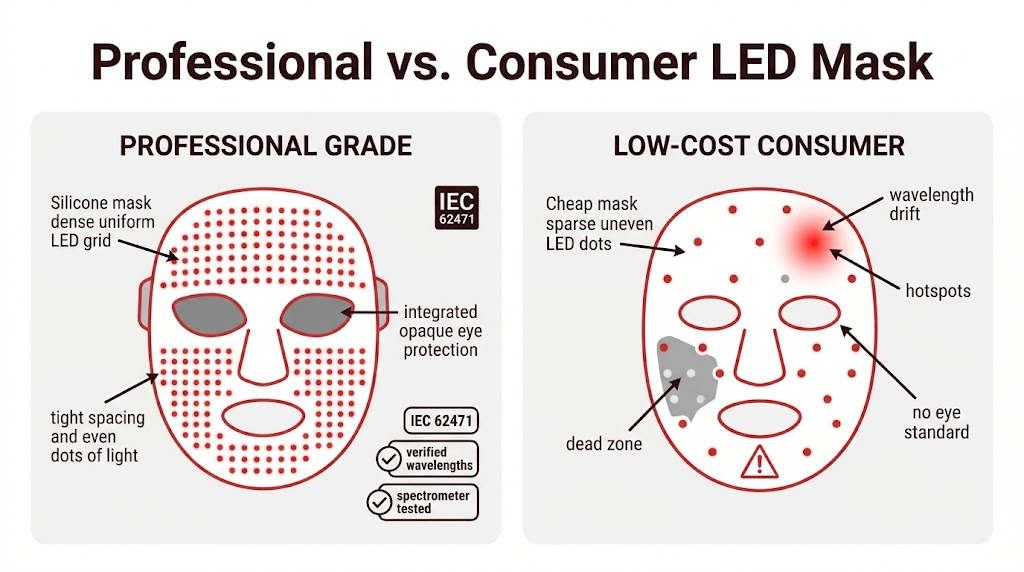
Table of Contents
- 1. Safety & Liability: The Eye Strain Issue
- 2. Inconsistent Wavelengths = Inconsistent Results
- 3. Hotspots & Poor Power Density
- 4. Durability & ROI
- 5. Lack of Contraindication Education
- 6. Turning Disadvantages Into a Competitive Advantage
- 7. Partner With Rainbow Technology
- 8. References
1. Safety & Liability: The Eye Strain Issue
- The risk: Many consumer masks rely on simple cutouts without opaque goggles. This can lead to eye fatigue or, with high-irradiance devices, retinal stress. Photobiological exposure limits for visible and infrared light exist for a reason[2].
- The business impact: For a clinic or spa, this is a liability. Selling or using a device that causes eye discomfort can lead to bad reviews and potential safety disputes.
- The solution: Only source devices that meet photobiological safety standards (like IEC 62471) and come with integrated, medical-grade eye protection. See our eye safety guide for the full breakdown.
2. Inconsistent Wavelengths = Inconsistent Results
- The science: Effective skin treatments rely on precise red light (typically 630–660 nm) and near-infrared (usually 810–850 nm). Cheap LEDs drift in spectrum — a “red” chip may actually emit 620 nm or 650 nm — shifting outside the absorption window of the target chromophores and reducing penetration[1].
- The business impact: If your clients use a mask for weeks and see no change, they lose trust in your product selection. High return rates and churn are costly.
- The solution: Ask suppliers for the wavelength spec and batch-level verification (spectrometer data). A spec sheet without testing is a promise, not a guarantee.
3. Hotspots & Poor Power Density
- The problem: Many consumer masks have fewer LEDs spaced far apart. This creates hotspots — areas of concentrated heat — and dead zones where no effective treatment occurs.
- The disadvantage: Uneven irradiance means uneven results. In heat-sensitive or melasma-prone skin, poorly managed heat can worsen pigmentation — a real clinical concern, not a theoretical one.
- Pro tip: Look for high-density arrangements that offer uniform coverage. And treat “power density” claims with suspicion until you know the measurement distance — see our irradiance inflation explainer.
4. Durability & ROI
- The reality: Standard consumer LED masks often use cheaper wiring and plastic that degrades after a few months of daily use.
- The disadvantage: Frequent replacements kill your profit margins and erode client confidence.
- The solution: Invest in professional-grade silicone or rigid polycarbonate masks designed for thousands of hours of use. A higher upfront cost often yields a better long-term ROI.
5. Lack of Contraindication Education
- The issue: Certain medications (e.g., photosensitizing drugs such as isotretinoin) and conditions (e.g., epilepsy) require caution with light therapy. Retail masks often lack detailed safety protocols, leaving the user to guess.
- The disadvantage: Misuse — especially with photosensitizing medication — can cause reactions that the retailer ends up answering for.
- Your opportunity: As a professional supplier, differentiate by providing comprehensive user guides, training, or consultations alongside the device. This is a service moat that cheap listings can’t copy.
6. Turning Disadvantages Into a Competitive Advantage
So what are the disadvantages of an LED mask? They mostly boil down to poor quality control, missing safety features, and weak performance in generic devices. For B2B buyers, the takeaway is clear: don’t compete on price — compete on quality.
The five disadvantages above map directly onto a five-point sourcing checklist: ① IEC 62471 photobiological safety + integrated eye protection, ② verified wavelengths with batch spectrometer data, ③ uniform LED density with irradiance measured at working distance, ④ medical-grade materials rated for thousands of hours, ⑤ contraindication guidance and training support. Our buyer’s checklist walks through each spec in detail.
7. Partner With Rainbow Technology
Looking for professional-grade LED solutions? Here’s what a factory-built-for-quality partner looks like:
- Masks engineered to IEC 62471 photobiological safety with integrated eye protection — verified per batch.
- Wavelength-matched 630–660 nm red, 415 nm blue, 810–850 nm NIR channels, checked by spectrometer per batch; irradiance measured at the actual working distance[3].
- Full CE, RoHS, FCC, KC certificates, ISO 13485 + MDSAP certified QMS, and FDA registration compliance documentation.
- OEM/ODM from concept to certification, including user guides and compliance support for your market. Consult our engineering team; reference designs on our product lineup page.
Request your custom quote today.
8. References
[1] Jagdeo J, Austin E, Mamalis A, et al.
Light-emitting diodes in dermatology: a systematic review of randomized controlled trials. Lasers in Surgery and Medicine. 2018;50(6):613-628.
[2] ICNIRP.
ICNIRP guidelines on limits of exposure to incoherent visible and infrared radiation. Health Physics. 2013;105(1):74-96.
[3] Hamblin MR.
Mechanisms and applications of the anti-inflammatory effects of photobiomodulation. AIMS Biophysics. 2017;4(3):337-361.
[4] Huang YY, Sharma SK, Carroll J, Hamblin MR.
Biphasic dose response in low level light therapy — an update. Dose-Response. 2011;9(4):602-618.

