
What Do Dermatologists Think of Red Light Therapy? Science, Safety, and Expert Perspectives
Most dermatologists view red light therapy as a promising supportive treatment — not a miracle cure. Peer-reviewed dermatology literature positions LED therapy as a complementary tool: collagen support for anti-aging, blue+red light for blemish-prone skin, and post-procedure recovery aid. Experts stress realistic expectations, consistent use, and device quality — and note that at-home masks deliver lower intensity than clinical equipment. This guide summarizes what the dermatology literature actually supports, what it doesn’t, and how to use devices safely.
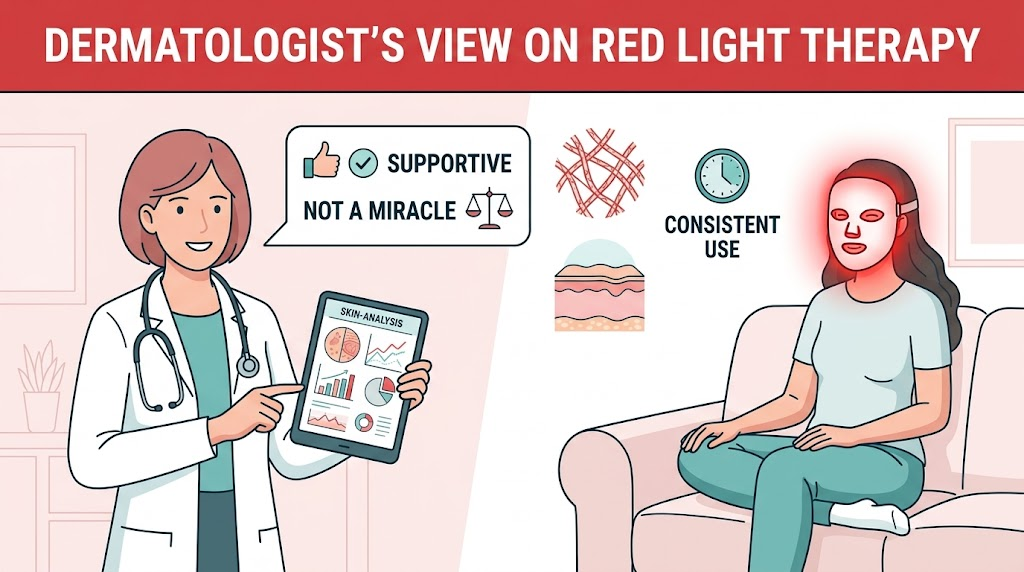
Table of Contents
- 1. What Is Red Light Therapy?
- 2. Do Dermatologists Recommend It?
- 3. Benefits Dermatologists Often Discuss
- 4. Safety and Limitations
- 5. At-Home Devices vs. Clinic Treatments
- 6. How to Use Red Light Therapy Safely
- 7. So, What Do Dermatologists Really Think?
- 8. Partner With Rainbow Technology
- 9. References
1. What Is Red Light Therapy?
Red light therapy (RLT), sometimes called photobiomodulation or low-level light therapy, uses visible red and near-infrared wavelengths — typically red 630–660 nm and near-infrared 810–850 nm — to interact with the skin.
Unlike UV radiation, which damages skin cells, red light is non-ionizing and doesn’t rely on heat or burning effects. Research suggests these wavelengths support cellular processes related to energy production and repair[5]. Dermatology discussions often mention that red light exposure may:
- Support collagen-related activity
- Improve the appearance of skin texture
- Help reduce the look of redness or irritation
- Promote overall skin vitality
Most dermatologists emphasize that results vary and should be viewed as gradual improvements rather than dramatic transformations.
2. Do Dermatologists Recommend It?
Many dermatologists see red light therapy as a supportive cosmetic treatment, especially when used alongside established skincare practices. A systematic review of randomized controlled trials published by dermatology researchers in Lasers in Surgery and Medicine found LED therapy useful for conditions including acne, herpes lesions, and acute wound healing, and recommended it for clinical use[1].
Rather than positioning it as a standalone solution, professionals often describe red light therapy as:
- A complementary treatment
- A maintenance tool for skin appearance
- A gentle option for certain cosmetic concerns
Dermatologists generally agree the technology shows promise, but they also stress realistic expectations and consistent use[1].
3. Benefits Dermatologists Often Discuss
1. Supporting Skin Appearance and Anti-Aging Routines
Red light therapy is frequently associated with collagen-supporting processes. Because collagen naturally declines with age, treatments that encourage skin renewal are often explored in anti-aging routines. In a controlled trial of 136 participants, red and near-infrared treatment significantly increased intradermal collagen density and reduced fine lines and wrinkles over 12 weeks[2]. See our tightening evidence guide for the honest version of these claims.
2. Acne and Redness Management
When combined with blue light, red light is sometimes used for blemish-prone skin. Blue light targets bacteria on the skin surface; red light helps calm visible inflammation. In a randomized trial, combined blue+red light reduced inflammatory acne lesions by 76% — better than blue light alone (60%) or benzoyl peroxide (58%), with zero side effects reported in the light group[3]. Dermatologists emphasize light therapy works best as part of a broader acne strategy, not a replacement for medical treatment. See our acne evidence review.
3. Supporting Recovery After Cosmetic Procedures
In clinical settings, LED therapy is sometimes used after treatments such as microneedling or laser procedures to support recovery and reduce the appearance of post-procedure redness — an application highlighted in the dermatology LED literature[1].
4. Emerging Interest in Hair and Scalp Care
Some dermatologists are exploring red light for scalp treatments related to hair density. While research is ongoing, early findings suggest it may support circulation around hair follicles[4]. Treat this as an emerging area, not an established claim.
4. Safety and Limitations
Safety Considerations
- Red light therapy is non-invasive and typically painless.
- Mild redness or dryness may occur in sensitive individuals.
- Eye protection is often recommended due to brightness, even though the light itself is not UV. See our eye safety guide.
Limitations to Keep in Mind
- Results vary widely between individuals.
- At-home devices usually operate at lower intensity than clinical equipment.
- Red light therapy does not replace sunscreen, skincare, or professional treatments for serious skin conditions.
Many dermatologists suggest consulting a professional before starting light therapy, especially for people with medical skin concerns.
5. At-Home Devices vs. Clinic Treatments
The rise of at-home LED masks and panels has made red light therapy more accessible than ever. The difference between the two tiers is mostly dose:
| Factor | At-Home Devices | Clinical Treatments |
|---|---|---|
| Output | Contact masks: ~20–60 mW/cm²; panels: higher at distance | Higher-power equipment, professional dosing |
| Supervision | Self-directed | Supervised by professionals |
| Role | Convenience & routine maintenance | Often combined with other procedures |
| Commitment | Requires consistent long-term use | Scheduled sessions |
Some dermatologists recommend a hybrid approach — occasional in-office sessions supported by at-home maintenance. For choosing between mask and panel formats, see our mask vs panel comparison and the results-focused comparison.
6. How to Use Red Light Therapy Safely
- Begin with clean, product-free skin.
- Follow manufacturer timing recommendations — typically 10–20 minutes per session. See our session duration guide for the dose logic.
- Avoid overuse — more sessions don’t necessarily mean faster results (photobiomodulation follows a biphasic dose response).
- Wear eye protection when needed.
- Maintain daily sun protection and a balanced skincare routine.
7. So, What Do Dermatologists Really Think?
Overall, dermatologists tend to view red light therapy as a promising but supportive tool rather than a miracle treatment. It may help improve the appearance of skin over time, especially when combined with good skincare habits and realistic expectations[1][2].
For those curious about trying LED therapy, consulting a qualified professional can help determine whether it aligns with your specific skin goals.
The key takeaway: experts acknowledge the potential — from supporting skin appearance to helping reduce visible redness — while emphasizing that consistency, device quality, and overall skincare habits play the major role in outcomes.
8. Partner With Rainbow Technology
“Device quality” isn’t vague — it’s measurable. At Rainbow, we engineer masks and panels that match the parameters dermatology research actually used:
- Wavelength precision: Verified 630–660 nm red, 415 nm blue, and 810–850 nm NIR channels, checked by spectrometer per batch.
- Delivered-dose honesty: Irradiance specified at actual working distance — not just chip rating.
- Compliance: CE, RoHS, FCC, KC; IEC 62471 photobiological safety; ISO 13485 + MDSAP QMS; FDA registration compliance documentation.
- OEM/ODM for brands & clinics: Consult our engineering team; reference designs on our product lineup page.
Request your custom quote today.
9. References
[1] Jagdeo J, Austin E, Mamalis A, et al.
Light-emitting diodes in dermatology: a systematic review of randomized controlled trials. Lasers in Surgery and Medicine. 2018;50(6):613-628.
[2] Wunsch A, Matuschka K.
A controlled trial to determine the efficacy of red and near-infrared light treatment in patient satisfaction, reduction of fine lines, wrinkles, skin roughness, and intradermal collagen density increase. Photomedicine and Laser Surgery. 2014;32(2):93-100.
[3] Papageorgiou P, Katsambas A, Chu A.
Phototherapy with blue (415 nm) and red (660 nm) light in the treatment of acne vulgaris. British Journal of Dermatology. 2000;142(5):973-978.
[4] Avci P, Gupta A, Sadasivam M, et al.
Low-level laser (light) therapy (LLLT) in skin: stimulating, healing, restoring. Seminars in Cutaneous Medicine and Surgery. 2013;32(1):41-52.
[5] Hamblin MR.
Mechanisms and applications of the anti-inflammatory effects of photobiomodulation. AIMS Biophysics. 2017;4(3):337-361.

