
Can Red Light Therapy Age Your Skin? The Truth About Red Light Therapy Masks
No — red light therapy is not known to accelerate skin aging when used correctly. The confusion comes from mixing it up with UV radiation, which damages DNA and breaks down collagen. Red and near-infrared light are non-ionizing and UV-free — the physics that drives photoaging simply doesn’t apply. The real cautions are different: overuse can cause temporary redness or dryness, and combining sessions with strong actives can irritate skin. This guide explains the physics, the genuine risks, and a safe-use routine.
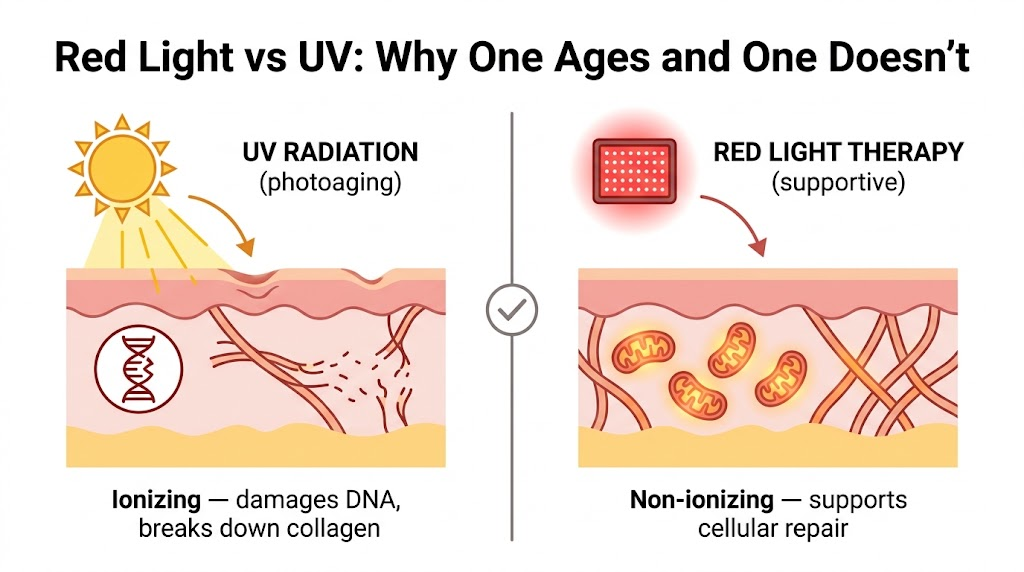
Table of Contents
- 1. What Is Red Light Therapy?
- 2. Can Red Light Therapy Age Your Skin?
- 3. When Could It Cause Problems?
- 4. Why Masks Are Popular for Home Use
- 5. How to Use a Mask Safely
- 6. What Experts and Users Say
- 7. Choosing a Reliable Mask
- 8. Partner With Rainbow Technology
- 9. References
1. What Is Red Light Therapy?
Red light therapy, often called photobiomodulation, uses specific wavelengths of visible red and near-infrared light to interact with the skin. Most cosmetic devices operate in the range of roughly 630–850 nm.
These wavelengths are commonly used in aesthetic treatments because they are associated with:
- Supporting collagen activity
- Improving the appearance of skin tone
- Helping skin look smoother and more balanced
- Supporting overall skin vitality
Unlike UV radiation, red light does not rely on heat or damaging rays to achieve visible effects — which is why it has become widely used in both professional clinics and home devices[1].
2. Can Red Light Therapy Age Your Skin?
In general, no — red light therapy is not known to accelerate skin aging when used correctly.
One of the biggest misconceptions comes from confusing red light therapy with UV exposure. UV light causes photoaging because it damages DNA and breaks down collagen over time. Red light therapy, however, uses non-ionizing wavelengths — the photon energy of red/NIR light (~1.8 eV) is far below the threshold needed to damage DNA (roughly 4 eV or more). That damage mechanism is what drives photoaging, and it simply doesn’t apply to red light[1][2].
Current cosmetic research suggests red light exposure may help support skin appearance by:
- Encouraging collagen-related processes[3]
- Supporting microcirculation
- Helping reduce the look of inflammation
That said, it’s important to keep expectations realistic. Red light therapy is typically considered a maintenance or supportive treatment — not a replacement for medical procedures or long-term skincare habits[4].
3. When Could It Cause Problems?
While red light therapy itself is generally gentle, improper use may lead to temporary issues:
- Mild redness or dryness
- Skin sensitivity from overuse
- Irritation if combined with strong active ingredients
There’s also a subtler science point: photobiomodulation follows a biphasic dose-response curve — beyond a certain dose, more light doesn’t help more; it can blunt the benefit[5]. This is why “longer sessions = faster results” is wrong.
To minimize risks:
- Follow device instructions carefully.
- Avoid combining sessions with strong exfoliating acids or high-strength retinoids. See our red light + retinol guide.
- Start with shorter treatment times and increase gradually.
Consistency and moderation matter more than intensity.
4. Why Masks Are Popular for Home Use
Wearable LED masks have become popular because they offer a hands-free way to incorporate light therapy into a weekly routine. Many modern devices include:
- Multiple light wavelengths for different skin concerns
- Flexible silicone structures for comfort
- Adjustable intensity settings
- Built-in timers for controlled sessions
5. How to Use a Red Light Therapy Mask Safely
- 1. Start with clean skin: Remove makeup, sunscreen, and heavy skincare products before treatment. Full details in our pre-treatment prep guide.
- 2. Choose the right mode: Some devices include different light colors for various cosmetic goals — red for overall skin appearance, blue for blemish-prone skin.
- 3. Keep sessions moderate: Typical sessions last 10–20 minutes. Overusing the device won’t improve results faster — the dose-response curve says otherwise[5].
- 4. Hydrate after treatment: Gentle moisturizers or hydrating serums afterward help maintain skin comfort.
- 5. Use daily sun protection: Red light itself is not UV, but good sun protection habits support long-term skin health.
- 6. Protect your eyes: Use built-in eye protection or goggles with high-power devices. See our eye safety guide.
6. What Experts and Users Say
Based on publicly available cosmetic guidance and user feedback:
- LED light therapy is often used after aesthetic procedures to support recovery[4].
- At-home masks usually operate at lower output levels than clinical devices, which contributes to a stronger safety profile.
- Visible improvements, when they occur, typically appear gradually over several weeks of consistent use[3]. See our results timeline guide.
Individual experiences vary depending on skin type, device quality, and overall skincare routine.
7. Choosing a Reliable Red Light Therapy Mask
“Used correctly” starts with a device you can trust. Look for:
- Stable wavelength ranges — verified by spectrometer per batch, not just claimed on a sticker
- Comfortable fit and even light distribution
- Automatic timers or safety shut-off features
- Certified electronic components (CE, RoHS, FCC, KC; IEC 62471 photobiological safety)
Our buyer’s checklist walks through each spec in detail.
8. Partner With Rainbow Technology
The myth is settled — the device is what remains. At Rainbow, we build masks that are safe by design and effective by specification:
- Multi-wavelength precision: Verified 630–660 nm red, 415 nm blue, and 810–850 nm NIR channels, engineered to match published research parameters.
- Comfort-first design: Flexible silicone structures with even LED distribution for consistent, gentle dosing.
- Safety built in: Automatic timers, IEC 62471 photobiological safety, CE/RoHS/FCC/KC certificates, ISO 13485 + MDSAP QMS, FDA registration compliance documentation.
- OEM/ODM for global brands: Consult our engineering team; reference designs on our product lineup page.
Request your custom quote today.
9. References
[1] Hamblin MR, Demidova TN.
Mechanisms of low-level light therapy. Proc SPIE. 2006;6140:614001. (Non-ionizing photon energy vs DNA damage threshold.)
[2] Hamblin MR.
Mechanisms and applications of the anti-inflammatory effects of photobiomodulation. AIMS Biophysics. 2017;4(3):337-361.
[3] Wunsch A, Matuschka K.
A controlled trial to determine the efficacy of red and near-infrared light treatment in patient satisfaction, reduction of fine lines, wrinkles, skin roughness, and intradermal collagen density increase. Photomedicine and Laser Surgery. 2014;32(2):93-100.
[4] Jagdeo J, Austin E, Mamalis A, et al.
Light-emitting diodes in dermatology: a systematic review of randomized controlled trials. Lasers in Surgery and Medicine. 2018;50(6):613-628.
[5] Huang YY, Sharma SK, Carroll J, Hamblin MR.
Biphasic dose response in low level light therapy — an update. Dose-Response. 2011;9(4):602-618.

