
What Do Dermatologists Think of Red Light Therapy?
Yes — most dermatologists recommend red light therapy as a supportive modality, with clear conditions attached. The recommendation is conditional: for gradual collagen support, post-procedure recovery, and blemish-prone skin, peer-reviewed dermatology literature supports LED therapy as an adjunct. Dermatologists do not frame it as an instant wrinkle remover or a replacement for medical procedures. The deciding variables are consistent use, realistic expectations, and device quality — verified wavelengths, controlled output, and regulatory compliance. This guide walks from the cellular mechanisms dermatologists recognize to the clinical reality they communicate to patients.
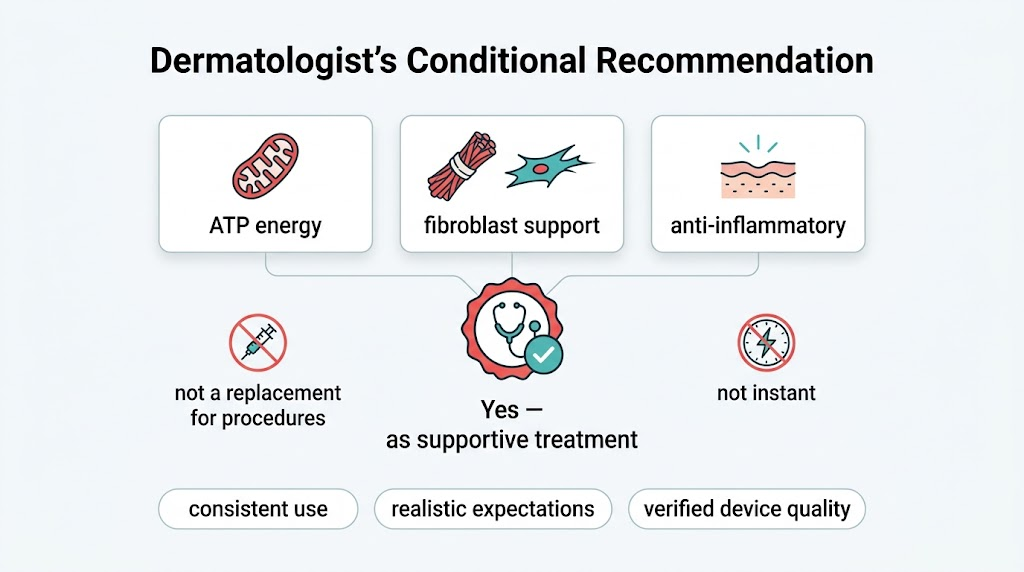
Table of Contents
- 1. Red Light Therapy: A Dermatology Perspective
- 2. Key Biological Mechanisms Recognized in Dermatology
- 3. Dermatologists’ Views on the Benefits
- 4. Safety Considerations Dermatologists Emphasize
- 5. Limitations: What Dermatologists Want You to Understand
- 6. Clinical Treatments vs. At-Home Devices
- 7. Why Dermatologist Opinion Matters
- 8. Final Thoughts: Should You Consider It?
- 9. Partner With Rainbow Technology
- 10. References
1. What Is Red Light Therapy? A Dermatology Perspective
Red light therapy — often referred to as photobiomodulation or low-level light therapy (LLLT) — uses specific wavelengths of visible red and near-infrared light to interact with biological tissue. The clinically referenced device bands are red 630–660 nm and near-infrared 810–850 nm.
Unlike ultraviolet radiation or ablative lasers, red light does not damage the skin barrier. Instead, dermatologists describe its mechanism as cellular modulation rather than tissue destruction.
2. Key Biological Mechanisms Recognized in Dermatology
Mitochondrial Stimulation
Red light is absorbed by cytochrome c oxidase in mitochondria, increasing ATP production — the primary energy source for cellular repair[1].
Collagen and Elastin Support
Fibroblast activity may increase under controlled light exposure, contributing to gradual improvements in skin firmness. In a controlled study of pulsed 660 nm light, type I procollagen increased by 31% and MMP-1 (a collagen-degrading enzyme) decreased by 18%[2] — consistent with the collagen outcomes dermatologists reference in anti-aging discussions[3].
Anti-Inflammatory Response
Clinical observations and mechanistic research suggest reduced erythema and improved skin recovery following procedures[1]. These mechanisms form the basis for dermatologist interest in red light therapy as an adjunctive treatment.
3. Dermatologists’ Views on the Benefits of Red Light Therapy
Most board-certified dermatologists describe red light therapy as a supportive modality rather than a standalone solution. Evidence varies depending on treatment goals and device quality. For the broader consensus view — including whether dermatologists recommend it in general practice — see our companion guide What Do Dermatologists Think About Red Light Therapy?
1. Anti-Aging and Skin Rejuvenation
Several clinical reviews indicate that consistent red light exposure may help improve fine lines and texture, skin tone uniformity, and elasticity over time[2][3]. Dermatologists often emphasize that improvements are gradual and cumulative, typically appearing after several weeks of consistent sessions. Rather than replacing injectables or lasers, RLT is frequently positioned as a maintenance tool. See our collagen-focused breakdown in Does Red Light Tighten Skin?
2. Acne and Inflammation Management
Red light therapy is valued for its anti-inflammatory properties. In dermatology settings, it is often paired with blue light therapy (~415 nm), which targets acne-causing bacteria — a combination with randomized controlled support, including in home-use devices[4]. Potential benefits noted by clinicians include reduced redness, improved healing after breakouts, and support for sensitive or reactive skin types. However, dermatologists stress that severe acne usually requires medical treatment alongside light therapy. See Red Light Therapy for Acne.
3. Post-Procedure Recovery and Skin Barrier Support
Many dermatology clinics integrate red light therapy after procedures such as microneedling or laser treatments. Clinical observations suggest faster visible recovery, reduced inflammation, and improved patient comfort. A systematic review of LED randomized controlled trials in dermatology — authored by dermatology researchers — supports clinical use for several indications while noting field limitations such as small samples and parameter variability[5]. This professional usage contributes significantly to dermatologists’ acceptance of the technology.
4. Hair Growth and Scalp Applications
Emerging studies explore red light’s impact on hair follicles. Some dermatologists combine light therapy with treatments like PRP to support hair growth outcomes. While results vary, the therapy is generally viewed as low-risk and complementary — an evolving area rather than an established first-line recommendation.
4. Safety Considerations Dermatologists Emphasize
One reason red light therapy has gained acceptance is its strong safety profile when used properly. Common dermatologist recommendations:
- Use devices with verified wavelength accuracy
- Avoid excessive session frequency
- Wear eye protection when recommended — see Do You Need Goggles?
- Consult a professional if using photosensitizing medications
Reported side effects are typically mild and temporary, such as warmth or slight redness. Importantly, dermatologists note that device quality and power output significantly influence both safety and effectiveness.
5. Limitations: What Dermatologists Want Consumers to Understand
A key theme across expert opinions is realistic expectations. Red light therapy is not:
- An instant wrinkle remover
- A replacement for medical procedures
- A cure for chronic skin disease
Instead, it works best as part of a broader skincare strategy including sun protection, topical treatments, and professional guidance.
6. Professional Treatments vs. At-Home Devices
Dermatologists distinguish clearly between clinical and home-use devices:
| Dimension | Clinical Treatments | At-Home LED Devices |
|---|---|---|
| Output | Higher energy output | Lower intensity for safety |
| Supervision | Administered by trained professionals | Self-administered at home |
| Role | Often combined with other procedures | Require consistent long-term use |
| Best fit | Targeted or post-procedure treatment | Maintenance rather than rapid transformation |
Many dermatologists recommend combining both approaches depending on individual skin goals. For choosing a home device form factor, see our mask vs panel comparison.
7. EEAT Insight: Why Dermatologist Opinion Matters in Red Light Therapy
From a clinical standpoint, red light therapy continues to evolve as research expands. Dermatologists generally agree that:
- The technology is scientifically plausible[1]
- Safety is high when devices follow regulatory standards
- Outcomes depend heavily on proper usage and device design[5]
This balanced perspective explains why red light therapy remains widely discussed — yet responsibly positioned — within dermatology. A note on method: we have not polled dermatologists for this article; we present what peer-reviewed dermatology literature and clinical guidelines actually support, so claims can be traced to sources.
8. Final Thoughts: Should You Consider Red Light Therapy?
Dermatologists increasingly view red light therapy as a valuable adjunct treatment for skin health, particularly for early signs of aging, mild inflammatory conditions, post-procedure recovery, and long-term skin maintenance.
However, professional guidance and realistic expectations remain essential. If you’re considering red light therapy, consult a qualified dermatologist to determine whether it fits your skin profile and treatment goals — and choose devices that can document the variables dermatologists care about.
9. Partner With Rainbow Technology
Dermatologists mention “device quality” as a deciding variable — but rarely quantify it. We do. When doctors say verified wavelengths, controlled output, and regulatory compliance, this is what they mean:
- Wavelength precision: 630–660 nm red / 810–850 nm NIR / ~415 nm blue — spectrometer-verified per batch, with irradiance stated at working distance.
- Controlled output: Preset modes and session caps inside the effective dose window — safety margins built for repeat home use.
- Compliance documentation: CE, RoHS, FCC, KC; IEC 62471; ISO 13485 + MDSAP QMS; FDA registration & 510(k) documentation.
- OEM/ODM: Custom wavelengths, molds, private labeling, firmware — from concept to certified product. Consult our engineering team; see designs on our product lineup.
Request your custom quote today.
10. References
[1] Hamblin MR.
Mechanisms and applications of the anti-inflammatory effects of photobiomodulation. AIMS Biophysics. 2017;4(3):337-361.
[2] Barolet D, Roberge CJ, Auger FA, et al.
Regulation of skin collagen metabolism in vitro using a pulsed 660 nm LED light source: clinical correlation with a single-blinded study. Journal of Investigative Dermatology. 2009;129(12):2751-2759.
[3] Wunsch A, Matuschka K.
A controlled trial to determine the efficacy of red and near-infrared light treatment in patient satisfaction, reduction of fine lines, wrinkles, skin roughness, and intradermal collagen density increase. Photomedicine and Laser Surgery. 2014;32(2):93-100.
[4] Kwon HH, Lee SK, Lee J, et al.
Combined 420-nm and 660-nm LED phototherapy for acne vulgaris: a double-blind, randomized, sham-controlled trial. British Journal of Dermatology. 2013;168(6):1288-1294.
[5] Jagdeo J, Austin E, Mamalis A, et al.
Light-emitting diodes in dermatology: a systematic review of randomized controlled trials. Lasers in Surgery and Medicine. 2018;50(6):613-628.
