
What Is the Strongest Red Light Therapy at Home? Optical Power vs. Marketing Myths
When consumers and clinic owners search for the “strongest” at-home red light therapy device, they are usually looking for fast treatment times and maximum tissue penetration for deep muscle recovery, joint pain relief, or collagen stimulation. However, the home therapy market is flooded with deceptive power ratings. Devices marketed as “1000W super-panels” often deliver weak, diluted light. To find or manufacture a truly high-output therapy device, one must look beyond electrical power consumption and measure true optical power density.
The strongest at-home red light therapy requires an actual optical irradiance of 100–150 mW/cm2 at 6 inches (spectroradiometer-verified), delivered by high-chip-density LED panels with 30∘ optical lenses, zero flicker, and active cooling substrates — not the electrical wattage printed on the box.
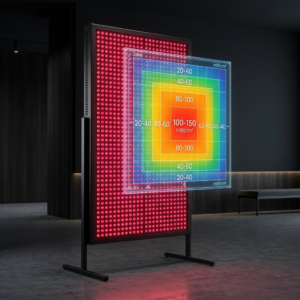 High-power full-body red light therapy panel with 630nm, 660nm and 850nm LEDs and an overlaid irradiance
measurement grid
1. The Physics of Power: What Truly Determines the “Strength” of Home Red Light Therapy?
In photobiomodulation (PBM), “strength” refers to the rate at which therapeutic photons are delivered to biological tissue. Higher optical intensity allows target cells to absorb the required energy dose in significantly less time.
Device strength is measured by optical irradiance (mW/cm2) at a specific treatment distance and energy dose (J/cm2) — not the electrical input wattage advertised on the box.
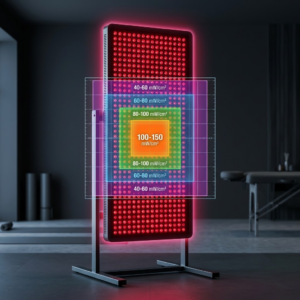 Concept diagram showing the difference between electrical wattage input and true optical irradiance delivered to tissue
2. Irradiance vs. Electrical Wattage: Exposing the “1000W” Marketing Trap
Many consumer brands advertise the theoretical maximum power capacity of their LED chips (e.g., 200 LEDs × 5W = 1000W). In reality, driving LEDs at 100% capacity would cause immediate thermal failure. Actual electrical draw might only be 150W to 200W, and due to driver inefficiency, only a fraction of that electricity converts into usable optical power.
The true benchmark of strength is Irradiance — the optical power striking a given surface area, measured in milliwatts per square centimeter (mW/cm2).
The total energy dose delivered (Fluence) is calculated using the following equation:
Fluence (J/cm2)=Irradiance (mW/cm2)×Time (seconds)1000
A high-output panel delivering 120 mW/cm2 requires just 2.7 minutes to administer a clinical dose of 20 J/cm2, whereas a low-cost panel delivering 15 mW/cm2 requires over 22 minutes for the same energy transfer.
⚠️ Read the Fine Print: Solar-Meter vs. Spectroradiometer
A solar power meter (broadband radiometer) reads all wavelengths — including heat and out-of-band emission — and routinely overstates therapeutic irradiance by 40–70%. A panel showing “167 mW/cm²” on a solar meter may deliver only ~89 mW/cm² of actual therapeutic light on a calibrated spectroradiometer. Always ask: what instrument, at what distance, warm or cold?
3. Targeting Deep Tissue: Why 850nm NIR Requires Higher Optical Density Than 660nm Red Light
While red light (630–660 nm) is rapidly absorbed by skin melanin and dermal blood vessels, Near-Infrared light (850 nm) penetrates deep into subcutaneous tissue, tendons, joints, and muscle beds. Because light scatters as it passes through human tissue, a higher initial irradiance at the skin surface is required to ensure sufficient photon density reaches deep tissue layers 3 to 5 cm below the skin.
4. Industrial Benchmarks: How Commercial-Grade High-Power Panels Are Built (Factory Perspective)
Engineers face strict physical constraints when designing high-output panels. Pushing higher electrical currents through LED chips generates excess heat, which in turn causes optical power decay and shortened diode lifespan if not properly mitigated.
Commercial-grade high-output panels utilize 5W/10W dual-chip LED arrays paired with narrow 30∘ secondary optical lenses and active cooling to sustain peak irradiance without thermal light decay.
| Parameter | Standard Consumer Panel ($100–$250) | Commercial / Clinical Grade High-Power Panel ($500+) |
|---|---|---|
| Real Optical Irradiance (6″) | 25–45 mW/cm2 | 100–150 mW/cm2 (spectroradiometer-verified) |
| Secondary Lens Angle | 60∘–90∘ (wide dispersion, low density) | 30∘ (focused beam, high optical density) |
| LED Chip Architecture | Single-chip 1W/3W LEDs | Dual-chip 5W/10W high-efficiency chips |
| Thermal Management | Thin FR-4 PCB with passive heat sinks | High thermal conductivity Aluminum Core PCB + dual ball fan array |
| Driver Ripple & Flicker | >15% PWM ripple (visible/invisible flicker) | <1% low-noise isolated constant-current driver |
| Power Decay Over Time | Drops 20–30% within 10 minutes | <3% output variance after 60-minute burn-in |
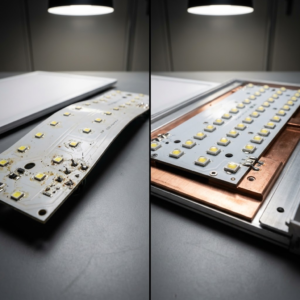 Side-by-side teardown of a cheap FR-4 PCB consumer panel versus an aluminum-core high-power panel with dual-chip
5. Optical Lens Geometry: How 30° Lenses Concentrate Photons for Deep Penetration
Unfocused LEDs scatter light across a wide 120∘ radiation pattern. While this provides broad coverage, photon density drops dramatically over distance. High-power therapeutic panels integrate custom optical secondary lenses with a 30∘ beam angle, focusing photons into parallel streams. This prevents rapid energy drop-off when standing 6 to 12 inches away from the panel.
6. Thermal Management & Power Supplies: Preventing Thermal Light Decay in High-Current LEDs
As semiconductor junctions heat up, their luminous efficacy drops — a phenomenon known as thermal light decay. To maintain continuous maximum output:
- Aluminum Core PCBs: High-power panels replace standard fiberglass (FR-4) with thick aluminum-backed circuit boards that immediately pull heat away from LED junctions.
- Forced Air Convection: High-CFM dual ball-bearing fans actively pull cool air across internal heat sinks, maintaining internal temperatures below 55°C even during prolonged high-current operation.
7. EMF Mitigation & Isolated Driver Design: Delivering Safe High Output
High-power electronics can produce electromagnetic fields (EMF) and electrical flicker if poorly shielded. Medical-grade high-power panels use isolated constant-current power supplies inside shielded aluminum housings, keeping magnetic-field emissions near ambient levels — typically ≤ 0.2 µT (about 2 mG) at 6 inches — while eliminating flicker.
Honest framing: Any AC-powered device emits some electromagnetic field. Reputable brands report “low EMF” figures measured at a stated distance, never an impossible “zero EMF” claim. Ask for third-party lab data with measurement distance specified.
8. Frequently Asked Questions
Q1: Can an at-home red light therapy device be too strong?
Yes. According to the Arndt-Schulz Law, photobiomodulation follows a biphasic dose-response curve with a therapeutic window of roughly 3–60 J/cm2 (depending on tissue depth). Excessive single-session dosage that pushes beyond this window can cause cellular fatigue or temporary biological inhibition. High-power panels delivering 120 mW/cm2 should be used for shorter durations (e.g., 3 to 10 minutes per treatment area) to stay within the optimal range.
Q2: What is the minimum optical irradiance required for deep joint or muscle treatment?
For deep tissue penetration (such as knees, lower back, or deep muscle groups), a minimum surface irradiance of 80–100 mW/cm2 at 6 inches is recommended. This ensures that enough NIR photons reach tissues 3+ cm beneath the dermal layers.
Q3: How can brands verify factory claims of 100+ mW/cm2 irradiance before bulk production?
Never rely on solar power meters, which overestimate optical power by 40–70% because they read broadband heat and out-of-band wavelengths rather than the therapeutic 660/850 nm bands. Demand testing via a lab-grade Integrating Sphere Spectroradiometer or Goniophotometer calibrated specifically for 660 nm and 850 nm spectral outputs — and ask for the measurement distance and whether the panel was thermally stabilized before testing.
9. Conclusion
Building the “strongest” red light therapy panel requires a precise balance of high-bin LED chips, narrow optical lensing, thermal management, and certified electrical safety. For brands aiming to capture the premium wellness, athletic recovery, or clinical market, manufacturing integrity is everything.
👉 Partner with a Leading Light Therapy OEM/ODM Manufacturer
Are you developing a custom high-power panel, full-body bed, or targeted therapy device for your brand? Rainbowdo offers end-to-end engineering support — from optical layout and thermal modeling to ISO 13485 cleanroom production.
- Get optical spectrum & irradiance test reports for your product concepts.
- Request high-power OEM/ODM prototype samples (30∘ secondary optical lenses, custom dual-chip arrays).
- Access full certification files: FDA 510(k), CE, IEC 62471 photobiological safety.
👉 Contact Our Optical Engineering Team | ✉️ Direct Email: oem@rainbowdo.com
Academic & Industrial References
- de Freitas, L. F., & Hamblin, M. R. (2016). Proposed Mechanisms of Photobiomodulation or Low-Level Light Therapy. IEEE Journal of Selected Topics in Quantum Electronics, 22(3), 348–364.
- Huang, Y. Y., et al. (2009). Biphasic Dose Response in Low Level Light Therapy. Dose-Response, 7(4), 358–383.
- International Electrotechnical Commission. (2020). IEC 60601-1-2: Medical Electrical Equipment — Collateral Standard: Electromagnetic Disturbances — Requirements and Tests. Geneva: IEC.
- International Electrotechnical Commission. (2006). IEC 62471: Photobiological Safety of Lamps and Lamp Systems. Geneva: IEC.
