
Do Red Light Masks Really Work? The Optical Physics of Effective Light Therapy
Walk through any online marketplace and you’ll find LED face masks ranging from $30 to well over $500 — all claiming to “boost collagen,” “erase fine lines,” and “clear skin” with light therapy. But can a budget device deliver the same cellular benefits as a clinical-grade system? The short answer is no. The biological efficacy of light therapy is governed by precise optical physics — wavelength accuracy, irradiance, and thermal stability — not merely the presence of visible red light.
Red light masks work — but only when they deliver precise wavelengths (630–660 nm and 810–850 nm) at clinically effective irradiance (≥30 mW/cm²). Most cheap masks fail because of spectral drift (±20 nm), thermal power decay, and weak energy density: the light looks bright, but the delivered dose is sub-therapeutic.
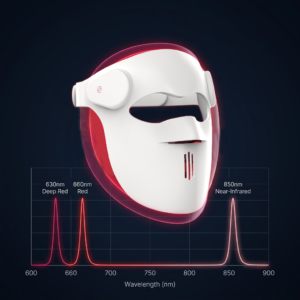
Red and near-infrared LED mask emitting 630nm, 660nm and 850nm wavelengths
1. The Science of Photobiomodulation: Do Red Light Masks Actually Work?
At the cellular level, light therapy relies on Photobiomodulation (PBM). When photons of specific red and near-infrared (NIR) light penetrate tissue, they are absorbed by a primary chromophore inside the mitochondria: Cytochrome c Oxidase (CCO) — the terminal enzyme of the electron transport chain. This absorption triggers a cascade of intracellular reactions: elevated adenosine triphosphate (ATP) production, reduced oxidative stress, and upregulation of the gene transcription responsible for pro-collagen synthesis.
PBM works only inside a narrow biological window: wavelengths matched to CCO’s absorption peaks, delivered at an irradiance high enough to reach the therapeutic fluence threshold — without overheating the tissue.
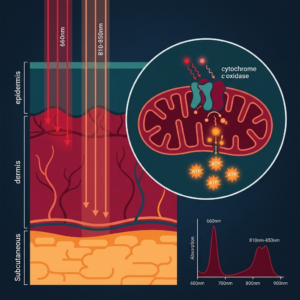
Cytochrome c oxidase absorption peaks and the mitochondrial ATP production cascade triggered by photobiomodulation
The Dual-Wavelength Gold Standard: Red (Dermal) vs. Near-Infrared (Subcutaneous)
Biological tissue selectively absorbs light by depth:
- Red Light (630–660 nm): Absorbed primarily in the upper epidermal and dermal layers (~1–2 mm). It targets fibroblasts to support the synthesis of collagen Types I and III.
- Near-Infrared Light (810–850 nm): Invisible to the eye, NIR penetrates deeper (~3–5 mm, and further in deeper tissue) into subcutaneous fat, connective tissue, and muscle, supporting cellular repair, microcirculation, and reduced localized inflammation.
Within the NIR band, 810 nm is the most heavily researched wavelength: it is absorbed by the CuA center of CCO and also interacts with deoxygenated hemoglobin to promote vasodilation. 850 nm is absorbed deeper by the CuB (heme a3-CuB) center, trading a longer wavelength and lower scattering for greater tissue depth. Both are valid; the choice is an engineering decision driven by target depth.
Energy Fluence & Dosage: Why Light Intensity (mW/cm²) Dictates Real-World Results
The Arndt-Schulz Law dictates that cellular stimulation follows a biphasic dose-response curve: too little energy yields zero effect, while too much can cause cellular fatigue or thermal damage. Total delivered energy is calculated as:
Fluence (J/cm²) = [ Irradiance (mW/cm²) × Time (seconds) ] ÷ 1000
Worked examples:
- 40 mW/cm² × 500 s → 20 J/cm² (about 8 minutes — a clinical-grade session).
- 5 mW/cm² → 20 J/cm² requires 4,000 s (about 67 minutes — over an hour of continuous wear).
- Below ~3 mW/cm², a single session to reach 20 J/cm² would exceed two hours.
This is the practical difference between a calibrated medical/industrial device and an underpowered consumer mask: it is not “light vs. no light,” it is therapeutic dose vs. cosmetic placebo.
2. Why Cheap LED Masks Fail: An Engineering Teardown
To understand why budget masks fail, you have to look at the internal engineering. A teardown of low-cost consumer masks reveals severe compromises in semiconductor wafer quality, optical packaging, and circuit design.
Low-cost LED masks fail primarily because cheap diode chips suffer severe spectral drift (±20 nm) and rapid thermal attenuation, dropping below therapeutic irradiance within weeks — despite the lights appearing visually bright.
| Engineering Spec | Low-Cost / Consumer Grade ($20–$50) | Medical / Industrial Grade OEM ($150+) |
|---|---|---|
| Spectral Tolerance | ±15 to ±25 nm (high drift) | ±3 to ±5 nm (monochromatic narrow band) |
| Effective Irradiance | <10 mW/cm² (uncalibrated) | 30–60 mW/cm² (spectrophotometer-calibrated) |
| Thermal Substrate | Paper-phenolic FR-1/FR-2 PCB | Flexible aluminum / copper-core PCB |
| Luminous Maintenance (L70) | >50% output drop within 100 operating hours | <5% output drop after 1,000 operating hours |
| Photobiological Safety | Uncertified / risk of blue-light leakage | IEC 62471 RG0 (exempt group, no optical hazard) |
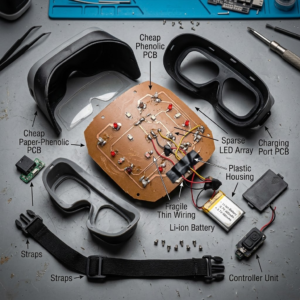
Teardown of a low-cost LED mask revealing a warped paper-phenolic PCB with uncooled diode chips
Wavelength Drift & Spectral Purity: How ±20 nm Nullifies Efficacy
Cytochrome c Oxidase has narrow absorption peaks centered around 630–660 nm and 810–850 nm. Low-quality LED chips sourced from unsorted wafer bins often emit a broad spectral bandwidth centered at, for example, 680 nm or 610 nm. Light emitted outside the biological target window is absorbed as non-therapeutic energy or scattered — rendering the device biologically inert even though it glows red.
Thermal Management & L70 Decay: The Invisible Power Loss in Passively Cooled Masks
LEDs emit heat from their substrate during operation. Without adequate thermal dissipation (flexible copper-core PCBs or aluminum substrates), heat builds up inside flexible silicone or plastic housings:
- Junction temperature rise: As the semiconductor junction heats, photon emission efficiency drops sharply.
- Luminous maintenance (L70) loss: Uncooled, low-bin LEDs experience severe optical-power attenuation within weeks. The mask still looks bright, but its measured irradiance falls below the therapeutic floor.
This is why “the lights are on” is not evidence that “the dose is delivered.”
Optical Safety & Material Standards: Eye Protection (IEC 62471) & Food-Grade Silicone
Budget devices often use recycled PVC or poorly cured silicone containing volatile organic compounds (VOCs) and plasticizers, which can off-gas when heated against the skin. Inadequate structural eye-shields also risk exposing delicate retinal tissue to scattered NIR rays or residual high-energy blue spikes — failing to meet IEC 62471 photobiological safety limits.
3. Frequently Asked Questions
Q1: How long does it take to see results from a properly powered red light mask?
When using a device calibrated to 30–45 mW/cm², clinical studies show measurable improvements in skin density, collagen synthesis, and fine-line appearance within 4–8 weeks of consistent use (3–4 sessions per week, 10–15 minutes per session).
Q2: Why do some cheap masks include blue light, and is it safe without eye shields?
Blue light (415 nm) targets P. acnes bacteria near the skin surface. However, 415 nm carries photobiological risk to the retina. Any device incorporating blue light must include opaque, medical-grade ocular shielding compliant with IEC 62471 to prevent cumulative macular strain.
Q3: What optical test reports should brands request from OEM manufacturers before sourcing?
Demand three core documents:
- Integrating-Sphere Spectroradiometer Report — verifies the exact spectral peak (nm) and optical power output.
- Goniophotometer Irradiance Mapping — confirms uniform energy distribution (mW/cm²) across the contact surface.
- IEC 62471 photobiological safety report (RG0) and, where the device makes wrinkle-reduction claims, FDA 510(k) clearance (Class II, 21 CFR 878.4810, product code OHS) — the latter is a separate regulatory pathway from optical safety testing.
Conclusion
Efficacy in light therapy is an engineering discipline, not a marketing gimmick. For beauty brands, healthcare distributors, and e-commerce sellers, a successful light-therapy product line requires rigorous optical engineering, verified chip binning, and ISO 13485 manufacturing controls. The difference between a $30 mask and a clinical-grade system is not the color of the light — it is whether the delivered photons actually reach the therapeutic window.
👉 Request Factory DFM & OEM Sample Testing
Developing a custom red light mask or upgrading your brand’s optical hardware lineup? Partner with our optical engineering team for complete Design for Manufacturability (DFM) analysis and optical testing.
- Optical spectrum testing reports for your current prototype.
- Medical-grade flexible silicone OEM samples (630 nm / 660 nm / 850 nm).
- ISO 13485 & FDA 510(k) compliance documentation packages.
Contact Our OEM/ODM Engineering Team | oem@rainbowdo.com
Academic & Industrial References
- Karu, T. I. (2008). Mitochondrial Signaling in Mammalian Cells Activated by Red and Near-IR Radiation. Photochemistry and Photobiology, 84(5), 1091–1099. PubMed PMID 18651871
- Hamblin, M. R. (2017). Mechanisms and Applications of the Anti-Inflammatory Effects of Photobiomodulation. AIMS Biophysics, 4(3), 337–361. PubMed PMID 28748217
- Huang, Y.-Y., et al. (2009). Biphasic Dose Response in Low-Level Light Therapy. Dose-Response, 7(4), 358–383.
- Jacques, S. L. (2013). Optical Properties of Biological Tissues: A Review. Physics in Medicine and Biology, 58(11), R37–R61.
- International Electrotechnical Commission. (2006). IEC 62471: Photobiological Safety of Lamps and Lamp Systems. Geneva: IEC.
- U.S. Food and Drug Administration. Class II Special Controls Guidance: Light-Based Over-The-Counter Skin Rejuvenation Devices. 21 CFR 878.4810, product code OHS.
