
What to Look for in a Red Light Therapy Face Mask: Your Ultimate Guide
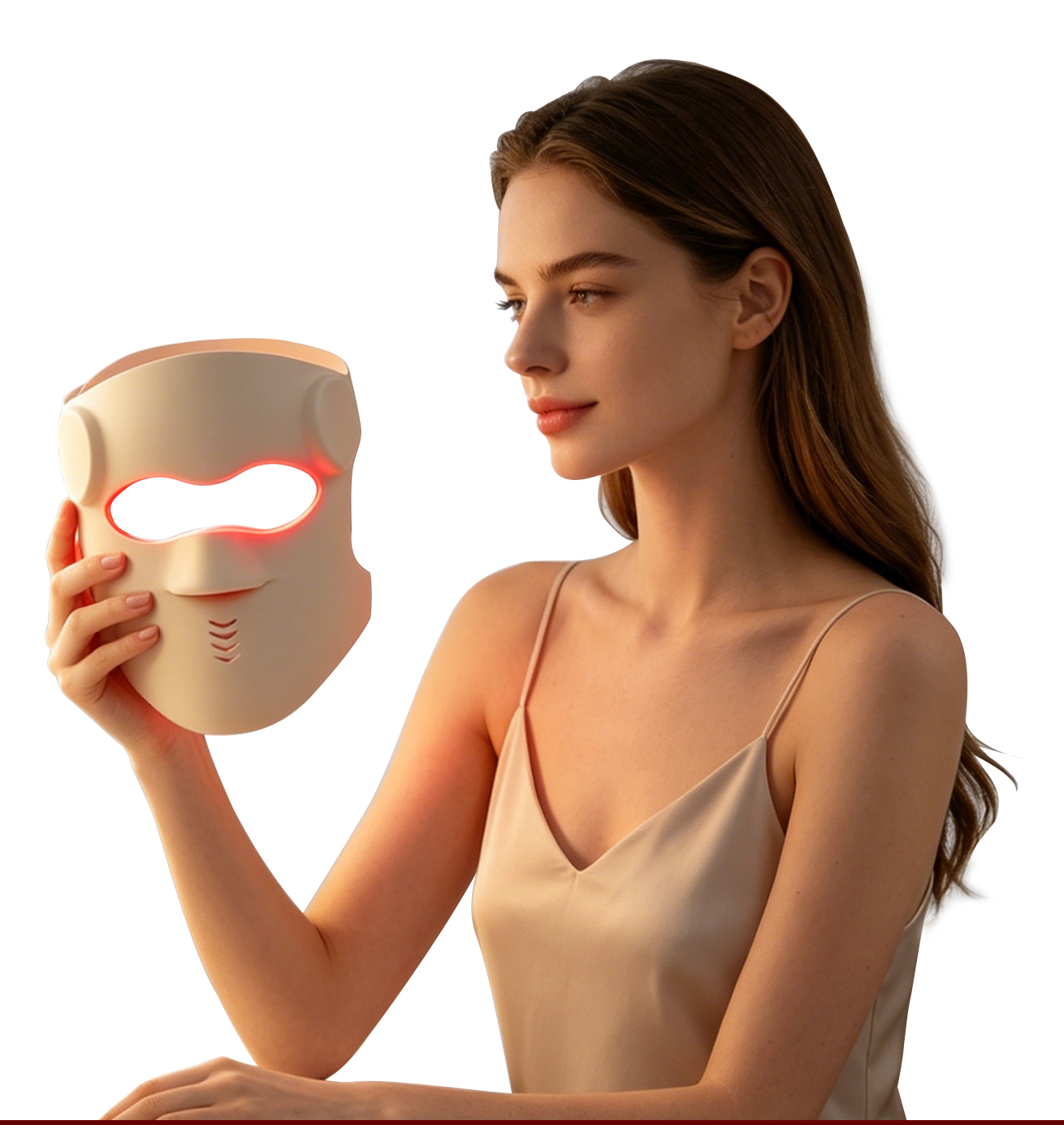
Six specs decide whether a red light mask works: exact wavelength (therapeutic red 630–660 nm, NIR ~830 nm, blue ~415 nm), irradiance at skin (aim 30–50 mW/cm² or higher, published in the spec sheet), LED coverage and uniformity (not just count), fit and skin contact, certification (FDA-cleared, CE, ISO 13485 manufacturer), and usable settings. LED count alone is a weak metric — a mask with 300 weak LEDs loses to 60 well-driven ones. Results are cumulative: 10-minute sessions, 3–5×/week, measurable at 8–12 weeks[1][2].
Table of Contents
- 1. Understanding Red Light Therapy Masks
- 2. The 6 Specs That Actually Matter
- 3. Matching Your Skin Type to the Right Mask
- 4. How to Evaluate Any Mask in 3 Questions
- 5. How to Get the Most Out of Your Mask
- 6. Partner With Rainbow Technology for Custom LED Devices
- 7. References & External Links
1. Understanding Red Light Therapy Masks
Red light therapy masks embed arrays of LEDs that emit specific wavelengths absorbed by skin cells. The photons stimulate mitochondrial activity — boosting cellular energy, collagen production, circulation, and anti-inflammatory signaling[1]. Most masks combine two or three wavelengths to cover different skin concerns:
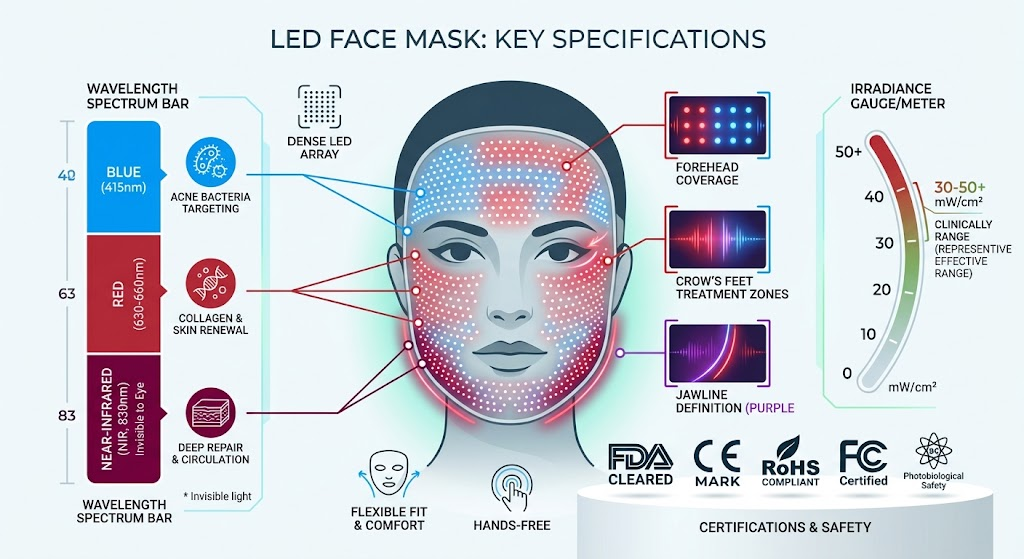
- Red light (630–660 nm): absorbed in the upper dermis; drives collagen and elastin for fine lines, firmness, and tone[2].
- Near-infrared (~830 nm): penetrates deeper for tissue-level repair; complements red for anti-aging[3].
- Blue light (~415 nm): activates porphyrins inside acne bacteria to kill them — the acne-specific addition[4].
The targets: fine lines and wrinkles, acne and breakouts, uneven tone and texture, and loss of firmness. For the mechanism deep-dive, see what red light does to your skin.
2. The 6 Specs That Actually Matter
Choosing a mask is not about the brand with the best ads — it is about reading the spec sheet like an engineer. These six factors, in order of importance:
2.1 Wavelength and light types
The single most important number on any spec sheet is the exact nm value. “Red light” without a number is marketing. Therapeutic red is 630–660 nm (most clinical devices center on 633–650 nm); NIR ~830 nm; blue ~415 nm for acne. A device that lists precise wavelengths with a tolerance (e.g., ±10 nm) is made by people who know what they are doing[1][2]. Wavelength science: see our guide.
2.2 Irradiance (light power at skin)
Irradiance — mW/cm² at the treatment surface — is the dose driver. Aim for 30–50 mW/cm² or higher, measured at skin contact; the clinical literature typically works in this range. Be suspicious of devices that do not publish irradiance at all: dose = irradiance × time, and you cannot verify an unpublished dose[1][2].
2.3 LED coverage and uniformity (not count)
“130+ LEDs” is a marketing metric, not a performance metric. What matters is how the LEDs are distributed and whether irradiance stays uniform across the treatment area — cheekbone to chin to crow’s feet. A mask with 60 well-driven LEDs in the right layout can outperform one with 300 LEDs clustered in the center. Look for coverage of wrinkle-prone zones: forehead, crow’s feet, nasolabial folds, and jawline.
2.4 Comfort and fit
Light intensity falls off with distance from the skin, so close, even contact is a performance spec, not a luxury. Medical-grade silicone masks conform to facial contours; adjustable straps keep LEDs in place. A mask you can wear comfortably for 10 minutes is a mask you will actually use 3–5 times a week — and consistency is the variable that predicts results[2].
2.5 Certification and brand reliability
Look for FDA-cleared or clinically tested devices, CE marking for EU markets, and — if you want the highest confidence — a manufacturer operating under ISO 13485 (the medical-device quality standard)[5]. Certifications are the minimum bar that separates real devices from gimmicks.
2.6 Customizable settings
Adjustable intensity, selectable light modes (red / NIR / blue / combos), and automatic timers are genuinely useful: they let you tailor dose to skin sensitivity and keep sessions consistent. Avoid masks whose only “feature” is flashy extras with no optical function.
3. Matching Your Skin Type to the Right Mask
| Skin Type | Recommended Features |
|---|---|
| Normal | Red + NIR with adjustable intensity for balanced skin health[2] |
| Oily / acne-prone | Red + Blue + NIR — blue targets C. acnes bacteria[4]; red calms inflammation; adjustable settings avoid over-stimulation |
| Dry | Red + NIR, paired with hydrating serums (hyaluronic acid) around sessions[2] |
| Sensitive | Lower-intensity red and NIR; start with shorter sessions and build up; cool, soothing skincare |
| Combination | Multi-wavelength mask with zone control where available — treat oily zones and dry zones separately |
One correction to common advice: blue light does not “reduce oil production” — its evidence is antibacterial, not sebum-suppressing[4]. For acne the winning combination is blue (bacteria) + red (inflammation), as covered in our blue light therapy guide.
4. How to Evaluate Any Mask in 3 Questions
Instead of trusting review lists, run any candidate through this three-question filter:
- Does the spec sheet list exact wavelengths in nm and irradiance in mW/cm² at the skin? If either number is missing, the manufacturer does not know — or will not say — whether the device delivers a therapeutic dose[1].
- Is it certified and made under a quality system? FDA-cleared/registered, CE, and an ISO 13485 manufacturing facility are the reliability baseline[5].
- Can you wear it comfortably for the full session, every other day, for 12 weeks? The best optics in the world fail if adherence fails[2].
An example of a mask that passes all three: the Rainbow Wrinkle Retreat Mask — FDA-cleared, red (630 nm) + NIR (830 nm), flexible medical-grade silicone, 10-minute sessions. It is built to the same standards as our OEM/ODM production line, because it is: see our manufacturing page. For format trade-offs (mask vs. panel vs. wand), compare mask vs. panel; for multi-color devices, 7-color masks.
5. How to Get the Most Out of Your Mask
- Consistency beats intensity: 10-minute sessions, 3–5 times per week, for at least 8–12 weeks — the timeframe where RCTs measure results[2]. Frequency science: how often to use a red light mask.
- Start clean and dry: light penetrates best on clean skin; what to apply before sessions — our pre-LED guide.
- Avoid photosensitizers: skip retinoids and citrus-based products immediately before/after treatment to prevent irritation.
- Hydrate: pair sessions with hyaluronic acid serums for enhanced results, especially for dry skin.
- Protect your eyes: use built-in shielding or wear the provided eye protection every session.
6. Partner With Rainbow Technology for Custom LED Devices
Every spec in this guide — wavelength tolerance, irradiance at skin, uniform LED coverage, ISO 13485 quality — is a decision made at the manufacturing level. That is the daily work of Rainbow Technology’s Shenzhen R&D and production teams. As an ISO 13485, CE, and FDA-compliant LED device manufacturer, we support:
- Custom mask, panel, and multi-wavelength device design with verified optical specifications.
- ODM/OEM production — including private label — from prototyping to mass production.
- Full regulatory documentation (ISO 13485, CE, FDA 510(k) support) for your market entry.
Building a light therapy brand? Visit our OEM/ODM Manufacturing Page or request your custom quote today.