
Who Cannot Use Red Light Therapy? Essential Safety Precautions and Contraindications
Red light therapy is generally safe, but it is not for everyone in every situation — the honest answer is “it depends.” True contraindications (avoid without medical supervision): treating directly over known cancer areas. Groups requiring caution and clinician consultation: pregnancy (abdomen/pelvis), photosensitivity disorders, epilepsy, pre-existing eye conditions, thyroid imbalance, systemic photosensitizing medications, and implanted electronic devices. And one common myth to clear up: topical retinol is not a red-light contraindication — its photosensitivity is UV-specific, and LED devices emit no UV. This guide grades all nine risk groups so you can decide — and tells you what to look for in a device that documents its own limits.
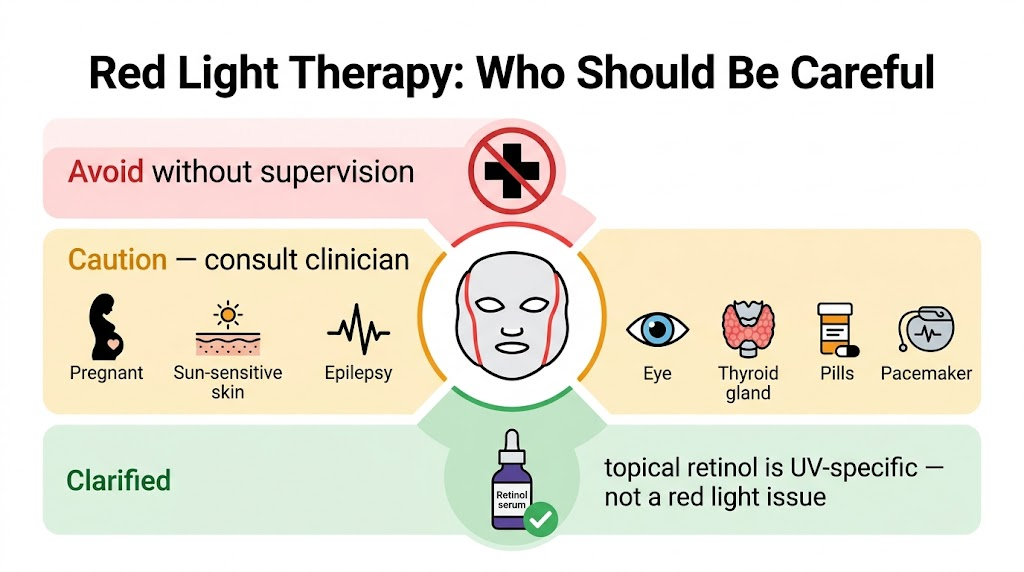
Table of Contents
- 1. Is Red Light Therapy Safe for Everyone?
- 2. What Is RLT and How Does It Work?
- 3. At a Glance: Contraindication Grading
- 4. Pregnancy: Caution, Not Confirmed Harm
- 5. Active Cancer or Cancer History
- 6. Photosensitivity Disorders
- 7. Epilepsy or Photosensitive Seizures
- 8. Pre-Existing Eye Conditions
- 9. Hyperthyroidism or Thyroid Sensitivity
- 10. Burns, Active Infections, Open Wounds
- 11. Photosensitizing Medications
- 12. Implanted Medical Devices
- 13. Essential Safety Tips
- 14. Realistic Expectations
- 15. Conclusion
- 16. FAQs
- 17. Partner With Rainbow Technology
- 18. References
1. Introduction: Is Red Light Therapy Safe for Everyone?
Red light therapy (RLT), also known as photobiomodulation or low-level light therapy, has become increasingly popular for skin rejuvenation, inflammation reduction, and recovery support. Many dermatologists and wellness professionals consider it a generally safe, non-invasive technology when used correctly.
However, one of the most common questions users ask is: Who cannot use red light therapy safely?
While red light therapy offers promising benefits, certain medical conditions, medications, and physiological factors may require caution or complete avoidance. Understanding these contraindications helps users make informed decisions and aligns with professional medical guidance. This guide explores the key groups who should avoid or carefully consider red light therapy based on current clinical insights and safety recommendations.
2. What Is Red Light Therapy and How Does It Work?
Red light therapy uses specific wavelengths of light — typically 630–660 nm (red light) and 810–850 nm (near-infrared) — to interact with skin and tissue at the cellular level. Research suggests these wavelengths may:
- Support mitochondrial activity and ATP production[1]
- Promote circulation and tissue recovery
- Reduce inflammatory responses[1]
- Encourage collagen synthesis
Unlike UV radiation, red light is non-ionizing: its photon energies are far below the threshold for DNA damage[5]. Still, increased cellular stimulation means it is not appropriate for everyone in every situation — especially individuals with certain health conditions.
3. At a Glance: Contraindication Grading
Not every caution is a true contraindication. We grade each group into three actions:
| Group | Grade | Recommended Action |
|---|---|---|
| Active cancer — direct treatment over known areas | 🔴 Avoid | Do not treat over tumor sites unless medically supervised |
| Acute burns / active infection / severe trauma | 🔴 Avoid (self-treatment) | Seek medical care; home LED is not a wound tool |
| Pregnancy | 🟡 Caution | Face ok; avoid abdomen/pelvis; consult obstetrician |
| Photosensitivity disorders (lupus, porphyria) | 🟡 Caution | Consult clinician; monitor skin response |
| Epilepsy / photosensitive seizures | 🟡 Caution | Continuous-wave devices only; medical consultation first |
| Pre-existing eye conditions | 🟡 Caution | Eye protection; avoid direct exposure; ophthalmologist for eye-area use |
| Thyroid imbalance (hyperthyroidism) | 🟡 Caution | Avoid prolonged neck exposure; endocrinologist guidance |
| Systemic photosensitizing medications | 🟡 Caution | Review medication list with clinician before starting |
| Implanted electronic devices | 🟡 Caution | Confirm with physician or device manufacturer |
| Topical retinol (misconception) | 🟢 Clarified | Not a red-light issue — photosensitivity is UV-specific |
4. Pregnancy: Caution, Not Confirmed Harm
Although red light therapy is non-ionizing and considered low risk, long-term clinical data during pregnancy remains limited. Systematic reviews of laser and light-based therapy in pregnancy — covering hundreds of patients across all trimesters — have not reported maternal or fetal harm from dermatologic light treatments, but the evidence base is still not large[2]. Healthcare professionals therefore often recommend:
- Avoiding treatment on the abdomen or pelvic region
- Consulting an obstetrician before beginning any light-based therapy
This precaution reflects a conservative, safety-first medical approach rather than confirmed harm. For the full pregnancy analysis — including what the safety reviews actually found — see Is Red Light Therapy Mask Safe During Pregnancy?
5. Individuals with Active Cancer or Cancer History
Because red light therapy may stimulate cellular metabolism, experts advise caution for people with active malignant tumors, a history of skin cancer, or ongoing oncology treatments. The mechanistic question — whether photobiomodulation could influence cancerous or pre-cancerous cells — remains an active area of research, and the conservative clinical position is clear:
- Avoid treating directly over known cancerous areas unless medically supervised
- Discuss any light-based therapy with your oncologist if you have a cancer history
While research is still evolving, dermatologists and oncologists typically recommend this precaution as the responsible default.
6. Photosensitivity Disorders or Light-Reactive Conditions
People with conditions such as lupus, porphyria, or severe photosensitivity syndromes may experience exaggerated skin reactions to light exposure. Because these conditions are often managed with UV avoidance in mind, and red/NIR light differs physically from UV, the guidance is a caution rather than an automatic ban — but an individual clinician who knows your condition should make that call. If you experience unusual redness, irritation, or burning sensations, discontinue use and seek professional advice.
7. Epilepsy or Photosensitive Seizure Disorders
Most high-quality red light devices emit continuous light. However, low-quality or pulsed devices may flicker — and flickering light is the relevant trigger for photosensitive epilepsy, not steady red light itself. For individuals with epilepsy:
- Choose continuous-wave (non-pulsed) devices
- Medical consultation is strongly recommended before use
Choosing medically compliant, well-engineered devices significantly reduces risk — flicker-free output is an engineering specification, not a marketing feature.
8. Pre-Existing Eye Conditions
Red light therapy itself is not typically harmful to vision when used properly, but intense brightness may cause discomfort — particularly for people with cataracts, glaucoma, or retinal disorders. Best practices include:
- Wearing protective eyewear
- Avoiding direct exposure to the eyes
- Consulting an ophthalmologist for eye-area treatments
For the full discussion of when eye protection is needed, see Do You Need Goggles for Red Light Therapy?
9. Hyperthyroidism or Thyroid Sensitivity
The thyroid gland is sensitive to metabolic stimulation. Some healthcare providers suggest avoiding prolonged exposure over the neck area if you have hyperthyroidism or a thyroid hormone imbalance. Always seek guidance from an endocrinologist before targeting this region.
10. Recent Burns, Active Infections, or Open Wounds
This one needs precision. In clinical settings, photobiomodulation has evidence for wound healing under professional protocols[3]. But a home-use LED mask is not a tool for acute trauma, and it is not recommended for self-treatment of:
- Acute burns (within 48 hours)
- Active bacterial infections
- Severe skin trauma
These situations require medical evaluation. Waiting until inflammation stabilizes — and letting a clinician manage the acute phase — is the responsible approach.
11. Users of Photosensitizing Medications
Medication-related light sensitivity is one of the most overlooked risks. Common systemic examples include:
- Oral isotretinoin (Accutane) and related systemic retinoids
- Tetracycline-class antibiotics
- Certain antidepressants and St. John’s wort
- Some diuretics and anti-inflammatory medications
Before starting red light therapy, review your medication list with a healthcare professional — especially during or shortly after courses of systemic photosensitizers.
🟢 Clarification — topical retinol is NOT a red-light contraindication. Retinol photosensitivity is UV-specific: the sensitivity it can cause is triggered by ultraviolet, and LED red-light devices emit no UV. The real sequencing considerations with topical retinoids are physical light-blocking and skin tolerance, not phototoxicity — see Can I Use Retinol After an LED Mask?
12. Individuals with Implanted Medical Devices
Red light therapy typically produces minimal electromagnetic interference. Still, people with pacemakers, neurostimulators, or other electronic implants should confirm safety with their physician or device manufacturer before use.
13. Essential Safety Tips Recommended by Experts
To maximize safety and effectiveness:
- ✔ Limit sessions to 10–20 minutes per treatment area — beyond the effective dose window, more exposure doesn’t add benefit[4]
- ✔ Use eye protection, especially with high-output devices
- ✔ Start with lower intensity settings
- ✔ Monitor skin response during the first few sessions
- ✔ Choose devices that follow medical safety standards (IEC 62471 photobiological safety, CE/RoHS/FCC, ISO 13485 QMS)
For the dose and duration science behind the 10–20 minute guidance, see How Long Should Red Light Therapy Sessions Be? — and for the procurement view of device risks, our LED mask disadvantages guide.
14. Realistic Expectations: Red Light Therapy Is Not for Everyone
Red light therapy is widely regarded as a supportive wellness technology — not a universal solution. Experts emphasize that it should:
- Complement professional medical care
- Be tailored to individual health conditions
- Be used consistently and responsibly
Understanding contraindications is part of using the technology safely and responsibly.
15. Conclusion: Should You Avoid Red Light Therapy?
Red light therapy may benefit many people, but individuals with active cancer (direct treatment over tumor sites), acute untreated trauma, photosensitivity disorders, epilepsy, thyroid disorders, or those on systemic photosensitizing medications should approach treatment cautiously. The safest approach is to:
- Seek professional medical advice
- Use high-quality, compliant devices
- Follow recommended exposure guidelines
When used appropriately, red light therapy can be a valuable addition to modern skincare and wellness routines — but safety should always come first. This guide is educational and does not replace professional medical advice.
16. FAQs: Common Safety Questions About Red Light Therapy
Is red light therapy safe for daily use?
Most experts recommend limited daily sessions depending on device intensity and treatment area — typical guidance is 3–5 sessions per week at 10–20 minutes per area, following the specific device manual.
Can red light therapy worsen skin conditions?
In sensitive individuals or incorrect usage scenarios, temporary irritation may occur. Professional guidance and starting at lower intensity help reduce risk.
Should I talk to a doctor before starting?
Yes — especially if you have underlying health conditions, are pregnant, or take prescription medications.
17. Partner With Rainbow Technology
Contraindications aren’t a product flaw — they’re a product specification. The safest devices are the ones that document their limits, and that documentation is built in Shenzhen, not written in marketing. At Rainbow:
- Flicker-free engineering: Continuous-wave output — relevant for photosensitive epilepsy; driver stability is tested, not assumed.
- Photobiological safety: IEC 62471 assessment with eye-safety documentation for your manual and packaging.
- Verified wavelengths: 630–660 nm red / 810–850 nm NIR — spectrometer-verified per batch, so contraindication guidance maps to real output.
- Education-ready: Warning language and contraindication sections drafted for manuals, packaging, and app content in your markets.
- Compliance: CE, RoHS, FCC, KC; ISO 13485 + MDSAP QMS; FDA registration & 510(k) documentation. Consult our engineering team; see designs on our product lineup.
Request your custom quote today.
18. References
[1] Hamblin MR.
Mechanisms and applications of the anti-inflammatory effects of photobiomodulation. AIMS Biophysics. 2017;4(3):337-361.
[2] Wilkerson EC, Van Acker MM, Bloom BS, Goldberg DJ.
Utilization of laser therapy during pregnancy: a systematic review. Dermatologic Surgery. 2019;45(6):818-828.
[3] Jagdeo J, Austin E, Mamalis A, et al.
Light-emitting diodes in dermatology: a systematic review of randomized controlled trials. Lasers in Surgery and Medicine. 2018;50(6):613-628.
[4] Huang YY, Sharma SK, Carroll J, Hamblin MR.
Biphasic dose response in low level light therapy — an update. Dose-Response. 2011;9(4):602-618.
[5] Hamblin MR, Demidova TN.
Mechanisms of low level light therapy. Proc. SPIE 6140, Mechanisms for Low-Light Therapy. 2006;6140:614001.

