
How to Use Red Light Therapy Mask (Step-by-Step): A Complete Guide for Radiant Skin
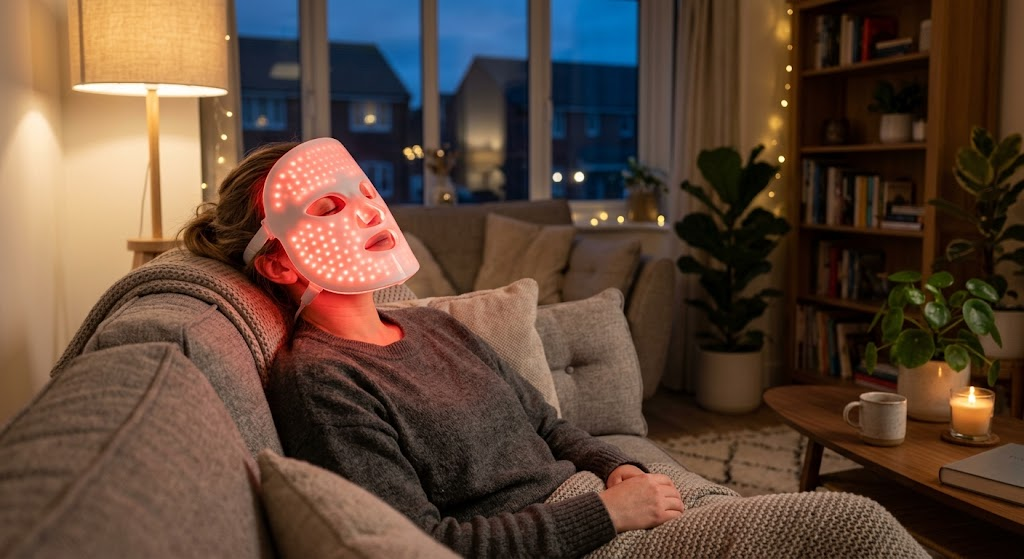
30-Second Summary:
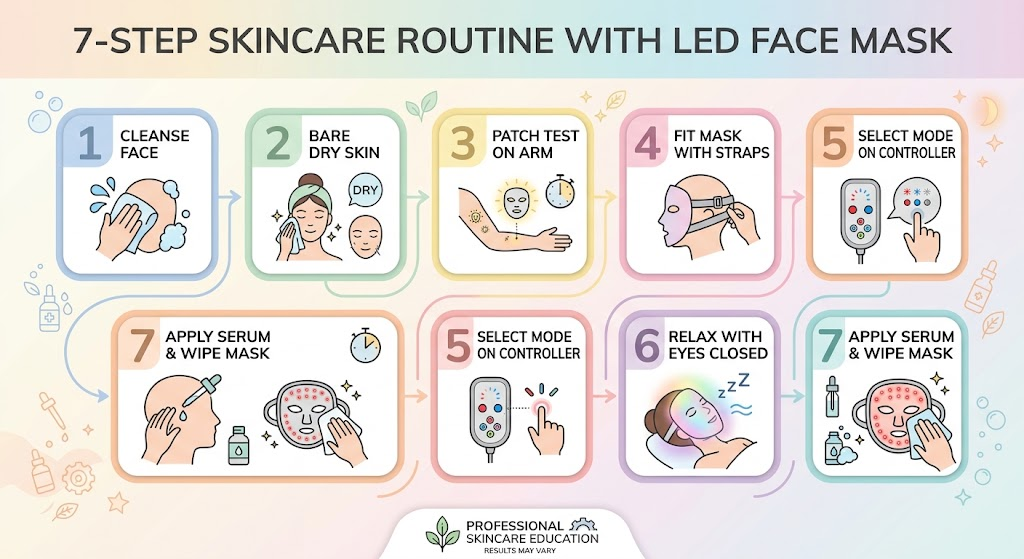
The correct routine has seven steps: cleanse → dry skin (no heavy products) → optional patch test → fit the mask snugly → select your mode → relax for 10–20 minutes → follow with serums and clean the mask. Light penetrates best on clean, bare skin, and dose falls with distance — so fit matters[1]. Results are cumulative: 3–5 sessions per week, measurable at 8–12 weeks[2][3].
Table of Contents
- 1. What Is a Red Light Therapy Mask?
- 2. Step-by-Step: The 7-Step Routine
- 3. Frequency and the Results Timeline
- 4. Why Red Light Therapy: The Evidence
- 5. Common Mistakes to Avoid
- 6. Partner With Rainbow Technology for Custom LED Devices
- 7. References & External Links
1. What Is a Red Light Therapy Mask?
A red light therapy mask is a wearable LED device that delivers red (630–660 nm) and often near-infrared (~830 nm) light to the face. The light penetrates the skin, is absorbed by mitochondria, and stimulates cellular repair and collagen synthesis[1][2]. Used consistently, it addresses fine lines, uneven tone, redness, and firmness — from home, with no downtime. The mechanism deep-dive is in what red light does to your skin.
2. Step-by-Step: The 7-Step Routine
Here is the full routine, in order — with the reasoning behind each step:
Step 1 — Cleanse your face thoroughly
Start with a clean, dry face. Remove makeup, sunscreen, dirt, and oils. Light scatters and absorbs less efficiently through product residue, and occlusive layers can trap heat. Clean skin = maximum photon delivery[1]. What to put on (and avoid) before sessions: our pre-LED guide.
Step 2 — Keep skin bare (do not apply serums first)
Apply skincare after the session, not before. Heavy creams and oils reduce light transmission; hyaluronic acid and other hydrating serums work best on freshly treated skin, when microcirculation is elevated[2].
Step 3 — Optional: patch test for first-time users
If you have very sensitive skin or a history of reactions, do a 5-minute test on a small area (e.g., inner forearm) before the first full session. Red light is generally extremely well tolerated, but the test removes doubt — especially if you are also using photosensitizing skincare.
Step 4 — Fit the mask snugly
Adjust straps or headband so the mask sits close and evenly on the skin. Irradiance falls with distance (inverse square), so a loose mask delivers a fraction of the dose. A good fit is a performance requirement, not a comfort nicety[1]. Fit and coverage details: what to look for in a mask.
Step 5 — Select your mode
Many masks offer anti-aging (red + NIR) and acne (red + blue) modes. Choose per your goal — for acne-prone skin, the blue addition targets C. acnes bacteria[4]. If unsure, start on the lowest intensity for the first two sessions.
Step 6 — Relax for 10–20 minutes
Sessions typically run 10–20 minutes; most devices auto-shutoff. This is not “more is better” territory — photobiomodulation has a biphasic dose response, and exceeding the therapeutic window can blunt the effect[1]. Keep eye protection on the whole time.
Step 7 — Follow up and clean
After the session, apply hydrating serums or moisturizer — hyaluronic acid works especially well post-treatment. Then wipe the mask with a damp, soft cloth (or water-based wipe per the manual) and store it dry, away from direct sunlight. Proper cleaning protects both your skin and the device’s lifespan.
3. Frequency and the Results Timeline
| Timeframe | What to Expect |
|---|---|
| Weeks 1–2 | Better circulation: subtle glow, calmer redness. No structural change yet[3] |
| Weeks 3–6 | Smoother texture; fine lines begin to soften as collagen synthesis ramps up[3] |
| Weeks 8–12 | Peak cumulative results — the endpoint where RCTs measure wrinkle and collagen outcomes[2][3] |
| Beyond 12 weeks | Maintain with 2–3 sessions/week; gains continue to build slowly[3] |
Target 3–5 sessions per week for at least 8–12 weeks, then maintain. Consistency is the single strongest predictor of results — a mask used 3×/week outperforms a stronger mask used twice a month. Frequency science: how often to use a red light mask.
4. Why Red Light Therapy: The Evidence
The most cited numbers, stated precisely:
- +31% Type I procollagen in a reconstructed-skin model treated with 660 nm LED (Barolet et al., 2009)[5].
- Significantly increased dermal collagen density in a randomized controlled trial of 136 volunteers — 30 twice-weekly sessions, confirmed by ultrasound (Wunsch & Matuschka, 2014)[6].
- −30% wrinkle volume after 10 treatments in a 2023 RCT (n=137), reported in the 2018 systematic review[2].
- Acne: blue light (415 nm) reduces inflammatory lesions by 59–67% in RCTs — for acne, add the blue mode[4].
Note: “red light kills bacteria” is a common misattribution — bacterial killing is blue light’s job. Red’s acne contribution is calming inflammation[4]. Full benefit breakdown: benefits of red light for skin.
5. Common Mistakes to Avoid
- Applying serums before the session. Products block photons; use them after[1].
- Doubling session time “for faster results.” Biphasic dose response means overdosing can inhibit the effect[1].
- Skipping eye protection. Even with closed eyes, use the provided shields or goggles.
- Using photosensitizing products (retinoids, citrus) right before/after. Space them apart to avoid irritation.
- Quitting at week 4. The evidence measures results at 8–12 weeks; week 4 is still the ramp-up[2][3].
6. Partner With Rainbow Technology for Custom LED Devices
A mask that fits the 7-step routine correctly is engineered for it: uniform irradiance at skin contact, auto-timers that land sessions in the therapeutic window, and materials that conform without pressure points. That is the daily work of Rainbow Technology’s Shenzhen R&D and production teams. As an ISO 13485, CE, and FDA-compliant LED device manufacturer, we support:
- Custom mask, panel, and multi-wavelength device design with verified optical specifications.
- ODM/OEM production — including private label — from prototyping to mass production.
- Full regulatory documentation (ISO 13485, CE, FDA 510(k) support) for your market entry.
Building a light therapy brand? Visit our OEM/ODM Manufacturing Page or request your custom quote today.

