
How to Choose a Red Light Therapy Mask: A Complete Guide for Radiant Skin
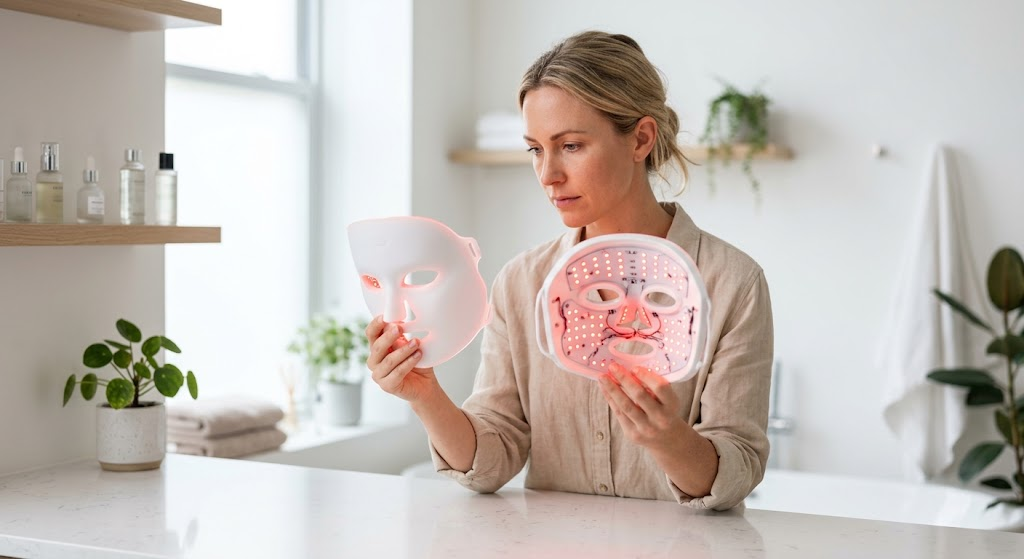
30-Second Summary:
Choosing a mask is a five-step process: (1) identify your skin type, (2) name your primary goal, (3) match wavelengths to that goal — red 630–660 nm + NIR ~830 nm for anti-aging, blue ~415 nm for acne, red at lower intensity for sensitivity[1][2] — (4) verify irradiance (≥30 mW/cm² at skin) and LED layout, (5) confirm certifications (FDA-cleared/registered, CE, ISO 13485 manufacturing)[6]. LED count alone is a weak metric. Budget for 3–5 sessions/week × 8–12 weeks — consistency is part of the purchase[2][5].
Table of Contents
- 1. Understanding Red Light Therapy Masks
- 2. The 5-Step Decision Framework
- 3. Mask Selection by Skin Type
- 4. Mask Selection by Skin Goal
- 5. Common Mistakes When Choosing
- 6. Partner With Rainbow Technology for Custom LED Devices
- 7. References & External Links
1. Understanding Red Light Therapy Masks
Red light therapy masks deliver specific wavelengths to the skin that stimulate cellular repair, collagen production, and anti-inflammatory signaling[1]. The documented benefits:
- Collagen and elastin stimulation — reduces wrinkles and fine lines[2]
- Reduced inflammation and redness — helpful for sensitive or acne-prone skin[1]
- Improved hydration and radiance with consistent use
- Acne bacteria targeting — that is blue light’s job (~415 nm), added alongside red[4]
- More even tone, with some evidence for pigmentation improvement
Benefit-by-benefit evidence: benefits of red light for skin. Now the decision process.
2. The 5-Step Decision Framework
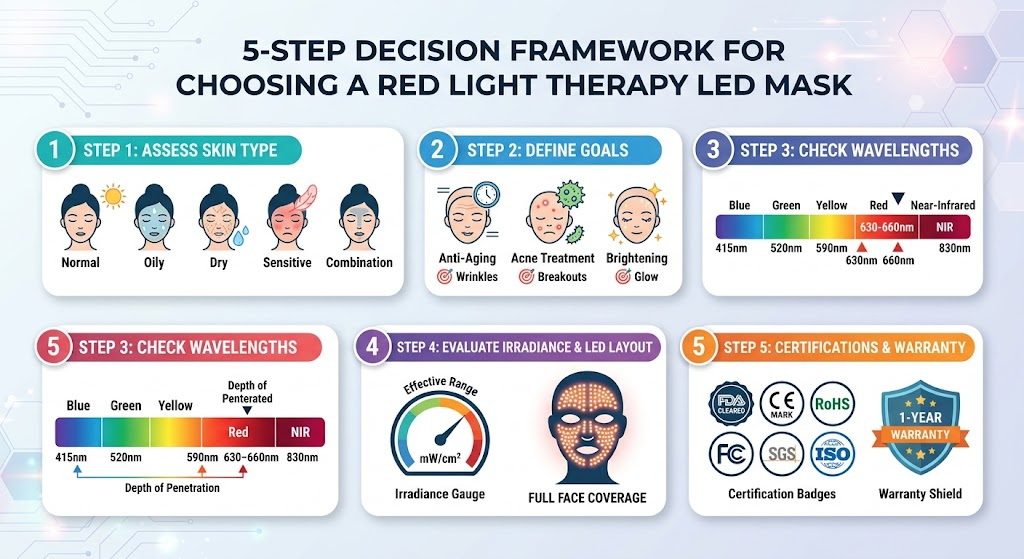
Run any candidate mask through these five steps, in order:
Step 1 — Identify your skin type
Normal, oily/acne-prone, dry, sensitive, or combination. This determines which wavelengths and intensity you need (Section 3). Sensitive skin, in particular, should prioritize adjustable, lower-intensity devices over maximum power.
Step 2 — Name your primary goal
Anti-aging, acne, brightening, or calming redness. A mask optimized for one goal beats a jack-of-all-trades at every goal — the wavelength mix should be selected for your priority (Section 4).
Step 3 — Match wavelengths to the goal
The clinically proven wavelengths are narrow and specific:
| Wavelength | What It Does | Evidence |
|---|---|---|
| Red 630–660 nm | Collagen, fine lines, firmness | Best-documented skin wavelength[2] |
| NIR ~830 nm | Deeper tissue repair, complements red | Deeper penetration band[3] |
| Blue ~415 nm | Kills C. acnes bacteria for acne | Antibacterial, not sebum control[4] |
| Yellow ~590 nm | Brightening, redness calming (secondary) | Clinical experience, smaller evidence base[5] |
| Green ~520 nm | Pigmentation (contested) | High doses may stimulate melanin in light skin[7] |
Any mask claiming a wavelength without a precise nm value is a red flag. Multi-color detail: 7-color mask guide; green light nuance: green light guide.
Step 4 — Verify irradiance and LED layout
Irradiance (mW/cm² at skin) is the dose driver — look for ≥30 mW/cm² and check that the number is published at all[2]. LED layout matters more than count: even coverage of forehead, crow’s feet, cheeks, and jawline beats a high count clustered in one zone. An example of layout-first design: the Rainbow LED mask arrays its LEDs for full-face coverage, including the jawline zone that cheaper masks miss.
Step 5 — Confirm certifications and support
Non-negotiable: FDA-cleared/registered or CE-marked, non-UV output, and eye protection (built-in or included goggles). Gold standard: a manufacturer operating under ISO 13485[6]. Warranty and responsive support matter — you will own this device for years, not weeks.
For the full spec-by-spec checklist and the “3 questions” filter, see what to look for in a red light mask — the companion guide to this one.
3. Mask Selection by Skin Type
| Skin Type | Recommended Configuration | Watch Out For |
|---|---|---|
| Normal | Red + NIR, adjustable intensity | — |
| Oily / acne-prone | Red + Blue + NIR; blue kills bacteria[4], red calms inflammation | Blue does not control oil — claims to the contrary are unsupported[4] |
| Dry | Red + NIR; pair with hyaluronic acid serums | “Built-in moisturizer/infusion” features are marketing — hydration comes from your serum step |
| Sensitive | Low-intensity red + NIR; cooling features welcome | Start at 3–5 min sessions and build up |
| Combination | Multi-wavelength with zone control where available | Treat oily and dry zones with separate modes |
Note: no credible LED mask “infuses” hydration or hyaluronic acid into skin — that is a serum’s job, best applied after sessions. Keep skincare honest: what to put on your face before/after LED.
4. Mask Selection by Skin Goal
| Primary Goal | Wavelength Mix | Evidence Note |
|---|---|---|
| Anti-aging | Red + NIR | The strongest RCT evidence base[2] |
| Acne | Blue + Red | Blue kills bacteria; red calms inflammation[4] |
| Brightening / tone | Red + NIR (+ yellow as secondary) | Yellow has clinical experience but a smaller evidence base[5] |
| Redness / sensitivity | Red at low intensity (+ green cautiously) | Anti-inflammatory is PBM’s most consistent effect[1] |
5. Common Mistakes When Choosing
- Shopping by LED count. 150 vs 1000 LEDs means nothing without layout and irradiance; coverage of the right zones matters more[2].
- Buying “blue light for oil control.” Blue light is antibacterial; sebum claims are not supported by the evidence[4].
- Believing “more wavelengths = better.” Only red, blue, and (to a lesser degree) yellow have solid clinical support; extra colors are often combo modes or marketing[7].
- Ignoring fit. A loose mask halves the dose — try fit before you buy[1].
- No plan for consistency. The mask that fits your schedule wins. Budget 3–5 sessions/week × 8–12 weeks before purchase[2][5].
Once you have chosen: the 7-step usage routine and frequency guidance.
6. Partner With Rainbow Technology for Custom LED Devices
Every step in this framework — wavelength binning, irradiance calibration, LED layout for even coverage, ISO 13485 quality systems — is a decision made at the manufacturing level. That is the daily work of Rainbow Technology’s Shenzhen R&D and production teams. As an ISO 13485, CE, and FDA-compliant LED device manufacturer, we support:
- Custom mask, panel, and multi-wavelength device design with verified optical specifications.
- ODM/OEM production — including private label — from prototyping to mass production.
- Full regulatory documentation (ISO 13485, CE, FDA 510(k) support) for your market entry.
Building a light therapy brand? Visit our OEM/ODM Manufacturing Page or request your custom quote today.

