
Red Light Therapy & Facial Skin: The Cellular Mechanism Behind Fibroblast Activation
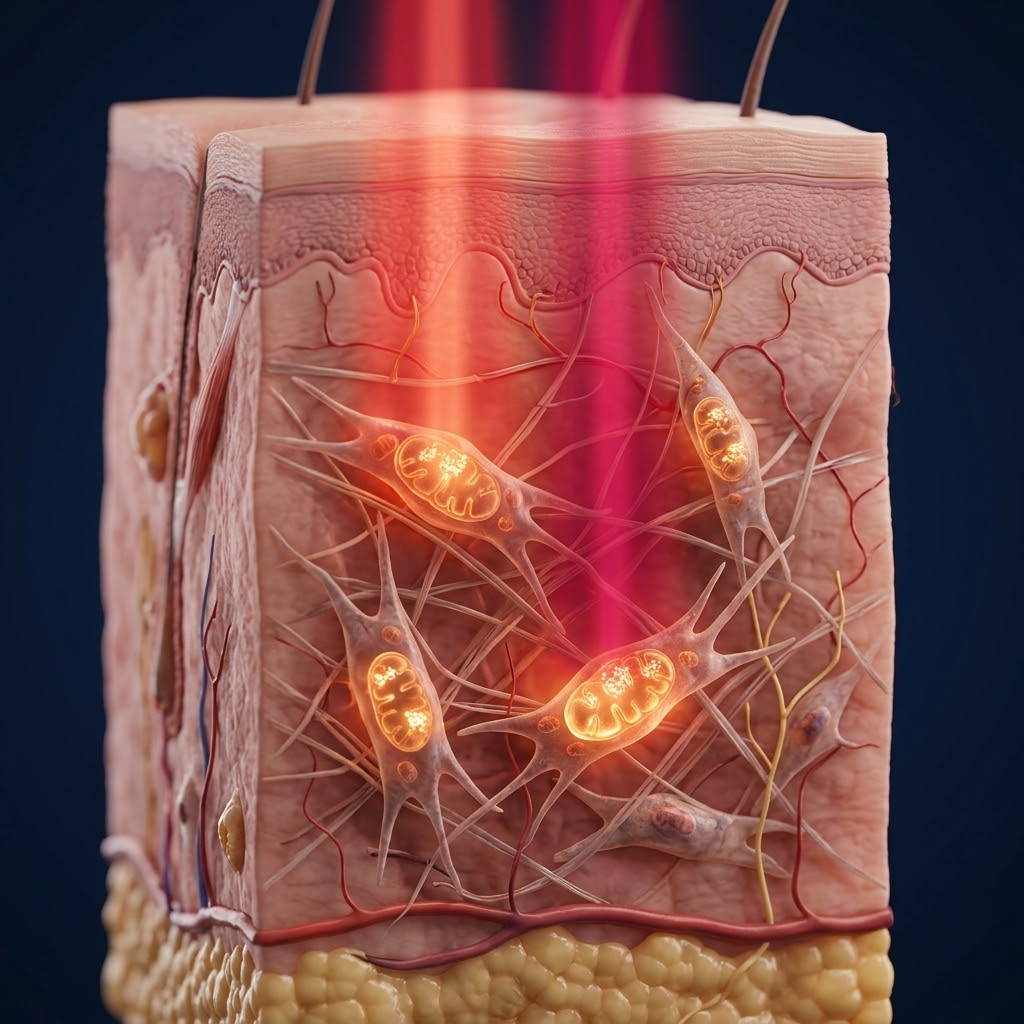
At its core, red light therapy is not a topical surface mask—it is a light-driven cellular fertilizer. When delivered at precise wavelengths, photons pass through the epidermis to stimulate Cytochrome c Oxidase (CCO) inside facial fibroblasts. This process boosts Adenosine Triphosphate (ATP) production, sparks neocollagenesis, and accelerates dermal repair. However, achieving these facial benefits requires exact optical energy density rather than dim, uncalibrated consumer lights.
Key Takeaway Red light therapy rejuvenates facial skin by stimulating mitochondrial ATP production, upregulating Type I and III collagen synthesis, and boosting microcirculation, provided the device delivers 30–60 mW/cm2 of targeted 630nm/660nm red and 810–850nm near-infrared light.
Table of Contents
- The Biological Engine: How Red Light Transforms Facial Skin Cells
- Mitochondrial Activation: Boosting ATP to Reenergize Aging Fibroblasts
- Neocollagenesis & Elastin Synthesis: Rebuilding the Dermal Scaffold
- Why Cheap Facial Devices Fail to Trigger Cellular Renewal (Factory Breakdown)
- Wavelength Drift: Why Unsorted Chips Miss the Mitochondrial Absorption Peak
- Irradiance Uniformity: Eliminating Cold Spots across Facial Contours
- Frequently Asked Questions (FAQ)
- Partner with a Certified Light Therapy Manufacturer
The Biological Engine: How Red Light Transforms Facial Skin Cells
The human face contains the highest density of facial expression muscles and microvascular networks, making it particularly responsive to Photobiomodulation (PBM). Rather than relying on thermal damage (like ablative lasers), red light triggers non-thermal photochemical reactions.
Red light therapy acts as an intracellular energy booster: absorbed photons stimulate mitochondrial respiration, increasing ATP production and activating collagen-producing fibroblast cells.
Mitochondrial Activation: Boosting ATP to Reenergize Aging Fibroblasts
When facial skin ages, cellular metabolism slows, leading to reduced collagen output and thinner dermal layers. Specific photons in the 630–660 nm range are absorbed by Cytochrome c Oxidase—the primary photoacceptor of red and near-infrared light—displacing inhibitory Nitric Oxide (NO). This allows oxygen to bind freely, driving ATP synthesis and restoring youthful cellular signaling. In controlled cell-culture studies, red and near-infrared exposure at therapeutic doses raised intracellular ATP levels by 15–20% within hours of irradiation.
Neocollagenesis & Elastin Synthesis: Rebuilding the Dermal Scaffold
Increased intracellular ATP fuels fibroblasts to manufacture pro-collagen, converting it into structural Type I and Type III collagen strands. Over an 8-to-12-week period of consistent use (clinical trials report measurable collagen-density gains after 30 sessions over ~15 weeks), this extracellular matrix remodeling thickens the dermis, softens fine lines, and improves elasticity around the eyes, mouth, and forehead.
Why Cheap Facial Devices Fail to Trigger Cellular Renewal (Factory Breakdown)
Delivering biological results to facial tissue requires strict optical physics. A teardown of low-cost consumer devices reveals why budget beauty masks fail to produce noticeable facial transformation.
Low-cost facial masks fail to stimulate fibroblasts because cheap LED diodes suffer from severe wavelength drift (±20 nm) and low power output (<10 mW/cm2), leaving cells under-dosed.
| Optical & Engineering Benchmark | Budget Consumer Facial Device ($20–$50) | Medical-Grade OEM Facial System ($150+) |
|---|---|---|
| Peak Spectral Accuracy | 610–680 nm (Broad, uncalibrated) | 630 nm/660 nm±3 nm (Precision binned) |
| Facial Irradiance Output | <10 mW/cm2 (Inadequate energy) | 30–60 mW/cm2 (Calibrated for dermal dose) |
| Energy Fluence per 10-Min Session | <3 J/cm2 (Sub-therapeutic) | 18–36 J/cm2 (Optimal clinical window) |
| Facial Ergonomics & Alignment | Rigid flat plastic (Hotspots & gaps) | 3D Ergonomic Flexible Silicone (Uniform coverage) |
| Thermal Decay Rate | >30% output drop within 15 minutes | <3% variance with copper-backed cooling |
Wavelength Drift: Why Unsorted Chips Miss the Mitochondrial Absorption Peak
Mitochondrial chromophores absorb light inside extremely narrow optical bands (630 nm±5 nm and 810–850 nm±5 nm). Cheap factory diodes sourced from unsorted bins scatter energy into dead zones (610 nm or 680 nm) that bounce off the stratum corneum as waste heat without sparking ATP synthesis.
Irradiance Uniformity: Eliminating Cold Spots across Facial Contours
The human face is 3-dimensional, featuring sharp contours around the nose, jawline, and orbital sockets. Rigid plastic masks create uneven distances between LEDs and the skin, causing severe energy drop-offs. High-performance devices utilize 3D ergonomic medical-grade silicone to keep diodes at a constant ~5mm proximity across all facial zones.
Frequently Asked Questions (FAQ)
Q1: How does red light therapy improve facial skin texture?
A: Red light therapy improves facial texture by stimulating fibroblast activity, which thickens the dermal layer with new collagen and elastin fibers while accelerating epidermal cell turnover to smooth rough patches and refine pores.
Q2: Can red light therapy help with facial redness and rosacea?
A: Yes. At low-to-moderate irradiance levels (20–30 mW/cm2), 630 nm red light helps reduce facial redness by modulating localized inflammation and stimulating microvascular repair without causing thermal irritation.
Q3: What optical test reports should brands request from manufacturers before launching a facial mask?
A: Brands must require an Integrating Sphere Spectroradiometer Report (confirming peak wavelength and radiant flux), Goniophotometer Irradiance Mapping (confirming uniform facial coverage), and IEC 62471 Photobiological Safety Clearance.
Partner with a Certified Light Therapy Manufacturer
Shenzhen Rainbow Technology Co., Ltd. (Rainbowdo) is an ISO 13485-certified OEM/ODM manufacturer specializing in high-performance LED facial beauty and medical therapy hardware.
- Custom Optical Engineering: 630 nm/660 nm/810 nm/850 nm dual/triple-chip configurations.
- Complete Regulatory Master Files: FDA 510(k) clearance packages, CE MDR, IEC 62471, and ISO 10993 biocompatibility testing.
- Precision SMT Manufacturing: Dust-free cleanroom production using platinum-cured medical-grade silicone.
👉 Contact Our OEM/ODM Engineering Team | ✉️ Direct Email: oem@rainbowdo.com
Academic & Industrial References
- Avci, P., et al. (2013). Low-Level Laser (Light) Therapy (LLLT) in Skin: Stimulating, Healing, Restoring. Seminars in Cutaneous Medicine and Surgery, 32(1), 41–52.
- Wunsch, A., & Matuschka, K. (2014). A Controlled Trial to Determine the Efficacy of Red and Near-Infrared Light Treatment in Patient Satisfaction, Reduction of Fine Lines, Wrinkles, Skin Roughness, and Intradermal Collagen Density Increase. Photomedicine and Laser Surgery, 32(2), 93–100. (Note: this trial used polychromatic 611–650 nm and 570–850 nm sources over 30 sessions.)
- International Electrotechnical Commission. (2006). IEC 62471: Photobiological Safety of Lamps and Lamp Systems. Geneva: IEC.