
What Makes a Good Red Light Therapy Mask: Your Ultimate Guide
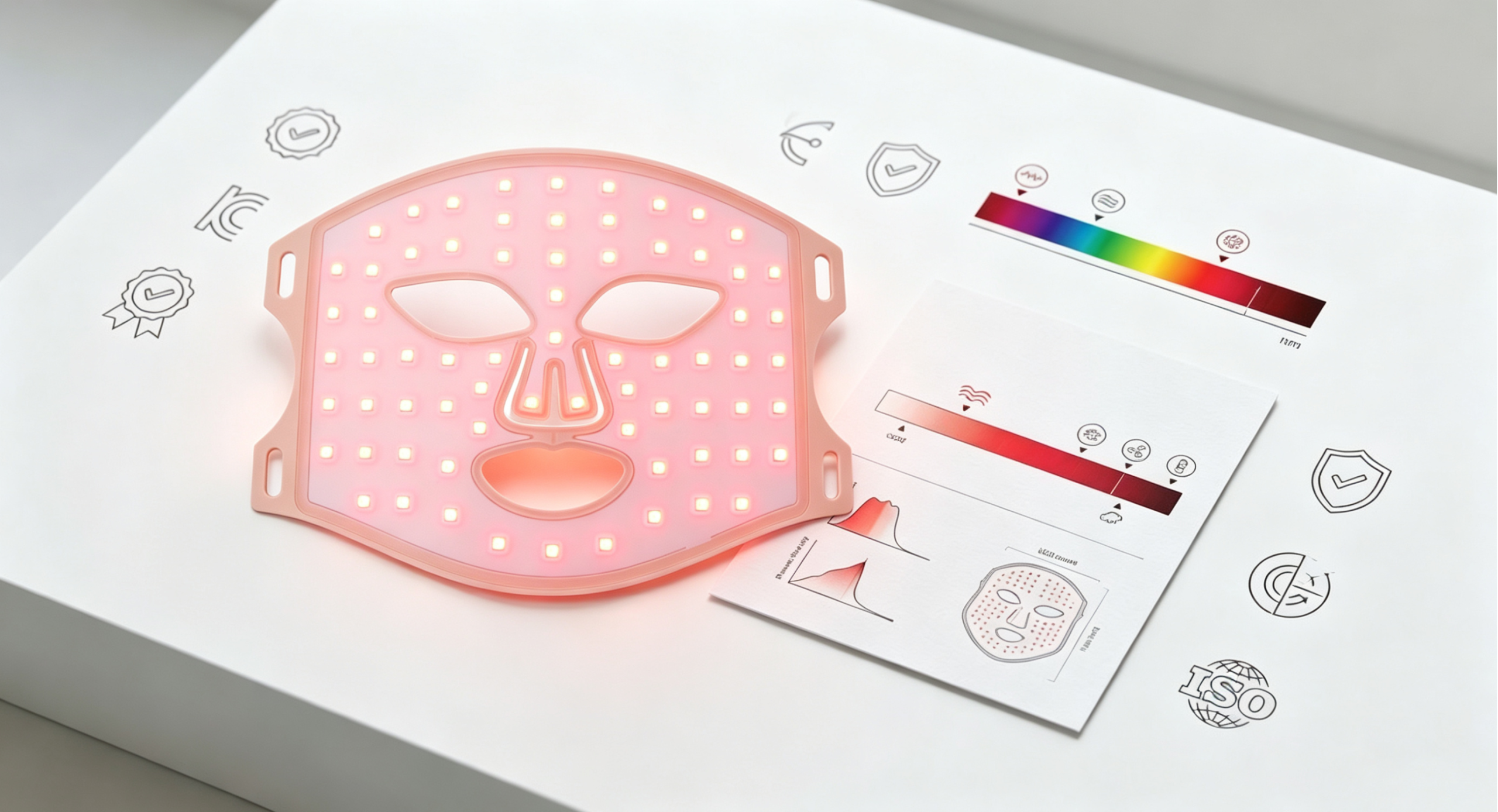
A good red light therapy mask meets six measurable standards: clinically proven wavelengths (red 630–660 nm, NIR ~830 nm, blue ~415 nm), published irradiance (30–50 mW/cm² or higher at skin), even LED coverage of wrinkle-prone zones, close-fitting medical-grade silicone, real certifications (FDA-cleared/registered, CE, ISO 13485 manufacturer), and sensible session design (~10 minutes). Each standard has a marketing trap version — “700 LEDs!”, “celebrity loved”, “instant glow” — that sells emotion, not photons[1][2].
Table of Contents
- 1. Understanding Red Light Therapy Masks
- 2. Six Standards of a Good Mask — and Their Marketing Traps
- 3. Why 10 Minutes Became the Standard Session
- 4. A Mask That Passes All Six Standards
- 5. Tips to Maximize Your Mask’s Benefits
- 6. Partner With Rainbow Technology for Custom LED Devices
- 7. References & External Links
1. Understanding Red Light Therapy Masks
Red light therapy masks deliver specific wavelengths to the skin — therapeutic red at 630–660 nm for collagen and cellular repair in the upper dermis, and near-infrared around 830 nm for deeper tissue effects. Some add blue (~415 nm) for acne. The treatment is gentle, non-invasive, and requires no downtime — which is exactly why the at-home category exploded[1][2]. For the full mechanism, see what red light does to your skin.
2. Six Standards of a Good Mask — and Their Marketing Traps
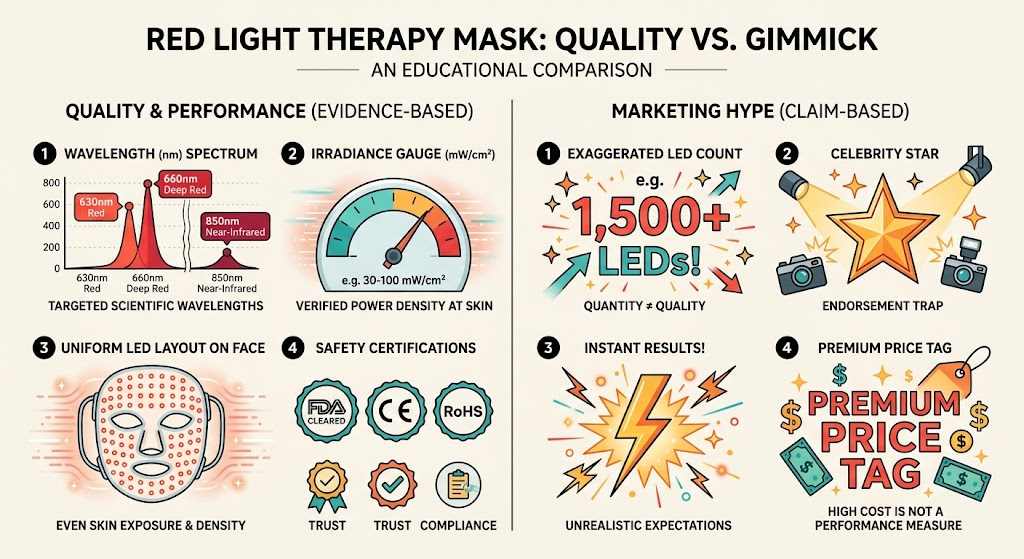
Every feature a marketer highlights has a measurable version that actually matters. Here is the comparison table worth saving:
| Standard (what makes it good) | Marketing Trap (what sells it) |
|---|---|
| 1. Clinically proven wavelengths Red 630–660 nm, NIR ~830 nm, blue ~415 nm, stated in nm with tolerance[1][2] |
“Red + infrared light” with no nm values. A 900 nm “infrared” heats skin; it does not photobiomodulate[3] |
| 2. Published irradiance 30–50 mW/cm² or higher, measured at skin contact; dose = irradiance × time[1] |
“High power!” with no number. If the mW/cm² is unpublished, it is unverifiable |
| 3. Even coverage of target zones LEDs distributed across forehead, crow’s feet, nasolabial folds, jawline |
“700 LEDs!” — count without layout. Clustered LEDs deliver uneven dose |
| 4. Close, conforming fit Medical-grade silicone; intensity falls with distance from skin |
“Featherlight!” — a mask that floats off the face wastes dose |
| 5. Real certifications FDA-cleared/registered, CE, ISO 13485 manufacturing[4] |
“Clinically tested!” with no study, no registration number, no verifiable claim |
| 6. Sensible session design ~10-minute sessions, 3–5×/week, auto-timer |
“Instant glow!” — results are cumulative over 8–12 weeks, not immediate[2] |
The pattern is simple: good masks publish numbers; gimmicks publish adjectives. For the checklist version of this guide (with the exact spec questions to ask), see what to look for in a red light mask.
3. Why 10 Minutes Became the Standard Session
“10 minutes” is not arbitrary — it is the result of a dose calculation. Photobiomodulation follows a biphasic dose response: below the effective window nothing happens, above it the same pathways are inhibited[1]. Clinical protocols typically target roughly 30–60 J/cm² per session. At an irradiance of 50 mW/cm², that is:
50 mW/cm² × 600 seconds (10 min) = 30 J/cm²
That is why well-designed masks land on ~10 minutes: it is the session length that puts a typical device into the therapeutic window. Longer is not automatically better — over-dosing can blunt the effect. Frequency and consistency (3–5×/week for 8–12 weeks) matter as much as session length[2]. Frequency science: how often to use a red light mask.
4. A Mask That Passes All Six Standards
An example of a mask built to the six standards above — and one we can verify because we manufacture it:
| Standard | Rainbow Wrinkle Retreat Mask |
|---|---|
| Wavelengths | Red 630 nm + NIR 830 nm, published with tolerance |
| Irradiance | Published mW/cm² spec at skin contact |
| Coverage | LED array laid out for forehead, crow’s feet, and jawline zones |
| Fit | Flexible medical-grade silicone, conforming contact |
| Certification | FDA-cleared; CE; ISO 13485 manufacturing[4] |
| Session | 10-minute sessions with auto-timer, 3–5×/week protocol |
It is built to the same standards as our OEM/ODM production line — because it is. If you are comparing masks, apply the six standards to every candidate; for format trade-offs see mask vs. panel, and for multi-wavelength options 7-color masks.
5. Tips to Maximize Your Mask’s Benefits
- Consistency is key: 3–5 sessions per week for at least 8–12 weeks — the window where clinical endpoints are measured[2].
- Start clean and dry: light penetrates best on clean skin — pre-LED guide.
- Pair with hydration: hyaluronic acid serums around sessions enhance results, especially for dry skin.
- Avoid photosensitizers: skip retinoids and exfoliants immediately before/after treatment to prevent irritation.
- Protect your eyes: use built-in shielding or provided eye protection every session.
6. Partner With Rainbow Technology for Custom LED Devices
The six standards above are not marketing copy — they are manufacturing decisions: wavelength binning, irradiance calibration, LED layout, silicone molding, and quality systems. That is the daily work of Rainbow Technology’s Shenzhen R&D and production teams. As an ISO 13485, CE, and FDA-compliant LED device manufacturer, we support:
- Custom mask, panel, and multi-wavelength device design with verified optical specifications.
- ODM/OEM production — including private label — from prototyping to mass production.
- Full regulatory documentation (ISO 13485, CE, FDA 510(k) support) for your market entry.
Building a light therapy brand? Visit our OEM/ODM Manufacturing Page or request your custom quote today.
