
What Does Red Light Do to Your Skin? Exploring the Benefits of Red Light Therapy
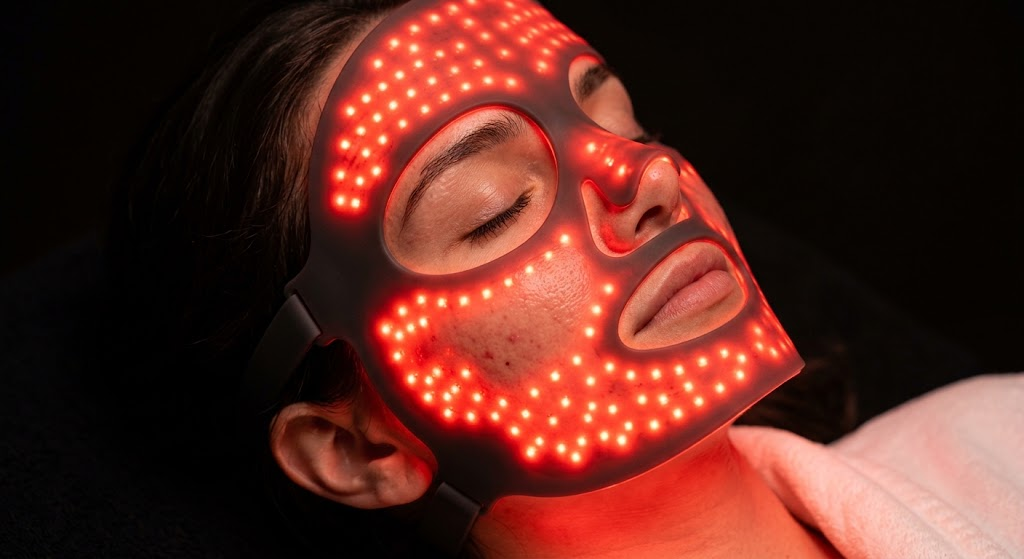
Red light (620–750 nm) penetrates the epidermis and upper dermis, where photons are absorbed by mitochondria in skin cells — most importantly fibroblasts. The resulting ATP boost increases collagen and elastin production[1][2], reduces inflammation[3], and supports healing[4]. A 2023 RCT measured a 30% reduction in wrinkle volume after 10 sessions[5]. For acne, red light’s role is anti-inflammatory — bacterial killing belongs to blue light. Results accumulate over 8–12 weeks of consistent use[2].
Table of Contents
- 1. The Mechanism Chain: Photon to Collagen
- 2. What Red Light Does — Effect by Effect
- 3. The Timeline: What to Expect and When
- 4. How to Incorporate It Into Your Routine
- 5. Choosing a Device That Actually Delivers
- 6. Partner With Rainbow Technology for Custom LED Devices
- 7. References & External Links
1. The Mechanism Chain: Photon to Collagen
What does red light do to your skin? The honest answer is a four-step cellular chain reaction — none of it visible during the session itself:
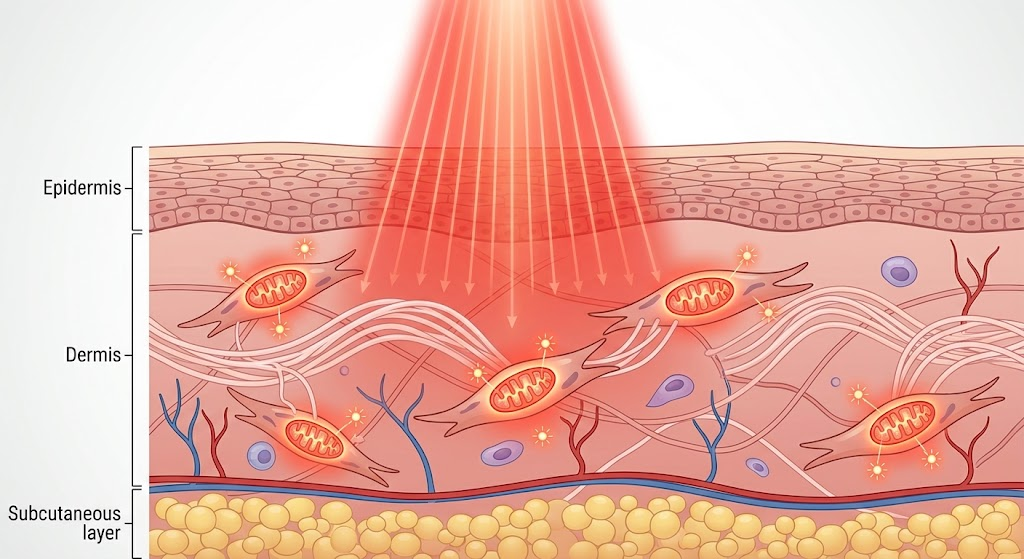
- Penetration. Red light (620–750 nm) passes through the epidermis into the upper dermis — deeper than blue or green, shallower than near-infrared. It is absorbed, not by melanin or water (which is why it does not burn or heat), but by chromophores inside cells[1][6].
- Mitochondrial activation. Photons are absorbed by cytochrome c oxidase in mitochondria, boosting ATP production and triggering a controlled signaling response[1].
- Fibroblast response. With more energy, fibroblasts — the collagen-making cells of the dermis — increase synthesis of collagen and elastin, the proteins responsible for firmness and elasticity[1][2].
- Tissue-level outcome. Over weeks of consistent use, more collagen means fewer fine lines, firmer skin, and better texture — the visible results[5].
2. What Red Light Does — Effect by Effect
Here is each claimed effect, matched to its mechanism and the strength of the evidence — with an honest note where marketing overstates:
| Effect | Mechanism | Evidence |
|---|---|---|
| Collagen & elastin stimulation | Fibroblast ATP boost → protein synthesis | Strong — 31-RCT systematic review; 2023 RCT: −30% wrinkle volume after 10 sessions[2][5] |
| Inflammation & redness reduction | Macrophage modulation, reduced inflammatory markers | Strong — reproducible across studies[3] |
| Wound healing & scar reduction | Cell proliferation and repair signaling | Moderate-strong — multiple reviews[4] |
| Tone, texture & radiance | Improved circulation and cellular turnover | Supported by clinical outcomes in RCTs[2] |
| Acne support | Anti-inflammatory (NOT antibacterial — that is blue light) | Adjunctive role; pair with blue for bacteria[3] |
One common claim needs correcting: red light does not “target bacteria.” That is the job of blue light (~415 nm), which activates porphyrins inside acne bacteria[7]. Red light’s contribution to acne is calming the inflammation around lesions. For the full picture, see our blue light therapy guide and the benefits of red light for skin.
3. The Timeline: What to Expect and When
Collagen remodeling is slow by nature — which is why the results timeline is honest about accumulation:
| Timeframe | What Changes |
|---|---|
| Session 1–2 | No visible change. Cellular processes are starting; some users notice better “glow” from improved circulation |
| Weeks 3–6 | Texture and tone improvements become noticeable; inflammation-related redness calms[3] |
| Weeks 8–12 | Peak cumulative effect: firmer skin, reduced fine lines — consistent with RCT endpoints at 8–12 weeks[2][5] |
4. How to Incorporate It Into Your Routine
- Frequency: 10–20 minutes per session, 3–5 times per week — the cadence used in clinical protocols. See how often to use a red light mask for the frequency science.
- Before the session: clean, dry skin maximizes light delivery. What you should (and shouldn’t) put on your face first — our pre-LED guide.
- Device format: mask vs. panel vs. wand changes coverage and convenience — compare formats.
- Patience: this is a cumulative therapy. The 8–12 week mark is where the evidence measures results[2].
5. Choosing a Device That Actually Delivers
“Red light” is a range, not a specification. A device that works needs three things published on its spec sheet:
- Exact wavelength in nm (therapeutic red: 620–650 nm, not “red” with no number).
- Irradiance in mW/cm² at the treatment distance — dose = irradiance × time, and underpowered devices cannot reach clinical doses[1].
- Certifications: CE, FDA registration, and an ISO 13485 manufacturer as the quality baseline[8].
For the wavelength science behind these numbers, see the science of red light wavelengths; for red vs. near-infrared depth trade-offs, red light vs. infrared.
6. Partner With Rainbow Technology for Custom LED Devices
What red light does to skin is biology; delivering it consistently is engineering. Wavelength tolerance, uniform irradiance across the treatment surface, and thermal management decide whether a mask performs — and they are the daily work of Rainbow Technology’s Shenzhen R&D team. As an ISO 13485, CE, and FDA-compliant LED device manufacturer, we support:
- Custom red / NIR / multi-wavelength mask and panel design with verified optical specifications.
- ODM/OEM production from prototyping to mass production, including private label.
- Full regulatory documentation (ISO 13485, CE, FDA 510(k) support) for your market entry.
Launching a light therapy device brand? Visit our OEM/ODM Manufacturing Page or request your custom quote today.

