
Red Light Therapy for Arthritis: Does It Really Work?
30-Second Summary:
Yes — but only at the right dose. The largest meta-analysis to date (22 randomized trials, 1,063 patients) found red/near-infrared light significantly reduces knee osteoarthritis pain, with the effect peaking at 2–4 weeks after treatment — while another meta-analysis found no effect. The difference? Dose and device quality. This guide covers the honest evidence, the mechanism, and how to choose a device that delivers a clinically meaningful dose.
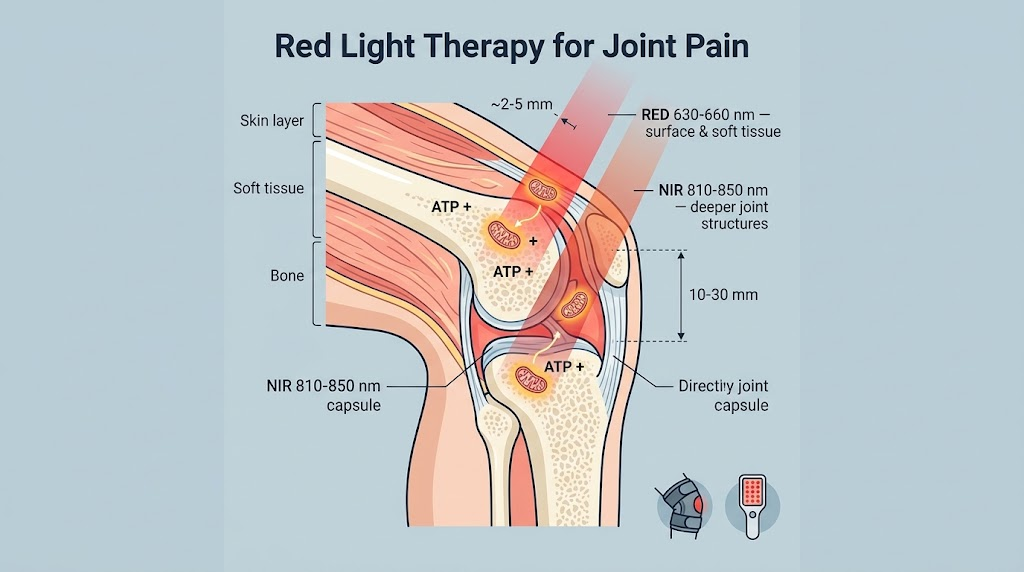
Table of Contents
- 1. Quick Answer: Is Red Light Good for Arthritis?
- 2. The Science: How Photobiomodulation Works on Joints
- 3. Comparing Arthritis Relief Options
- 4. What the Clinical Research Says (Including the Conflicts)
- 5. A Dose-Based Home Protocol
- 6. Frequently Asked Questions
- 7. Partner With Rainbow Technology
- 8. References
1. Quick Answer: Is Red Light Good for Arthritis?
Yes — when the dose is right. The strongest meta-analysis to date (22 randomized placebo-controlled trials, 1,063 knee osteoarthritis patients) found that light therapy significantly reduces pain and disability, with no adverse events reported[1]. The effect peaked 2–4 weeks after the end of treatment, at about 32 mm on a 100 mm visual analog scale beyond placebo in the recommended-dose subgroup.
For rheumatoid arthritis, an earlier Cochrane-style meta-analysis found pain reduced by ~70% relative to placebo, with morning stiffness reduced by 27.5 minutes[2].
The honest caveat: evidence is mixed. Another meta-analysis (9 trials, 518 patients) found no significant effect[3]. The gap between positive and negative trials comes down to dose and device quality — which is exactly what this guide will help you evaluate.
2. The Science: How Photobiomodulation Works on Joints
Red light therapy doesn’t just heat the skin — it triggers a biological process called photobiomodulation. When red and near-infrared photons reach joint tissue, they interact with the mitochondria, the “power plants” of your cells[4].
- Increased ATP production: Light stimulates cytochrome c oxidase, boosting ATP — more energy means faster cell repair.
- Inflammation suppression: Down-regulates pro-inflammatory cytokines such as IL-6 and TNF-α[4].
- Nitric oxide release: Dilates blood vessels, improving delivery of oxygen and nutrients to oxygen-starved joint capsules.
- Cartilage support: Early studies suggest near-infrared light can stimulate chondrocytes, potentially supporting cartilage maintenance in osteoarthritis.
3. Comparing Arthritis Relief Options
| Feature | Red Light Therapy | NSAIDs (Painkillers) | Surgery / Injections |
|---|---|---|---|
| Effectiveness | Moderate–high, dose-dependent[1] | Moderate (temporary) | High (varies) |
| Pain source | Targets cellular repair & inflammation | Masks pain signals | Structural repair |
| Side effects | Minimal: non-thermal, no UV; possible mild transient redness at high dose | High (gastric, kidney, cardiovascular risks with long-term use) | High (infection, recovery time) |
| Convenience | At-home, non-invasive, no downtime | Daily pills | Hospital-based, recovery period |
Note: Light therapy is a complementary tool, not a replacement for prescribed medication. Always discuss changes to your treatment plan with your clinician.
4. What the Clinical Research Says (Including the Conflicts)
You don’t have to take our word for it — but you should also know that the literature isn’t one-sided. Here’s the honest picture:
- Knee osteoarthritis (positive): Stausholm 2019, BMJ Open — 22 randomized placebo-controlled trials, 1,063 patients. Pain significantly reduced vs placebo; disability improved; no adverse events. Recommended-dose subgroup peaked at 31.87 mm VAS above placebo at 2–4 weeks follow-up. Effective doses: 4–8 J per treatment point at 785–860 nm, or 1–3 J at 904 nm[1].
- Rheumatoid arthritis (positive): Bjordal 2003 meta-analysis — pain reduced ~70% vs placebo, morning stiffness reduced 27.5 minutes[2].
- Knee osteoarthritis (negative): Huang 2015, Osteoarthritis and Cartilage — 9 trials, 518 patients. No significant difference vs sham in pain or function[3].
Why the conflict? The negative meta-analysis pooled trials with widely varying doses, wavelengths, and treatment sites. The positive one grouped trials by dose and found a clear dose–response relationship. The practical takeaway: the dose is the medicine — a device that under-delivers (weak irradiance, wrong wavelengths, poor contact) is exactly what produces “no effect” results.
5. A Dose-Based Home Protocol
Rather than a memorized “rule,” use the physics: Dose (J/cm²) = Irradiance (mW/cm²) × Time (seconds) ÷ 1000. Target roughly 4–8 J/cm² per treatment area, which matches the effective window in the clinical trials[1].
- Wavelength synergy: Use a device that combines red (630–660 nm) for surface and soft-tissue inflammation with near-infrared (810–850 nm) for deeper joint structures. NIR is the workhorse for joints — see our NIR explainer.
- Irradiance at the skin: Wearable wraps typically deliver ~40–60 mW/cm² at the treatment surface; panels 50–120 mW/cm² at their working distance. Ask the supplier for the spec at the distance you’ll actually use it.
- Session math: At ~50 mW/cm², a 15-minute session delivers ~45 J/cm² across the wavelength mix — comfortably in range per treatment area. For a single joint wrap, 10–20 minutes per joint is a sensible starting point.
- Frequency & reassessment: 3–5 sessions per week for 4–6 weeks, then reassess. The trial data shows effects persisting weeks after treatment ends[1].
- Skin contact: Keep the light source as close to the skin as possible — distance increases light scatter and reduces delivered dose. See our session duration guide for the full timing logic.
6. Frequently Asked Questions
Q: Will it get rid of my arthritis completely?
A: There is currently no cure for arthritis. Red light therapy is an evidence-supported tool for managing symptoms — pain and stiffness — and may support joint health over time. It is not a replacement for medical treatment.
Q: Can I use it on my hands?
A: Yes. Small joints in fingers and wrists respond well; the meta-analyses included hand treatments for RA with positive results[2].
Q: Are there any risks?
A: Red/near-infrared light is UV-free and non-thermal, and the meta-analysis reported no adverse events[1]. Very high irradiance can cause transient redness. Use eye protection with high-power panels. If you take photosensitizing medication or have a medical condition, check with your clinician first.
7. Partner With Rainbow Technology
Joint relief devices live or die on delivered dose. At Rainbow, we design wraps, pads, and panels for measurable output:
- Medical-grade LED chips: Stable 630–660 nm red and 810–850 nm near-infrared channels, verified by spectrometer per batch — no “drift” chips.
- Ergonomic wraps: Contoured for knees, elbows, and wrists so the light stays close and consistent — the difference between delivered dose and lost dose.
- Verified compliance: CE, RoHS, FCC, KC certificates; ISO 13485 + MDSAP certified QMS; FDA registration compliance documentation; IEC 62471 photobiological safety.
- OEM/ODM from concept to certification. Consult our engineering team; reference designs on our product lineup page.
Request your custom quote today.
8. References
[1] Stausholm MB, Naterstad IF, Joensen J, et al.
Efficacy of low-level laser therapy on pain and disability in knee osteoarthritis: systematic review and meta-analysis of randomised placebo-controlled trials. BMJ Open. 2019;9(10):e031142.
[2] Bjordal JM, Couppé C, Chow RT, Tunér J, Ljunggren EA.
A systematic review of low level laser therapy with location-specific doses for pain from chronic joint disorders. Australian Journal of Physiotherapy. 2003;49(2):107-116.
[3] Huang Z, Chen J, Ma J, Shen B, Pei F, Kraus VB.
Effectiveness of low-level laser therapy in patients with knee osteoarthritis: a systematic review and meta-analysis. Osteoarthritis and Cartilage. 2015;23(9):1437-1444.
[4] Hamblin MR.
Mechanisms and applications of the anti-inflammatory effects of photobiomodulation. AIMS Biophysics. 2017;4(3):337-361.

