
Should You Wash Your Face After a Mask?
The short answer: it depends on the mask type. Sheet, hydrogel, overnight, and red light therapy masks are leave-on — you do not wash after. Clay, mud, and peel-off masks are rinse-off — you must wash to remove the product and impurities. For red light therapy masks, the key is washing before, not after. This guide gives you the quick reference table, per-type rules, and the common mistakes to avoid.
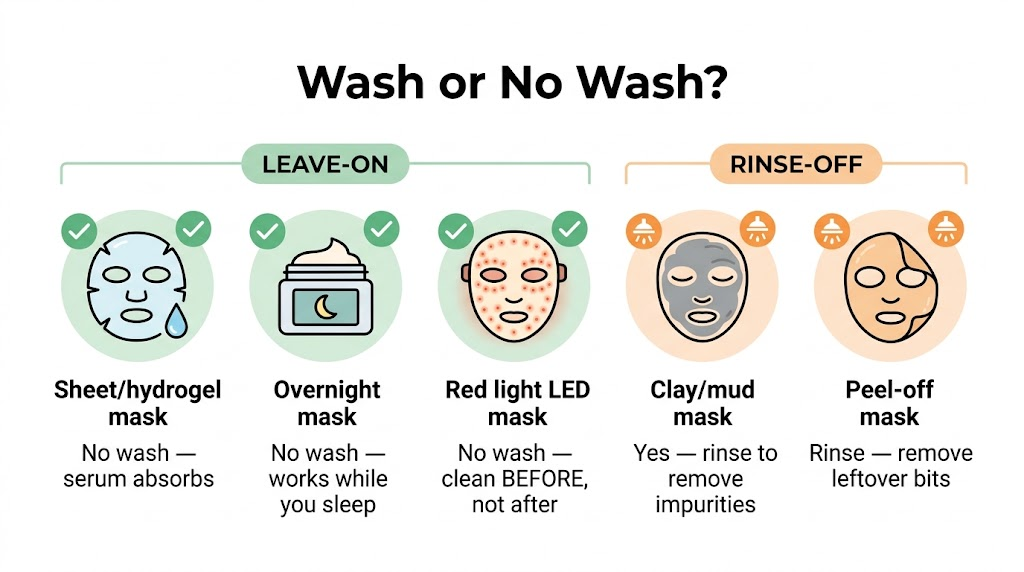
Table of Contents
- 1. Quick Reference Table
- 2. Sheet & Hydrogel Masks: Leave It Be
- 3. Clay & Exfoliating Masks: The Clean Rinse
- 4. Red Light Therapy Masks: The “Clean Start” Rule
- 5. Overnight Masks: Sleep-On Hydration
- 6. Common Post-Mask Mistakes to Avoid
- 7. Frequently Asked Questions
- 8. Partner With Rainbow Technology
- 9. References
1. Quick Reference Table
| Mask Type | Wash After? | Why |
|---|---|---|
| Sheet / Hydrogel | No | Residue is concentrated serum meant to absorb. |
| Clay / Mud | Yes | Detoxifiers that need rinsing to remove impurities. |
| Peel-Off | Rinse only | Rinse away tiny leftover bits; no full cleanse needed. |
| Red Light Therapy | No | Wash before the session, not after. |
| Overnight | No | Designed to work as your final moisturizer while you sleep. |
2. Sheet & Hydrogel Masks: Leave It Be
Sheet masks are essentially a delivery system for concentrated serums.
- The rule: Do not wash your face. After removing the sheet, gently pat the remaining liquid into your skin.
- Sticky residue? If your skin feels too sticky, it’s usually a sign the mask was left on too long (past ~20 minutes), causing the serum to dry on the surface rather than absorb.
- Pro tip: Seal it in with a light moisturizer to prevent evaporation.
3. Clay & Exfoliating Masks: The Clean Rinse
Clay masks (kaolin, charcoal, etc.) are designed to pull impurities out of your pores. Once they dry, they hold onto those impurities.
- The rule: Yes, rinse thoroughly with lukewarm water.
- Common mistake: Using a harsh foaming cleanser after a clay mask. This strips your skin’s natural oils and can damage the skin barrier. Just use water and a soft cloth.
4. Red Light Therapy Masks: The “Clean Start” Rule
Red light therapy masks work differently. They don’t use liquid — they use photons to stimulate cellular repair via photobiomodulation[1].
- Do you wash your face after? No.
- The protocol: You must wash your face before the session. Dirt, makeup, and especially SPF can block or scatter the light wavelengths (typically 630–660 nm red and 810–850 nm near-infrared), reducing the dose that reaches your skin[2].
- Post-session care: After your 10–20 minute session, your skin cells are in an “active” state. This is the ideal time to apply a high-quality hyaluronic acid or peptide serum — blood flow is increased and the skin is primed for absorption.
See our results timeline guide for how long it takes to see visible changes.
5. Overnight Masks: Sleep-On Hydration
- The rule: Do not wash. Overnight masks are designed to work as your final moisturizer while you sleep.
- The morning after: Rinse with lukewarm water as part of your regular morning cleanse.
6. Common Post-Mask Mistakes to Avoid
- Using hot water: This can inflame the skin and cause redness. Always use lukewarm or cool water.
- Skipping moisturizer: Even a hydrating mask needs a “seal.” Without a moisturizer, hydration can evaporate through transepidermal water loss.
- Over-masking: Using a clay mask every day can lead to reactive oil production. Stick to 1–2 times per week for clay, and 3–5 times per week for red light therapy.
7. Frequently Asked Questions
Q: My face feels sticky after a sheet mask. Can I at least splash water?
A: If the stickiness is unbearable, you can lightly splash your face with water, but do not use a cleanser. It’s better to use the excess serum on your neck and chest.
Q: Can I use red light therapy right after a clay mask?
A: Yes! A clay mask cleans the “canvas,” and red light therapy then helps heal and rejuvenate the skin. Just ensure the clay is completely rinsed off first so the light isn’t blocked.
Q: Should I apply toner after a mask?
A: Toner usually comes before a mask to balance pH. After a mask, move straight to serums or moisturizers.
8. Partner With Rainbow Technology
Maximizing your skincare investment comes down to understanding the “leave-on” vs. “wash-off” principle — and, for red light therapy, using hardware engineered to deliver the right dose. At Rainbow:
- Multi-wavelength precision: Masks with verified 630–660 nm red, 415 nm blue (acne), and 810–850 nm near-infrared channels — engineered to match the parameters validated in published research[3][4].
- Maximum absorption: Flexible, medical-grade silicone masks deliver a snug fit so every cm² of your skin receives consistent irradiance — not a “close enough” approximation.
- Safety first: Built to international standards, with CE, RoHS, FCC, KC certificates, ISO 13485 + MDSAP certified QMS, and FDA registration compliance documentation.
- OEM/ODM from concept to certification. Consult our engineering team; reference designs on our product lineup page.
Request your custom quote today.
9. References
[1] Hamblin MR.
Mechanisms and applications of the anti-inflammatory effects of photobiomodulation. AIMS Biophysics. 2017;4(3):337-361.
[2] Wunsch A, Matuschka K.
A controlled trial to determine the efficacy of red and near-infrared light treatment in patient satisfaction, reduction of fine lines, wrinkles, skin roughness, and intradermal collagen density increase. Photomedicine and Laser Surgery. 2014;32(2):93-100.
[3] Papageorgiou P, Katsambas A, Chu A.
Phototherapy with blue (415 nm) and red (660 nm) light in the treatment of acne vulgaris. British Journal of Dermatology. 2000;142(5):973-978.
[4] Kwon HH, Lee SK, Choi YS, et al.
Combined 420-nm blue and 660-nm red light-emitting diode phototherapy shows significant improvement in acne vulgaris: a randomized, double-blind, sham-controlled trial. British Journal of Dermatology. 2013;168(6):1288-1294.

