
What Is a Red Light Therapy Mask? The Science Behind the Glow
An LED mask is a wearable photobiomodulation device — it delivers specific wavelengths of red and near-infrared light that penetrate the skin and are absorbed by mitochondrial cytochrome c oxidase, boosting ATP production and triggering a cascade of cellular repair[1]. The difference between a clinical tool and a beauty gadget comes down to two engineering variables: irradiance (power density) — whether the light is strong enough to trigger a response — and wavelength stability — whether 850 nm is actually 850 nm or a cheap approximation. Those are the variables a source manufacturer controls, and they are exactly what determine whether a mask delivers results or just glows.
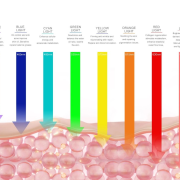
Table of Contents
- 1. The Science: Recharging Cellular “Batteries”
- 2. Why the Source of the Mask Matters
- 3. FAQ: Honest Insights From the Factory
- 4. Partner With Rainbow Technology
- 5. References
1. The Science: Recharging Cellular “Batteries”
An LED mask is a wearable bio-hacking tool — not a surface treatment. It emits specific wavelengths, usually red (630–660 nm) and near-infrared (830–850 nm), that penetrate the skin and are absorbed by mitochondrial cytochrome c oxidase (COX) — the photoacceptor in the mitochondrial respiratory chain. This absorption increases mitochondrial membrane potential, boosting ATP (cellular energy) production and triggering a cascade of cellular repair signals[1].
Think of mitochondria as the batteries of your cells. When they absorb this light, they produce more ATP — and that energy triggers three observable repair pathways:
- The collagen spark: Red light stimulates dermal fibroblasts to synthesize new collagen and elastin, reducing fine lines from the inside out — confirmed in randomized trials measuring intradermal collagen density increases[2][3].
- The circulation boost: The light promotes nitric-oxide-related vasodilation and increased microcirculation, delivering oxygen and nutrients to where skin needs to heal.
- The inflammation kill-switch: Photobiomodulation modulates pro-inflammatory cytokine production and reduces oxidative stress, calming redness and supporting post-procedure recovery[1].
2. Why the Source of the Mask Matters
Most masks on the market are the same generic designs with different logos. At Rainbow, we are a source manufacturer — we control the two engineering variables that determine your results:
- Irradiance (power density): If the light isn’t powerful enough, it just bounces off the skin. We calibrate our masks to hit the therapeutic irradiance threshold — the minimum power density at which mitochondrial response actually triggers. Cheap masks often advertise wattage without specifying the irradiance (mW/cm²) at the treatment distance, which is the number that matters.
- Wavelength stability: We test every production batch to verify that 850 nm is actually 850 nm. Near-infrared is invisible to the eye — many factories cut corners and ship 940 nm (common cheap NIR peak) while calling it “850 nm.” At Rainbow, we use spectrometer verification. Near-infrared is the heavy lifter for deep tissue and inflammation, which is why we don’t skip it.

3. FAQ: Honest Insights From the Factory
Q: Why do some masks have blue light too?
A: Because acne and aging often go hand-in-hand. While red light heals, blue light at 415 nm is absorbed by bacterial porphyrins in Cutibacterium acnes, generating reactive oxygen that kills the bacteria at the surface — a mechanism confirmed in the landmark acne RCT[4]. Multi-mode masks let you switch wavelengths based on your skin’s needs each day.
Q: Can I see the Near-Infrared (NIR) light?
A: No — if you see it, it isn’t NIR. In a Rainbow mask, the 850 nm LEDs look like they’re “off,” but they’re doing the deepest work. We include them because NIR is the wavelength that reaches muscle and joint tissue, which is why we don’t skip it.
Q: Will it make my skin feel hot?
A: High-quality LEDs generate light, not heat. You may feel a very slight, relaxing warmth — but a “hot” mask usually means poor-quality chips that waste energy as heat. Medical-grade silicone construction ensures thermal dissipation while keeping the LEDs close to the skin.
Q: Is it safe for daily use?
A: Yes — but more isn’t always better. Photobiomodulation follows a biphasic dose-response curve: too little won’t trigger a response, and excessive exposure doesn’t add benefit. We recommend 10–15 minutes once a day. Think of it like a daily multivitamin for your skin. See our session duration guide for the full dose explanation.
4. Partner With Rainbow Technology
Experience the difference of source technology. Don’t settle for middleman markups and unverified specs. Get the precision of the Rainbow source factory — where clinical-grade technology meets home-use convenience:
- Looking to start a brand? We offer full OEM/ODM services with low MOQs, spectrometer batch verification, and factory-direct engineering support. Consult our engineers to spec your first production run.
- Looking for the best mask? Experience the Rainbow product lineup, or request a quote and virtual factory tour.
Rainbow (R&S) delivers ISO 13485, CE, and FDA registration compliance documentation from our Shenzhen facility. Request your custom quote today.
5. References
[1] Hamblin MR.
Mechanisms and applications of the anti-inflammatory effects of photobiomodulation. AIMS Biophysics. 2017;4(3):337-361.
[2] Wunsch A, Matuschka K.
A controlled trial to determine the efficacy of red and near-infrared light treatment in patient satisfaction, reduction of fine lines, wrinkles, skin roughness, and intradermal collagen density increase. Photomedicine and Laser Surgery. 2014;32(2):93-100.
[3] Barolet D, Roberge CJ, Auger FA, et al.
Regulation of skin collagen metabolism in vitro using a pulsed 660 nm LED light source: clinical correlation with a single-blinded study. Journal of Investigative Dermatology. 2009;129(12):2751-2759.
[4] Papageorgiou P, Katsambas A, Chu A.
Phototherapy with blue (415 nm) and red (660 nm) light in the treatment of acne vulgaris. British Journal of Dermatology. 2000;142(5):973-978.
[5] Jagdeo J, Austin E, Mamalis A, et al.
Light-emitting diodes in dermatology: a systematic review of randomized controlled trials. Lasers in Surgery and Medicine. 2018;50(6):613-628.

