
What Is Blue Light Therapy For? A Comprehensive Guide to Its Benefits and Uses
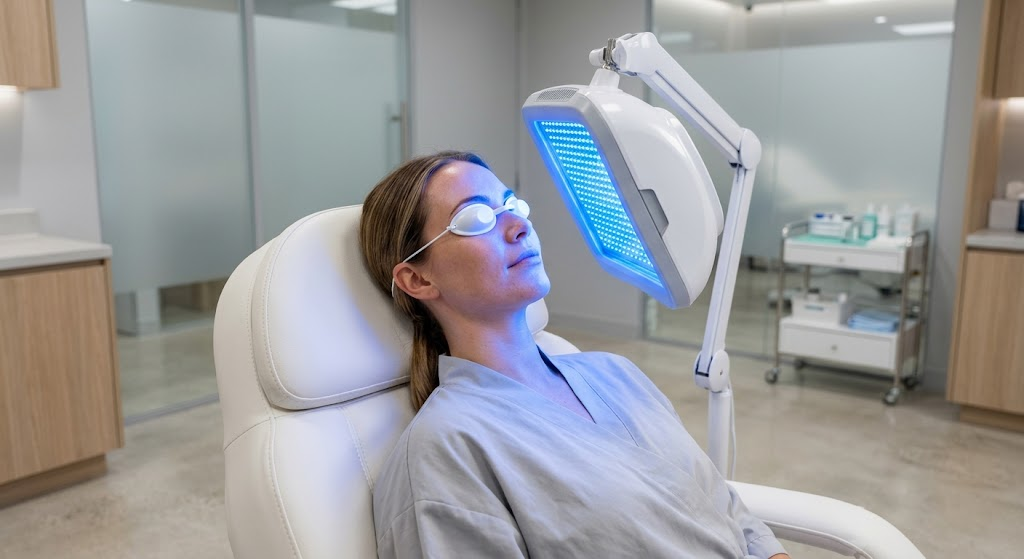
“Blue light therapy” names two different treatments. Blue LED light (~415 nm) needs no drug: it activates porphyrins inside acne bacteria to kill them — RCTs show 59–67% reduction in inflammatory acne lesions[3]. Clinical PDT applies a photosensitizer (ALA) first, then blue light, and is FDA-approved for actinic keratoses — precancerous lesions — with Phase 3 complete-response rates around 77%[4]. Recovery differs too: LED has no downtime; PDT causes days of redness and peeling. This guide separates the two so you know what to expect.
Table of Contents
- 1. Two Treatments, One Name: Blue LED vs. PDT
- 2. What Blue Light Actually Does
- 3. Key Uses and Benefits, Matched to Evidence
- 4. What to Expect: LED Session vs. PDT Session
- 5. Aftercare and Safety
- 6. Who Should Consider It — and Who Shouldn’t
- 7. Partner With Rainbow Technology for Custom LED Devices
- 8. References & External Links
1. Two Treatments, One Name: Blue LED vs. PDT
Many articles — and even some clinics — use “blue light therapy” and “photodynamic therapy (PDT)” interchangeably. They are not the same. The difference is whether a photosensitizing drug is applied first:
| Blue LED Therapy | Photodynamic Therapy (PDT) | |
|---|---|---|
| Photosensitizer | None — targets endogenous porphyrins in bacteria[3] | Topical ALA (aminolevulinic acid) applied and incubated[4] |
| Primary uses | Inflammatory acne; home and clinic use[3] | Actinic keratoses (precancerous lesions); FDA-approved[4] |
| Wavelength | ~415 nm (peak of bacterial porphyrin absorption)[3] | Blue or red light, depending on protocol[4] |
| Downtime | None — return to normal activity immediately | Several days of redness, peeling, possible swelling[4] |
If a product page calls itself “PDT” but requires no photosensitizer, it is not PDT — it is blue LED therapy. Both are legitimate; they just treat different problems. See our companion guide, Blue Light Therapy for Skin, for the acne-focused deep dive.
2. What Blue Light Actually Does
Both therapies rely on the same photochemistry, just with different chromophores:
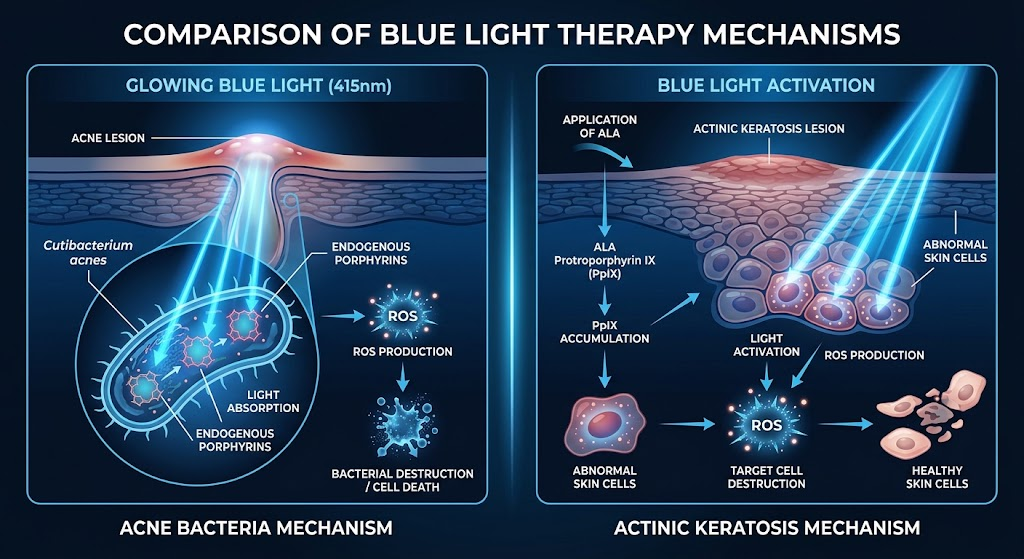
- Blue LED (no drug): Cutibacterium acnes — the bacterium behind inflammatory acne — naturally produces porphyrins. Blue light at ~415 nm matches the porphyrin absorption peak, activating them to produce reactive oxygen species that kill the bacteria[3][5].
- PDT (with ALA): ALA is absorbed by abnormal keratinocytes and converted into protoporphyrin IX. Blue light then activates this drug-generated porphyrin, generating ROS that selectively destroy the abnormal cells — this is the “selective destruction” mechanism that targets actinic keratoses while sparing healthy tissue[4].
3. Key Uses and Benefits, Matched to Evidence
| Use | Which Treatment | Evidence |
|---|---|---|
| Inflammatory acne | Blue LED (~415 nm) | RCTs: 59–67% lesion reduction after 8 sessions; systematic review + meta-analysis support[3][5] |
| Actinic keratoses (precancerous) | PDT (ALA + light) | FDA-approved; Phase 3 trial: 77% complete clearance of AK lesions[4] |
| Inflammatory skin conditions (psoriasis, eczema) | Blue LED (400–453 nm) | Limited but real — small RCTs show improvement in plaque erythema and eczema severity; not first-line[6] |
| Skin rejuvenation / fine lines | Usually red/NIR — see note below | Rejuvenation evidence is primarily red/NIR; blue is adjunctive[6] |
| Sun-damaged skin | PDT (field treatment) | PDT is used as field therapy for photodamage; evidence centered on AK clearance[4] |
One clarification: for wrinkles, collagen, and general rejuvenation, the evidence base belongs to red and near-infrared wavelengths — blue light is not the anti-aging workhorse some marketing suggests. See red light benefits for skin and our mask vs. panel guide for the wavelength-by-goal breakdown.
4. What to Expect: LED Session vs. PDT Session
The experiences are very different — which is another sign they are different treatments:
| Step | Blue LED | PDT |
|---|---|---|
| Preparation | Cleanse and dry skin | Cleanse, then ALA applied and incubated 30–60+ min |
| Treatment | 10–20 min of ~415 nm light; sensation: none to mild warmth | Light exposure after incubation; burning/stinging sensation common during treatment |
| After | Immediate return to normal activity | Redness, peeling, possible swelling for several days; strict sun avoidance[4] |
| Cadence | 3–5 sessions/week at home; see frequency guide | 1–2 clinic sessions, spaced weeks apart, per dermatologist plan |
5. Aftercare and Safety
- For blue LED at home: keep skin clean and dry before sessions; wear the device per the manual; use eye protection. Blue light is generally well tolerated — no UV, no downtime[6].
- For PDT: the treated area is photosensitive for days — avoid sun exposure completely, use broad-spectrum SPF 30+ on any exposed skin, and follow your dermatologist’s skincare instructions (gentle cleansers, no harsh actives) until peeling resolves[4].
- Watch the eyes: never stare directly at any blue light source; choose devices with built-in eye protection.
- Device quality matters: check exact wavelength (look for ~415 nm), published irradiance, and certifications (CE, FDA registration, ISO 13485 manufacturer)[7].
6. Who Should Consider It — and Who Shouldn’t
Blue LED is a reasonable choice for people with mild-to-moderate inflammatory acne who want a non-antibiotic, non-drying adjunct to their routine[3][5]. PDT is a medical treatment — prescribed and performed by a dermatologist for actinic keratoses and related photodamage[4].
Honest limitations: blue light is not established for deep wrinkles (that is red/NIR territory); evidence for eczema and psoriasis is early-stage; and PDT involves real downtime. If your goal is anti-aging, our wavelength science guide and red vs. infrared comparison are the better starting points.
7. Partner With Rainbow Technology for Custom LED Devices
A blue LED device that actually clears acne has to hit ~415 nm with meaningful irradiance — wavelength tolerance and dose control are engineering problems, not marketing slogans. That is the daily work of Rainbow Technology’s Shenzhen R&D team. As an ISO 13485, CE, and FDA-compliant LED device manufacturer, we support:
- Custom blue (~415 nm), red, and multi-wavelength device design with verified optical specifications.
- ODM/OEM production of acne masks, anti-aging masks, and body panels — from prototyping to mass production.
- Full regulatory documentation (ISO 13485, CE, FDA 510(k) support) for your market entry.
Building a light therapy brand? Visit our OEM/ODM Manufacturing Page or request your custom quote today.

