How Infrared Therapy Supports Muscle Recovery
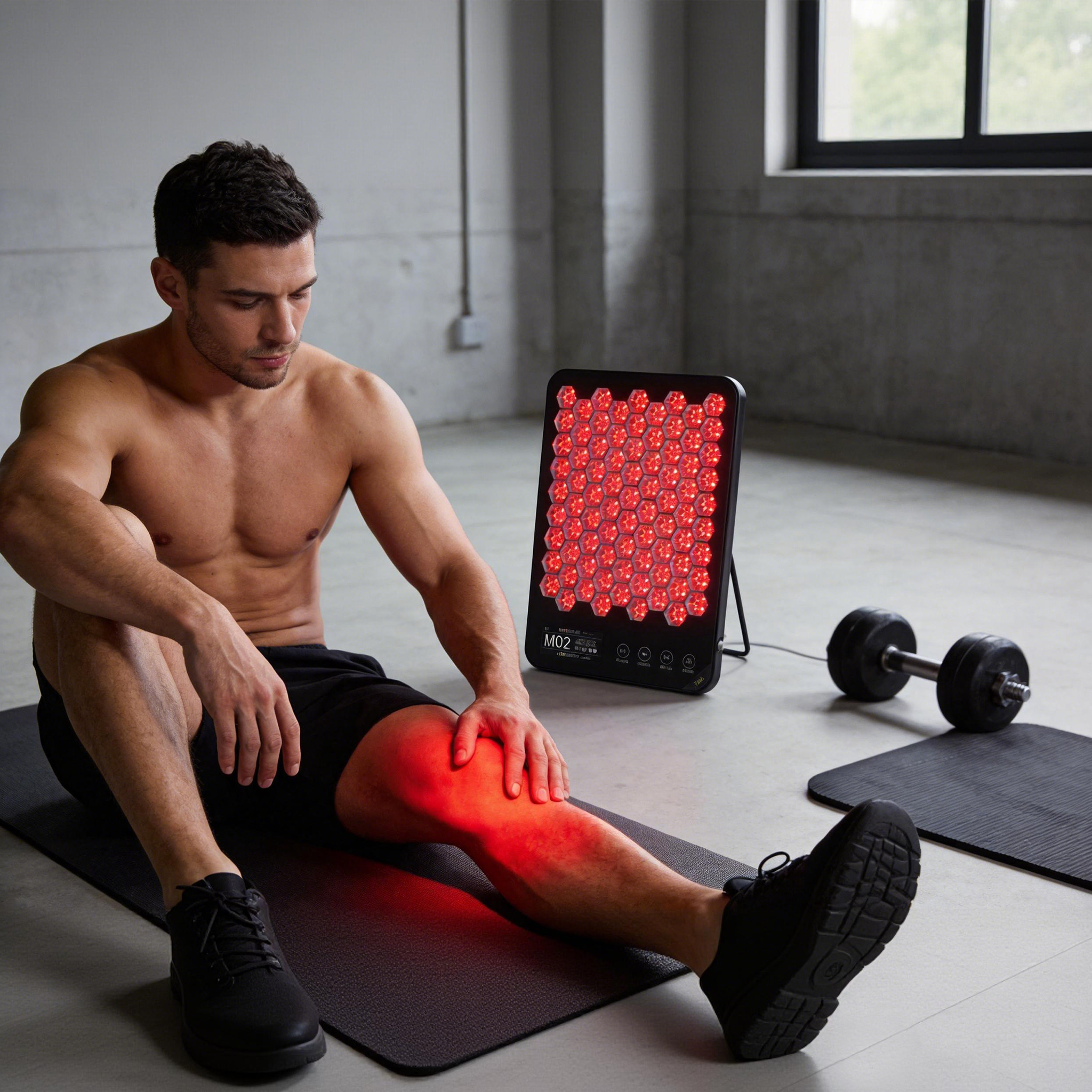
“Infrared therapy” for recovery comes in two very different forms: far-infrared (FIR) heat (saunas, heating pads) that warms tissue, and near-infrared (NIR) photobiomodulation — non-thermal LED light that stimulates mitochondria directly[1]. The athletic recovery evidence — reduced delayed-onset muscle soreness (DOMS), faster functional recovery, lower creatine kinase — comes overwhelmingly from NIR and red-light phototherapy[2][3]. In this guide we separate the two, and explain what to look for in a device that actually delivers.
Table of Contents
- 1. Two Different “Infrareds”: Heat vs. Photons
- 2. How Near-Infrared Supports Muscle Repair
- 3. What the Evidence Says: DOMS, Fatigue, Recovery
- 4. How to Build an NIR Recovery Routine
- 5. Choosing a Device: The Specs That Matter
- 6. Partner With Rainbow Technology for Custom LED Devices
- 7. References & External Links
1. Two Different “Infrareds”: Heat vs. Photons
Before talking about recovery benefits, it is worth clearing up a confusion that even professional product pages get wrong: “infrared therapy” is not one technology. The infrared spectrum is subdivided (ISO 20473) into near-infrared (NIR), mid-infrared, and far-infrared (FIR)[1]:
- Far-infrared (FIR) — the wavelength range used by infrared saunas and heating blankets. FIR is experienced as heat: it warms tissue from within, promotes sweating, and relaxes muscles thermally. Claims that FIR “penetrates 1.5 inches” are marketing exaggerations — thermal effects are shallow and surface-driven[1].
- Near-infrared (NIR) — roughly 780–850 nm in therapeutic devices. NIR is not felt as heat. It penetrates skin and soft tissue, is absorbed by mitochondrial cytochrome c oxidase, and triggers cellular repair signaling — a completely different, photon-driven mechanism[4][5].
When athletes, physiotherapists, and sports-science papers talk about light therapy for muscle recovery — reduced soreness, faster return to strength — they are talking about the second kind: NIR (and red) photobiomodulation. This guide focuses on that.
2. How Near-Infrared Supports Muscle Repair
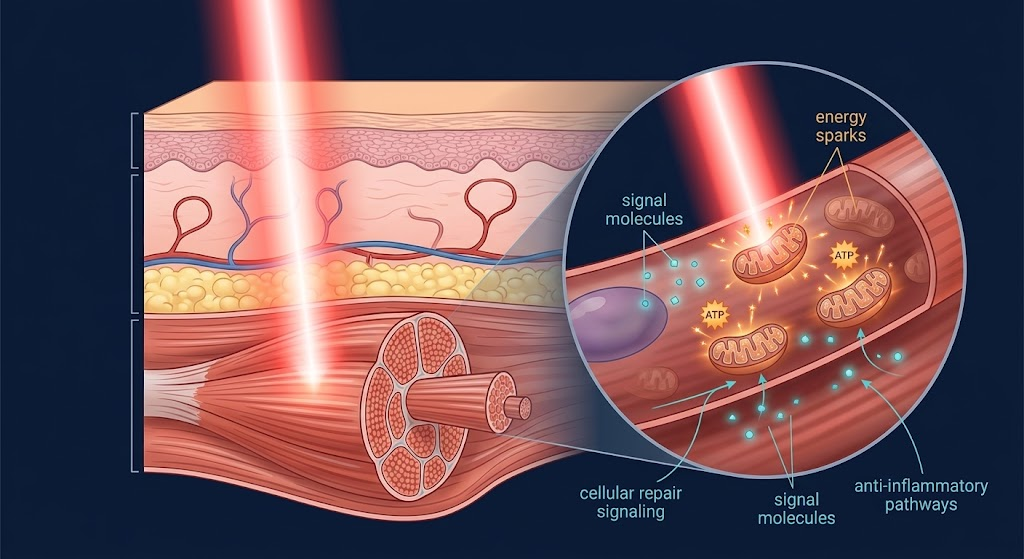
The mechanism behind NIR muscle recovery is photobiomodulation (PBM): photons absorbed by cytochrome c oxidase in mitochondria increase ATP production, trigger a controlled reactive-oxygen-species signal, and up-regulate transcription factors that drive cell survival, proliferation, and new protein synthesis[4]. The downstream effects relevant to athletes:
- Reduced inflammation — one of the most reproducible PBM effects, driven by macrophage phenotype modulation and reduced inflammatory markers[5]. This matters for both DOMS and chronic joint/tendon irritation.
- Lower markers of muscle damage — creatine kinase (CK), a standard biomarker of exercise-induced muscle damage, is reduced in studies using NIR and red phototherapy before and after exercise[2][3].
- Faster functional recovery — improved time to exhaustion, more repetitions, and quicker return of strength after damaging exercise[2][3].
- Enhanced microcirculation — improved blood flow supports nutrient delivery and metabolic waste clearance in exercised muscle[3].
3. What the Evidence Says: DOMS, Fatigue, Recovery
Three systematic reviews give us a solid, human-data evidence base (details in the reference list):
| Review | Scope | Key Finding |
|---|---|---|
| Leal-Junior et al. 2015[2] | Meta-analysis, 13 RCTs (laser + LED phototherapy) | Time to exhaustion +4.12 s vs placebo (p < 0.005); repetitions +5.47 (p < 0.0006); 13/16 comparisons positive for recovery markers. Best results: red/NIR wavelengths, applied before exercise, 5–6 J per point |
| Borsa et al. 2013[3] | Systematic review, 10 studies (PEDro ≥ 7) | Phototherapy before resistance exercise consistently delayed fatigue, reduced the fatigue response, improved recovery, and protected cells from exercise-induced damage |
| Hamblin 2017[5] | Mechanism review (anti-inflammatory effects) | PBM’s most reproducible effect is reduced inflammation, via M1→M2 macrophage shift and lower inflammatory markers — relevant to joints and injured muscle |
One nuance worth knowing: pre-exercise application showed the most consistent performance benefits in the meta-analysis[2]. Many athletes treat NIR as purely a post-workout tool — the data suggest using it before training (or both) for maximum effect. This is the kind of detail that separates evidence-based brands from marketing pages.
4. How to Build an NIR Recovery Routine
- Timing: 10–20 minutes per muscle group, ideally pre-workout (for performance) and/or within a few hours post-workout (for recovery). Studies used doses of roughly 5–6 J per point — your device manual should state irradiance so you can match this[2].
- Consistency: like training itself, recovery responds to repeated sessions. 3–5 sessions per week is a reasonable target for competitive and recreational athletes alike.
- Combine with stretching and mobility work: NIR reduces inflammation and soreness; stretching maintains range of motion. They complement each other — see our step-by-step usage guide for protocol habits that carry over to body panels.
For a full breakdown of red vs. NIR wavelengths, penetration, and which to choose, see our companion guide: Red Light Therapy vs. Infrared. And if you are comparing device formats, our mask vs. panel comparison covers coverage, dose, and cost trade-offs.
5. Choosing a Device: The Specs That Matter
The evidence above only applies if the device delivers the right dose. Three specs determine whether a “recovery panel” actually works — and whether it is safe:
| Spec | Why It Matters | What to Check |
|---|---|---|
| Wavelength | Red (620–700 nm) is surface-oriented; NIR (780–850 nm) reaches muscle[4] | Exact nm stated per band, not “red + infrared” |
| Irradiance (mW/cm²) | Dose per session = irradiance × time. Under-powered devices cannot deliver the 5–6 J/point used in trials[2] | Published, measured irradiance at skin distance |
| Safety & certification | Photobiological safety (IEC 62471), electrical safety, and quality systems protect users | CE, FDA registration, ISO 13485 manufacturer[6] |
If a product page cannot tell you the exact wavelength and irradiance per band, treat the recovery claims as unverifiable. A manufacturer that publishes full optical specs is a manufacturer that understands the science — the same reason we publish ours.
6. Partner With Rainbow Technology for Custom LED Devices
Building a recovery device means engineering the dose, not just assembling LEDs: dual-band red/NIR driver circuits, measured irradiance at the treatment surface, thermal management, and photobiological safety compliance. This is the daily work of Rainbow Technology’s Shenzhen R&D team. As an ISO 13485, CE, and FDA-compliant LED device manufacturer, we support:
- Custom red / NIR / dual-wavelength spectrum design with verified per-band irradiance.
- ODM/OEM production of recovery panels, masks, and full-body devices — from prototyping to mass production.
- Full regulatory documentation (ISO 13485, CE, FDA 510(k) support) for your market entry.
Building a recovery device brand? Visit our OEM/ODM Manufacturing Page or request your custom quote today.

